

Manal Shqair, this week’s guest blogger, writes about her doctoral work which engages with the pastoralist women of Masafer Yatta, Palestine. Reflecting on her roots and the positionality of the activist researcher, Manal describes how she came to her research and her experience of carrying out interviews amid violence and marginalisation.
Doing sociology for those who go through a violent process of othering like the Palestinian people is a highly motivated political act. Being the activist ethnographer who carries out the study implies ethical implications on her positionality. These two concerns have been growing since 2022 when I embarked on a PhD activist research project at Queen Margaret University on the resistance of Palestinian semi-nomadic women to Israeli dispossession in Masafer Yatta, southern Hebron, occupied Palestine.
The academic routes I decided to follow have been determined by my roots. I was born and raised in the village of Al-Zawiya, in the district of Salfit, occupied Palestine. Israel controls all the entrances and exits of the village by confining it with illegal Jewish-only settlements, the erection of the Apartheid Wall, and military checkpoints.1
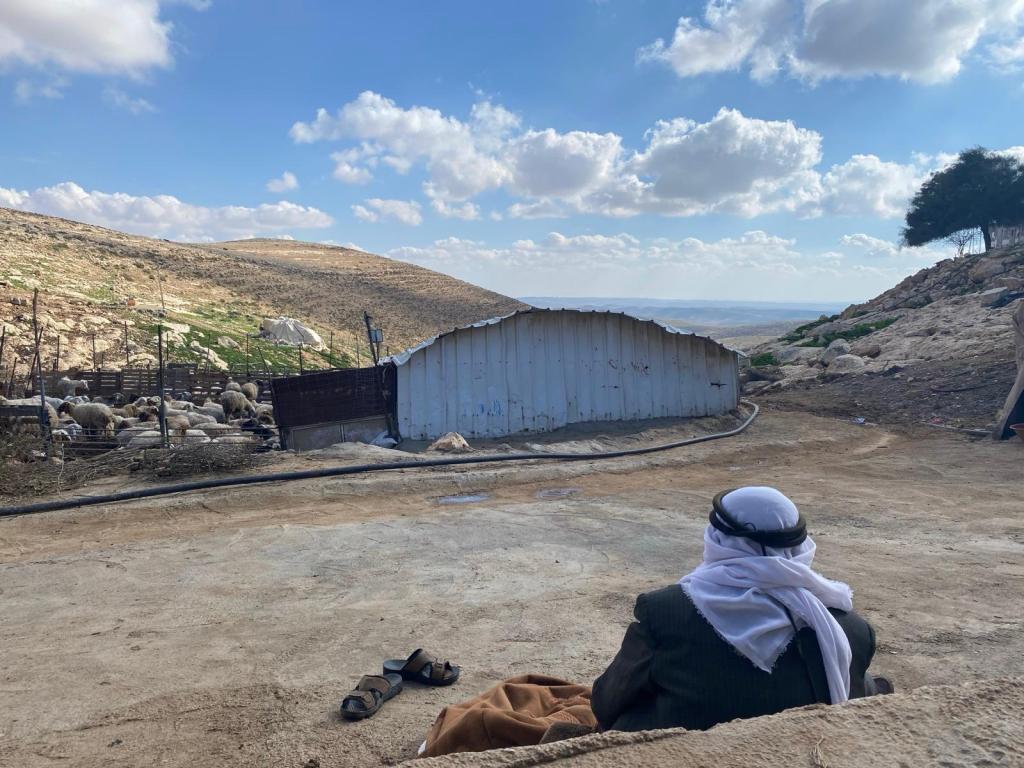
Growing up within a family that partly depended on animal husbandry and agriculture for livelihood, I was intimately connected to the land and immersed in our traditional agrarian lifestyle and the cultural practices associated with it. Land-based activities such as grazing the cattle, cultivating the land, and harvesting the crops, were a source of knowledge and skills that also linked me with my kin and ancestral roots. Our deep intertwinement with the land compelled a constant confrontation with Israeli violence to protect it from takeover. My family’s existence, ingrained in practising sumud (steadfastness), is defined by their resistance.
The sumud practices that I was embedded in as a child provided me with the strength, confidence, and perseverance to engage in the grassroots movement against Israeli illegal settlement expansion in the West Bank as an adult. Activism, I believe, should take place both materially on the ground and intellectually. Our fight for liberation is as much about the right to (re) tell our story as it is about the right to exist on the land. With this belief in mind, in 2018, I started an MA in English Literary Studies at Aberdeen University thanks to the support I received from Scottish Universities Supporting Palestinian Students (SUSPS).
With a focus on Palestinian life writing, my MA sought to engage in the dialectical processes of narrating the Palestinian. While Israel tells great stories to moralize the occupation of Palestine, it also stereotypes the Palestinians through a story of inferiorisation. Indeed, the 15-month-long Israeli genocidal campaign2 against my people in Gaza was justified and rationalized by the racialized Western and Israeli mainstream narrative silencing, demonizing, and dehumanizing Palestinians.
The politics of storytelling as an anti-colonial act extends beyond the literary work of those who possess the intellectual means of writing down their personal stories. It also includes the ethnography of documenting the experiences of those who are perceived as lacking such means, like pastoralist women in Masafer Yatta.
Between July-August 2023 and July 2024, I conducted 26 interviews with pastoralist women from Masafer Yatta. In addition to the interview technique, I relied on the participant observations method to gather data, engaging in the daily resistive activities of the participants. Unlike an outsider ethnographer, I did not need to go through a process of becoming ‘native’ by learning the language and participating in the culture of the people being studied. In talking about the land through the lens of the participants, I also make sense of my own, first-hand experience of engaging with it and on it physically and socially. My enmeshment with the lives and resistance of the participants through an upbringing embedded in a similar struggle in my village raised ethical dilemmas concerning the positionality of the activist as a researcher.
Additionally, the ordinariness of Israeli violence permeating all social spaces of Palestinian existence in Masafer Yatta turned the ethnographic setting into an activist one several times. Interviews were interrupted by Israeli brutality, where I joined the women in confronting that. These encounters pushed me to an in-between positionality, where the line demarcating my identification as a researcher and as an activist was blurred. Within this realm of the in-between, I was able to gain insightful experiential knowledge beyond theoretical work through immersion in and familiarity with the material reality of the participants. However, my in-between positionality is also a dangerous site of knowledge production as it grants me an authoritative voice as an insider. This might lead to silencing and/or marginalizing the very voices of the women the research is sought to raise.
The in-betweenness of my positionality compels me to be in a constant state of self-reflexivity to interrogate the implications of the sense of familiarity and unfamiliarity I have with the participants. Through self-reflexivity I unsettle my positionality by stepping outside my comfort zone of commonality and familiarity. This includes the constant redrawing of the boundaries between my insider and outsider position in terms of the co-production of knowledge and negotiation of meaning. In this sense, I don’t understand my positionality as a pre-determined issue before engaging in ethnographic work with the participants. It is performative, re/constructed, and negotiated constantly with each participant, and the relational, corporeal, temporal, and spatial circumstances that contributed to the formation of each setting in which data was generated.3 To reflect critically on my positionality, I do not seek to absolve myself of the ethical implications of my in-between positionality. It is rather a process of self-interrogation that prioritizes the co-production of knowledge with pastoralist women in Masafer Yatta.4
The urgency of accounting for and documenting what would, otherwise, remain oral stories of wisdom is inspired by a statement made by Hajah Fatima from Masafer Yatta, shortly before she passed away in 2022, aged 95. Quoting her grandmother, Sameeha told me:
‘Resistance is an idea that exceeds our limited bodies because we die, but an idea never dies. The Israeli occupation can control our bodies and what we can physically do by arresting and killing us, but they will never be able to confine the mission of resistance and sumud.’
Beyond the bodies that perish, the ideas and strategies of semi-nomadic women’s resistance are the stories my activist research seeks to immortalize.
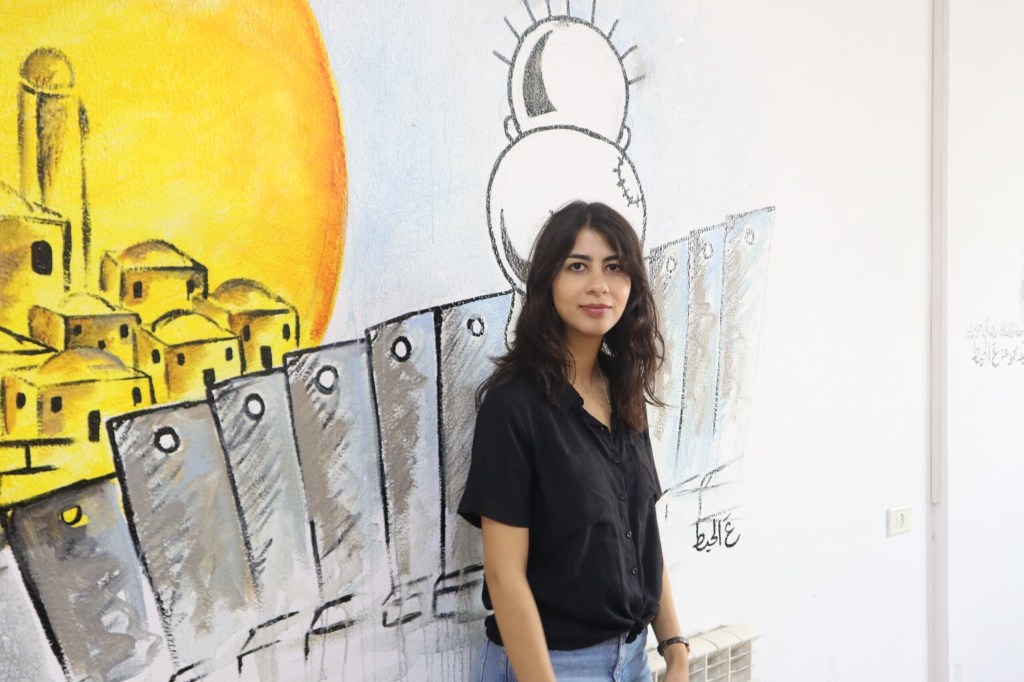
Manal Shqair is a Palestinian activist researcher. Currently, she is doing her PhD research at Queen Margaret University. In her study, she examines the role of Palestinian semi-nomadic women in Masafer Yatta, Palestine, in resisting Israel’s colonial dispossession. Manal has published works on Israel’s environmental colonialism and Palestinian resistance to that from a gendered perspective.
- ‘Experts hail ICJ declaration on illegality of Israel’s presence in the occupied Palestinian territory as “historic” for Palestinians and international law’, UN Human Rights, <https://www.ohchr.org/en/press-releases/2024/07/experts-hail-icj-declaration-illegality-israels-presence-occupied> [accessed 22/01/2025]. ↩︎
- ‘UN Special Committee finds Israel’s warfare methods in Gaza consistent with genocide, including use of starvation as weapon of war’, UN Human Rights, <https://www.ohchr.org/en/press-releases/2024/11/un-special-committee-finds-israels-warfare-methods-gaza-consistent-genocide> [accessed 22/01/2025]; ‘Amnesty International investigation concludes Israel is committing genocide against Palestinians in Gaza’, Amnesty International, <https://www.amnesty.org/en/latest/news/2024/12/amnesty-international-concludes-israel-is-committing-genocide-against-palestinians-in-gaza/> [accessed 22/01/2025]. ↩︎
- Gemignani, M. (2017). Toward a critical reflexivity in qualitative inquiry: Relational and posthumanist reflections on realism, researcher’s centrality, and representationalism in reflexivity’, Qualitative Psychology, 4(2), 185–198. ↩︎
- Pillow, W. (2003). ‘Confession, catharsis, or cure? Rethinking the uses of reflexivity as methodological power in qualitative research’, International Journal of Qualitative Studies in Education, 16 (2), pp. 175-196. ↩︎
 SGSAH Blog