

Recently, I attended and presented at a conference themed ‘Milestones and Markers’. The particular theme for the call for papers within my working group, Performance and New Technologies, was concerned with Generation Alpha and their growing up in the age of artificial intelligence. Within the working group sessions, there was one member (also a presenter) who appeared to be on their phone – perhaps checking emails, social media, other light tasks requiring minimal attention – for nearly every paper presentation. As someone whose research concerns the social implications of new and networked technologies, of course I was fascinated by this conference participant: They didn’t seem to be ignoring the participant, but at the same time, I could sense that they were unable to give their ‘full attention’ (or perhaps, an idea of attention) to the presentation at hand.
This phenomenon I observed is nothing new: In fact, in her book, Disordered Attention, Claire Bishop traces this back to Victorian era theatre, noting that the advent and subsequent boom of controlled stage lighting – the idea that the lowering of the house lights signals the start of the show, a strong bid for our attention – is the beginning of what we would later popularly identify as the ‘attention economy’. And following the Victorian era, as the power of media advertising, the internet, social media, etc. grows, more and more demands are placed on our attention. Attention is currency. Because of this, Bishop argues, our ideal for attention has monumentally shifted to something more ‘disordered’, split and splintered.1
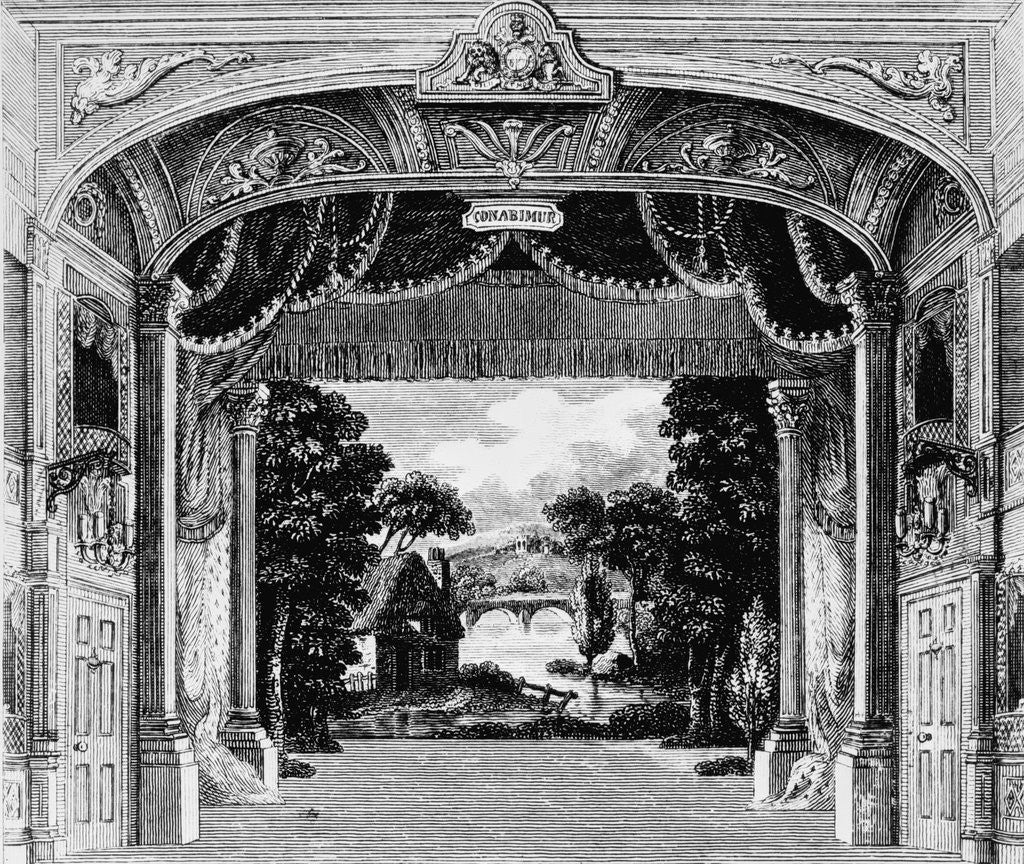
The proscenium arch: a convention of ‘attention’ that Claire Bishop now refutes. Image courtesy of magnoliabox.com.
In the midst of yet another ‘AI boom’, then, how have the latest developments in artificial intelligence contributed to this attention economy? I would suggest that there is nothing wrong with the type of attention Bishop describes. And, in fact, Bishop does not presume that ‘disordered attention’ is a crisis that needs to be solved. However, the rise of generative artificial intelligence (GenAI), in particular, should be something of concern to all academics and researchers alike: It is no longer attention that is in flux, but the very art of critical thinking that is steadily becoming endangered.
Not surprisingly, this idea has already been posited by several researchers both within industry and academia. Several refer to this as ‘cognitive offboarding’: that is, an effect of GenAI that allows users to ‘offload’ the mental and cognitive work used in critical thinking processes. As a PhD researcher in the arts and humanities, I would argue that much of my research (due to the nature of the topic) is impossible to do with the full or partial assistance of generative AI. However, an analysis conducted by Andrew Gary in xxxx suggests that many researchers are, in fact, using generative AI to either write or assist in the writing of their own academic articles.

Some compelling statistics from Andrew Gary’s study. Image courtesy of Scientific American.
In this study, Gary identifies at least 60,000 scientific papers that may have used an LLM in the writing process.2 Another study cited in an article from Scientific American reports that “up to 17.5% of recent computer science papers exhibit signs of AI writing.”3 It is no wonder that these instances seem to be more prevalent in scientific journals, and as this is a blog for arts and humanities researchers, this is worth pointing out: The work of scientists and mathematicians, I would argue is more aligned with those of LLMs. On the other hand, many would argue that there is no true way to know if a paper, academic article, or otherwise is actually using genAI. While Gary’s study is fascinating, it may simply be highlighting academia’s role as an echo chamber– something that is known to those within and without it. It also may be a product of what Professor Shannon Vallor refers to as the ‘AI Mirror’– that is, the ability of large language models to reflect back the biases, harms, and information our world feeds into these models to make them run.
Whatever the verdict is, there is no doubt that the growing popularity and use of genAI has taken us far beyond a crisis of ‘attention’. Out of a seemingly endless generation of artificial text, image, and most recently, uncannily accurate video, our ability to challenge, interrogate, and question information in a multitude of forms is being challenged like never before. As arts and humanities researchers, we should see this as an opportunity to highlight the importance and urgency of criticality and advanced reasoning in an age that is increasing tampering these fundamental principles of thought.
- Bishop, C. (2024). Disordered Attention: How We Look at Art and Performance Today. Verso Books. ↩︎
- Gray, A. (2024). ChatGPT ‘contamination’: estimating the prevalence of LLMs in the scholarly literature. [online] arXiv.org. Available at: https://arxiv.org/abs/2403.16887. ↩︎
- Stokel-Walker, C. (2024). AI Chatbots Have Thoroughly Infiltrated Scientific Publishing. [online] Scientific American. Available at: https://www.scientificamerican.com/article/chatbots-have-thoroughly-infiltrated-scientific-publishing/.
↩︎
 SGSAH Blog