

This week, guest blogger Matthew Floyd writes about his residency at Cove Park and how this opportunity helped him find focus and creativity as he shifted from part time to full time studies. For those hoping to undertake a residency of this sort in the future, reading Matthew’s post is a great way to find out more about Cove Park and what to expect from a week at this scenic and inspiring artistic haven.
After a summer of welcome distractions – work, travel, family, friends – a week’s residency at Cove Park was intended as the hard reset going into the new academic year. At the beginning of 2024, I successfully applied to SGSAH’s opportunity to undertake ‘dedicated creative time, space, and freedom to develop work within a supportive and inspiring context’, scheduling it for the start of September in expectation of a disrupted summer. Despite being several years into my research, Cove Park remained an experiential mystery, save for glowing accounts from the lucky few at SGSAH functions. It is billed as offering private accommodation with optional studio space, oriented around a central communal workspace shared by up to 12 domestic and global artists in residence across disciplines.
As a researcher focused on history, archive and festival, my impulse is not to classify my work as art or myself as an artist – I am overwhelmingly laptop- and library-based. Would Cove Park be appropriate for me? The short answer is yes, for anybody supported by SGSAH. My PhD constructs a history of the Edinburgh Television Festival (1976-present), looking particularly at its keynote MacTaggart Lecture, this year delivered on the subject of classism in broadcasting by prolific writer for screen and stage James Graham. My work is centred on how the industry regards itself, at an annual moment for major players to gather on neutral territory – during the Fringe – to reflect on the year that’s been and forecast what’s to come.

Unexpectedly, my experience at Cove Park dovetailed with the idea of the Television Festival as neutral territory. What an extraordinary perk from SGSAH to facilitate a creative and fulfilling stay in such a beautiful and natural environment to continue or reinvigorate your research. More specifically for myself, there was an historical resonance in that Helensburgh, the closest train station to Cove Park, was the birthplace of John Logie Baird, widely credited as the father of television. With the Edinburgh Television Festival taking place at the end of August, followed immediately by my turning thirty, the time was ripe to step out of the city to refocus on my historical research.
After a professionally and socially intense August, having booked the residency some months previously I went into the experience relatively unknowing. Helensburgh Central is just a 45-minute train from Glasgow, followed by a leisurely ride around the peninsula’s reliable 316 (beware the near-vertical hill from the bus stop to Cove Park, especially when trailing luggage) or a 30-minute drive. The friendly taxi driver, himself a lifelong Helensburgh resident, knew nothing of Cove Park he could share with me, to underline it as a brilliant hidden treasure. Thankfully, they provide a generous Handbook to residents with all information on history, access and amenities, including the most generous provision of a site 4×4 vehicle and three e-bikes, the latter of which I took up with aplomb.
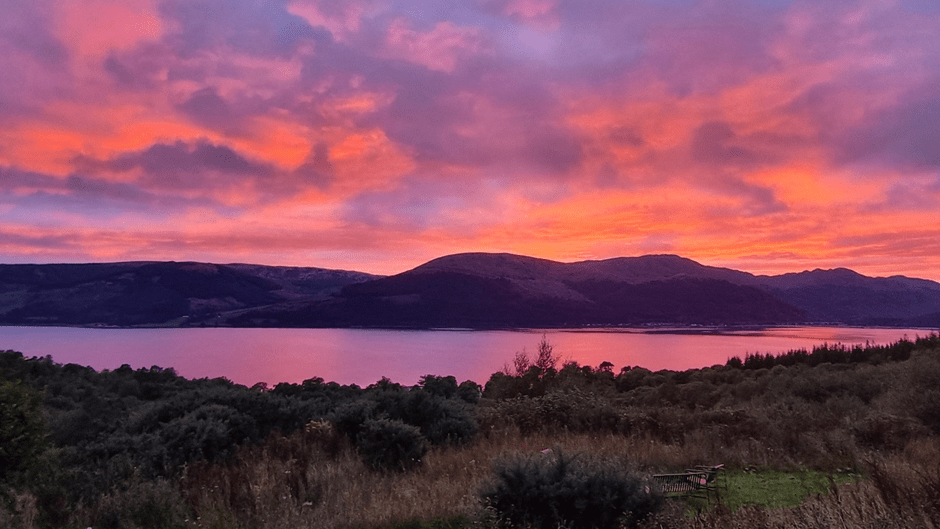
The unequivocal fact of Cove Park – that cannot be done justice with words nor smartphone photography – is that it is an astoundingly beautiful place, in both design and nature. It sits near the peak of the peninsula adjoining Helensburgh, facing out across Loch Long and the opposing hill range that nestles the sunset each evening. The architecture of Cove Park is open, sustainable and allows floods of natural light to appreciate the surroundings, with the Jacobs Building offering a communal kitchen, library and workspaces to share with staff and residents. A short walk down, I was shown to my accommodation – one of six ‘Cubes’ that serve as entirely self-contained studio living spaces complete with desk, en-suite and kitchen, opening into a pond terrace looking into the Loch.
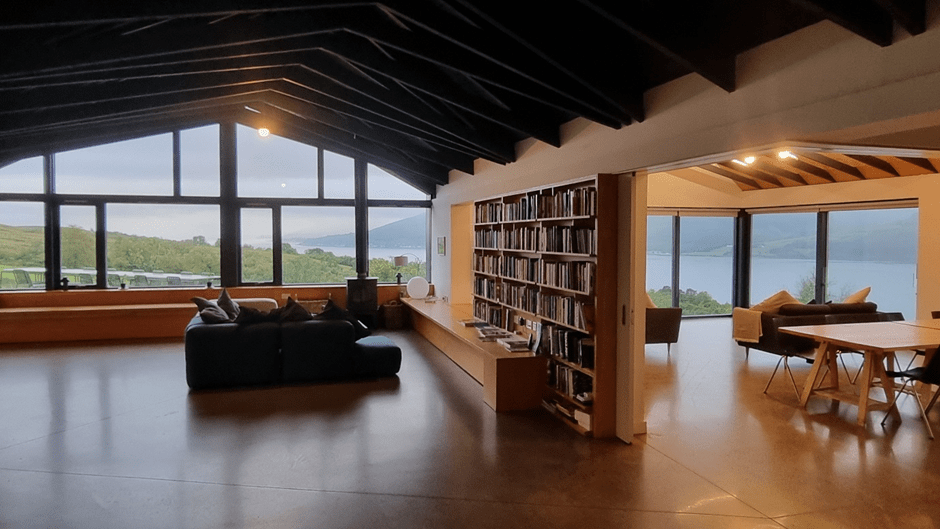
Working primarily from a laptop really doesn’t jar nearly as much when you look up and see clouds rolling over hills and boats drifting across a loch, in sharp contrast to my city-based research. Unusually, I was resident in a week where few others were present, with a ceramics artist fulfilling a two-week stay my only neighbour until two groups made short visits later in the week, and a final crossover resident arrived for the weekend. My path as a researcher has, as noted, been a disrupted one, taking in a shift from full-time to part-time, and now back to full-time as other work responsibilities proved valuable deviations. To have a couple of days nearly to myself in this environment was hugely rewarding to reassert my two feet firmly in the PhD mindset.

Nonetheless, it was a joy to meet other visiting artists and researchers in both similar and completely different disciplines. The Park hosted a ‘happy hour’ as a welcome session to get to know each other, and a real highlight was an evening spent around the firepit with wine and great conversations, made all the more memorable by a resident getting engaged on the beach that day. Friday evening also saw the launch of former resident Rodge Glass’ new book Joshua in the Sky: A Blood Memoir, which provided an intimate and moving discussion backlit by a stunning sunset. Cove Park is a place to be both personally productive and to engage with new ideas, artists and practices.
Another great perk of the space is the opportunity to explore. Work-permitting, there is much to uncover a short distance from the Park. At the foot of the (very steep) hill is a shingle beach at the mid-perimeter of Loch Long, and Peaton Hill Conservation Reserve is equidistant in the opposite direction. I favoured the e-bikes and used them daily, with the e-function a necessity to climb the inclines returning you to Cove Park, and some nerve required as you go down them. I was very fortunate to stay during a late-summer sunny spell, and cycled on every (mostly) dry day. Gems for your own discovery include Cove Bay, Burgh Hall (home of the volunteer-run library), and Kilcreggan Pier. Coming away from Cove Park, I feel myself and my research are revitalized. If the opportunity arises, there’s no better way to spend the working week.
Enormous thanks to all staff and residents during my stay, particularly Director Alexia Holt.
Photos by the author.
Connect with Matthew on Twitter/X, LinkedIn and Instagram.

Matthew Floyd is a Yorkshire-born, Glasgow-based doctoral researcher with the Edinburgh Television Festival (ETVF) and the University of Glasgow, supported by the Sottish Graduate School for Arts & Humanities. Matthew’s thesis studies the history of the ETVF (1976-present) as an annual opportunity for British broadcasting to reflect on and forecast its practices and contribution to culture, focusing on its keynote MacTaggart Lecture. Recent lecturers include James Graham, David Olusoga, and Michaela Coel. Matthew also undertakes a range of festival and event work.
 SGSAH Blog