
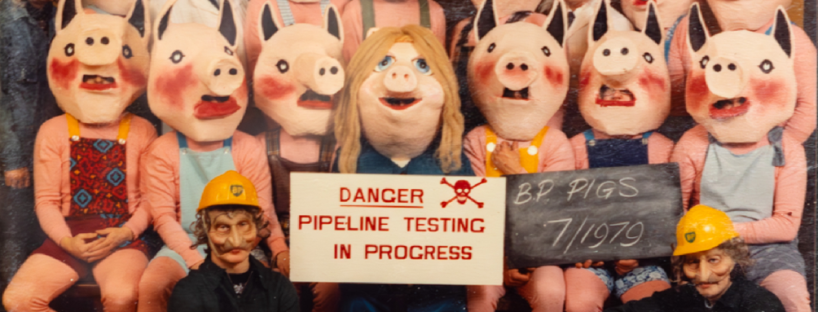
In the first in a series of posts from the British Council Scotland SGSAH EARTH Scholarship Scheme, guest blogger Miriam Sentler shares her creative research methodology in the context of Shetland’s changing energy landscapes and industries.
My dissertation project ‘Energy Acts’ at the University of Oslo investigates how Shetlanders encountered different forms of energy throughout history, utilising their creative island culture to ‘translate’ oil, wind, and other energy industries operating in the context of the North Sea and Northern Atlantic. By focusing specifically on archival material showcasing a century of festival performances about energy production that took place within the framework of Shetland’s famous Up Helly Aa festival between 1925 and 2025, I analyse how the acts visualise complex negotiating processes between islanders and different energy industries through a performative language characterised by satire and humour.
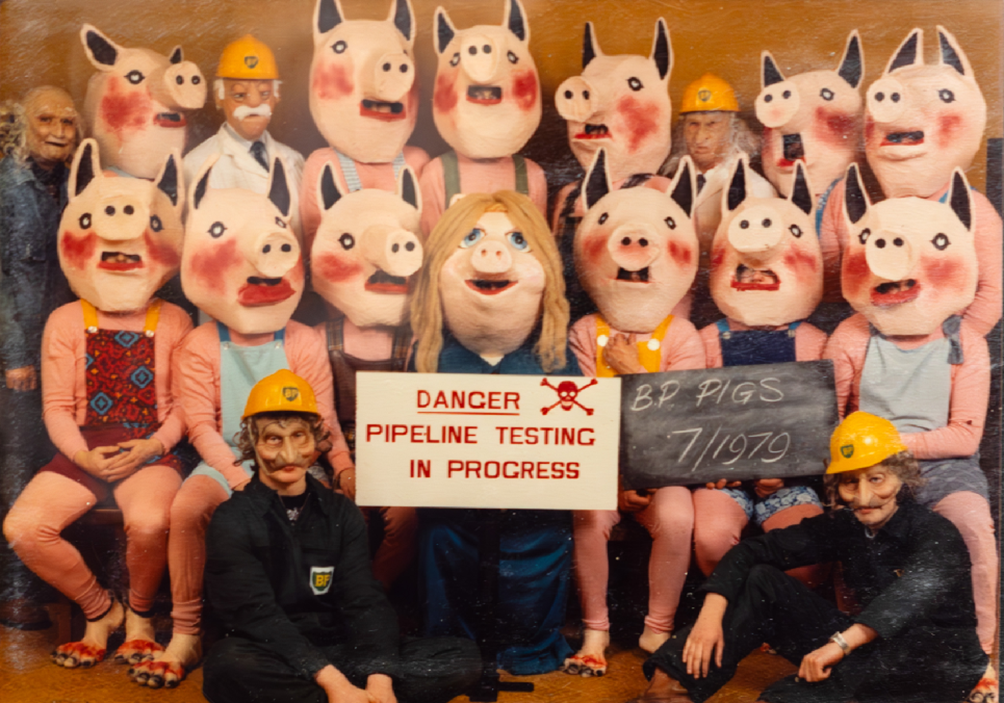
‘BP Pigs’ (1979). Credit: The Up Helly Aa Committee Archive.
By utilising my artistic practice within the research process, I set out to test the methodological potential of the energy acts in the here and now. This quest took shape in The Moving Energy Theatre (TMET) (2025), a self-initiated research-creation project produced as part of my thesis research in Shetland and in collaboration with artist and Deep Time Agency co-founder Wouter Osterholt and curator Anna Tudos. TMET was funded through the Dutch Mondriaan Fund with a Project Grant for Professional Artists and the EARTH scholarship, and locally supported by Shetland-based art spaces Gaada, Sew Far North, and Atelier Gilly Bridle. The project took place during three weeks in June and July 2025 in Shetland and used archival re-enactment to bring back and revive eight selected energy acts from Shetland’s archives.
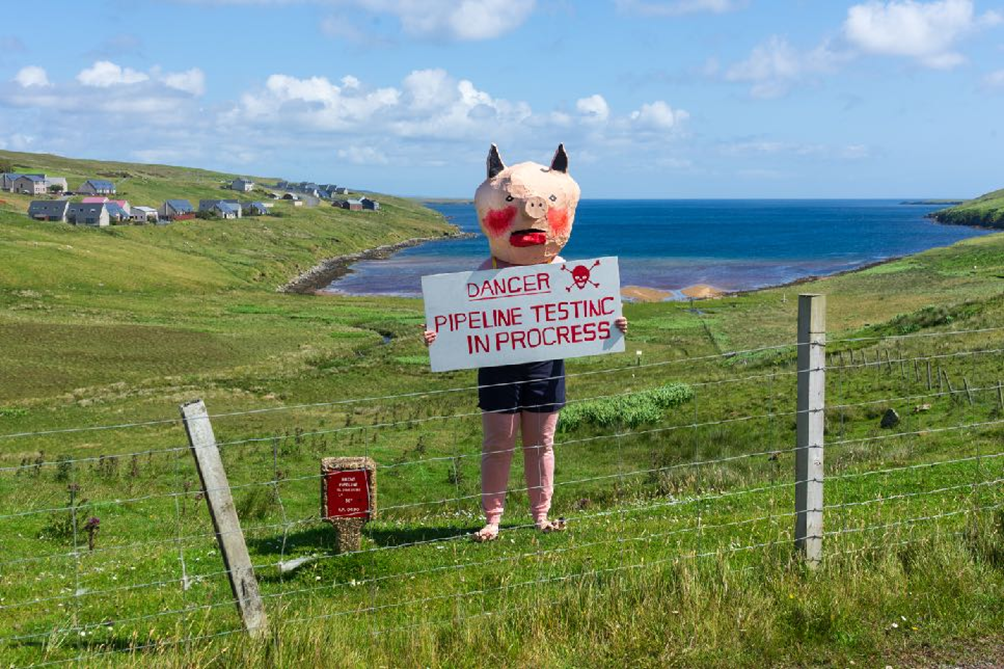
Re-enactment of Up Helly Aa skit ‘BP Pigs’ (1979) on top of the Brae Field oil pipeline. Following the pipeline up from the sea towards the Sullom Voe oil terminal leads Piggie to a little house from which oil and gas workers can access the Brae pipeline for maintenance and cleaning purposes. Part of The Moving Energy Theatre tour, 2025. Credit: Deep Time Agency, Miriam Sentler and Wouter Osterholt 2025.
In TMET, we played with ‘activating’ the archive material to explore how the costumes and props featured in the historical energy acts could be used to unearth and capture contemporary voices about energy in Shetland. For this purpose, costumes and props, as visible in the archive material of the energy acts, were recreated by the core team and placed into the industrial environments the acts once spoke about, letting interactions around them unfold spontaneously with audiences already present in the landscapes. In this way, the historical performances became contemporary ‘icebreakers’ by triggering discussion about the roles of energy industries in Shetland and beyond with local inhabitants, industry workers, and tourists.
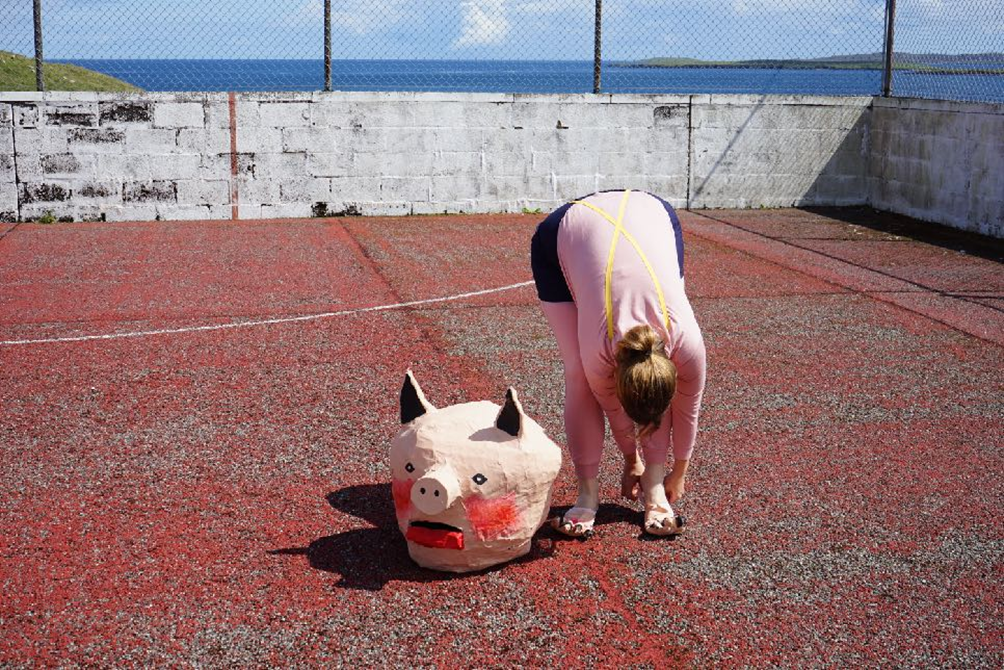
Getting ready for a re-enactment on a basketball court in a housing estate in Firth, Shetland, built especially for oil workers in the 1970s. Part of The Moving Energy Theatre tour, 2025. Credit: Deep Time Agency, Miriam Sentler and Wouter Osterholt.
The sensory experiences and conversations generated through TMET benefited my thesis research in two different ways. Firstly, the stories of the re-enactments came to function as vignettes, described by Sergi (2011) as short stories that illustrate performance-based research in action. The vignettes in my thesis start from the point of view of one of the characters, and map felt tension and confusion about the borders, policies, and rules of energy industries in Shetland. They also showcase the ecological and social realities of the industrial landscapes. Exemplary, one vignette describes how a character stemming from an act that thematised pipeline inspection gadgets is placed on top of an oil pipeline leading from the sea to Sullom Voe oil terminal, and another tells about a character stemming from an energy act about wind turbines that wanders through the peat hills surrounding the Viking wind farm.
By situating the costumes and props in the very industrial environments they once spoke about or criticised, the energy acts are tested out as critical objects, unearthing what anthropologist Anna Tsing Lowenhaupt (2004) terms ‘friction’ between the local and the global in the context of contemporary energy production landscapes. The hybrid methodology followed, therefore, essentially allows for an experimental act of transgression with the archive material, wherein the energy act archive is researched from a liminal perspective. My belief that underpins the choice to integrate this creative research methodology in my thesis is that it is helpful to zoom out of the energy acts themselves and into the real (post)industrial places they comment on. Ultimately, the re-enactment then shifts attention from the archive as a contained, historical object to the natural environments and social relations it continues to inhabit.
Secondly, material findings gathered from remaking some of the costumes and props became an integral part of the visual analysis that I wrote for each energy act. This is because the remaking of the costumes and props provided me with material and tactile insights into the archive material that only became palpable whilst reproducing the objects physically—representing creative and practical information which could not be gathered from only looking at the energy act documentation in text or image form. This thus essentially foregrounds creative reenactment as a valid research method that adds to the overall methodology in productive and creative ways. In the end, The Moving Energy Theatre (2025) provided me with a three-dimensional understanding of the archive material I was researching: functioning as an imaginative ‘pop-up card’ in which something rendered two-dimensional again inhabits form and shape in the real world.
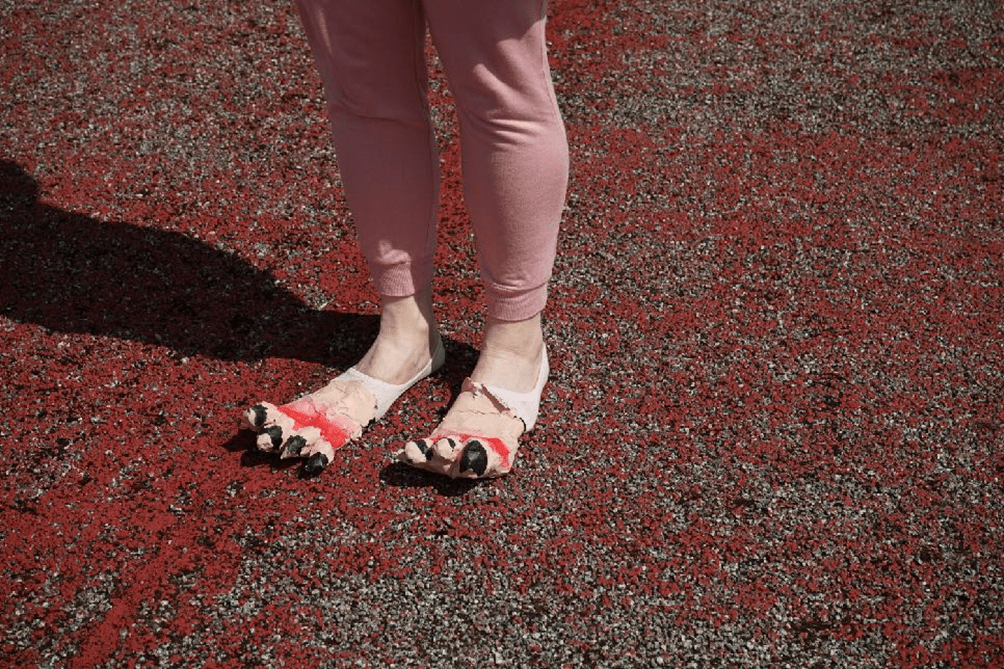
The hooves of the ‘BP Pigs’ costume, made using aluminium foil, masking tape, socks, and paint. Part of The Moving Energy Theatre tour, 2025. Credit: Deep Time Agency, Miriam Sentler and Wouter Osterholt.
The EARTH Scholarships Impact Symposium is at the University of Glasgow on 22 April 2026.
Miriam Sentler is a contemporary artist and researcher living in Norway. Educated at the Maastricht Institute of Fine Arts and the University of Amsterdam, she is currently a doctoral research fellow in Petroculture Studies at the University of Oslo, who partnered with the University of Highlands and Islands for her British Council Scotland SGSAH Earth Scholarship in 2025. Her projects deal with mining histories and the realities of the left-behind extractive landscapes, and often result in long research trajectories, taking shape in different mediums like installations, performance, audio, textile, video, artist publications, and essays. Inspired by her family history in the coal-mining region of Limburg, she deals with complex questions of belonging, myth-making, transformation, and sacrifice in different landscapes. She founded the interdisciplinary project Deep Time Agency together with artist Wouter Osterholt in 2019. You can find out more about Miriam’s research here.

