
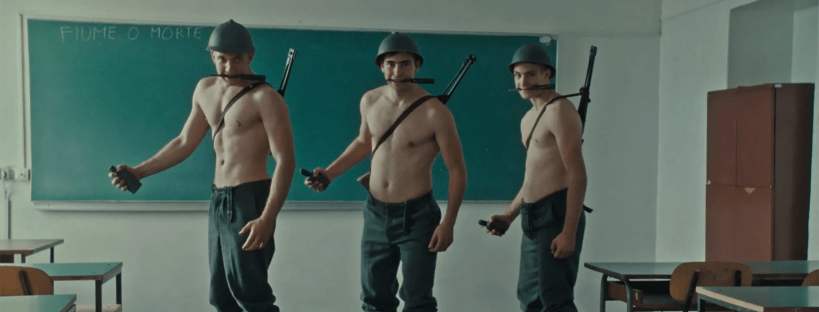
Guest blogger Ludovic Brunot extends academic research into irredentism in Italy, a 19th-century nationalist movement geared towards ‘redeeming’ Italian-speaking regions from foreign domination, through his review of the 2025 film, Fiume o morte!
The movie Croatia chose to send to the Oscars this year is a documentary film, the most watched in the country’s history, beating all attendance records. Igor Bezinović’s Fiume o morte! (‘Fiume or death’) tells the little-known story of the Fiume endeavour. In November 1919, Italian poet and soldier Gabriele D’Annunzio—known for his cocaine consumption and playboy lifestyle—militarily occupied the city of Fiume (now Rijeka). He embarked on his endeavour to conquer, for Italy, the territories the country had claimed but not received in the aftermath of the Great War. During the occupation, the city on the Adriatic coast became both a laboratory of fascism and one of the most extravagant embodiments of the Roaring Twenties. The occupation was ended by the Italian army in December 1920 which restored the city’s freedom. Fiume o morte! is the sad and ironic story of nationalists so nationalist that they ended up fighting their own country.
Bezinović’s storytelling and formal choices create a comic distance which allow him to convey the absurdity of nationalism. He follows the archives to retrace the history of this occupation, from speeches to photographs, knowing very well what they are: propaganda. He demystifies these by having the speeches and the pictures reconstituted in the same spaces where they took place; the same form but in a modern context, stressing their absurdity. However, the events were not only absurd, but also violent, notably with anti-Slavic aggressions, repression of elections and, finally, war. All are absent from the propaganda’s visual archives. Bezinović recreates them to highlight where nationalism leads. For all the absurdity and extravagance of its protagonists, which make it an entertaining story to tell, the Fiume endeavour ended in blood and was fought in the name of Italian imperialism in the Balkans.
Archives are not only used for comedy, but they also connect the past and the present. Bezinović engages Rijeka’s inhabitants with their past, making a documentary with them, that is also for them. All the re-enactments rely on non-professional local actors interested in the story of their city. This is also true of the seven different narrators, who all speak Fiumanski, the disappearing local Italian dialect. This linguistic choice conveys not only the story of the occupation, but also the mixed identity of a city where different communities coexist. Fiume o morte! hopes to dismantle nationalist myths of militarism and homogeneity, instead celebrating localism as a scale of cohabitation, mixed identity and shared memory.
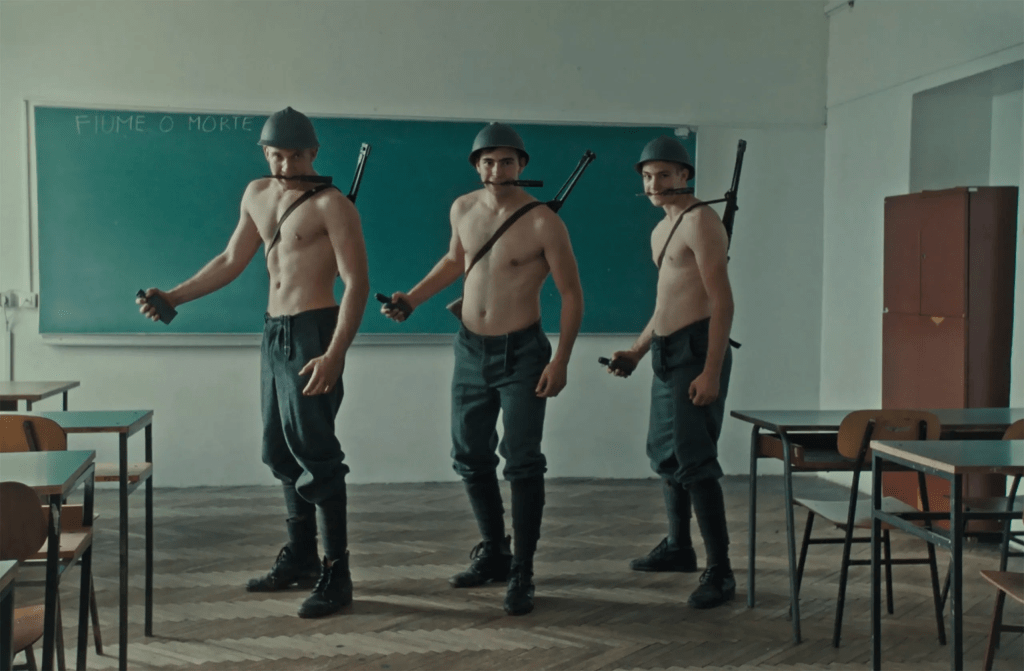
Still from Fiume o morte!, Igor Bezinović (2025).
I watched this documentary for the first time in February 2025, a few days after its release in Italy. I was in the city of Trieste and to go to the cinema, I walked in front of a statue of D’Annunzio. As shown in the movie, it was inaugurated in 2019. His figure is still one celebrated in Italy, as an artist and as a patriot, conveniently forgetting about his deep ties with fascism. Trieste is a prime example of Italian forgetfulness of Italy’s darkest hours, and reuse of nationalist myths. I know it because I grew up there, because I study Trieste and how its selective relationship to memory reflects nationalism in Italy. It was highlighted again while I was watching the film, when two movie-goers made clear their belief that the movie contained unacceptable criticism of D’Annunzio. These realities are symptoms of the Italian relationship to the memory of the 20th century.
The history of D’Annunzio is especially felt in Trieste because Rijeka/Fiume is, to a certain extent, its twin city. Both were in the Dual Monarchy, Trieste serving as the main port of the Kingdom of Austria, while Fiume/Rijeka was its counterpart for the Hungarian half of the empire. Both were cosmopolitan, serving as the gates of ‘Mitteleuropa’. After Italian unification in 1861, both cities were at the heart of Italian territorial claims. In 1915, Italy joined the Great War in the hope of conquering both cities. But the peace of Versailles frustrated Italian ambitions as Trieste joined Italy, while Rijeka did not. D’Annunzio tried to annex it by himself but failed. These cities are often portrayed as the two faces of a single coin, the coin of Italian nationalist myth and the glorious martyrdom it requires. But, as Bezinović tells us, they should perhaps be instead a reminder of the absurdity and violence of nationalism, and of the oppressive nature of nation-states acting in the name of capitalism and empire.
The Italian memory of the 20th century is a divided one, along lines of what being Italian means. But these discourses often forget about Italian and fascist crimes both in the country itself and abroad, from Yugoslavia to Libya and the Horn of Africa. In this frame, D’Annunzio can be remembered as an eccentric poet and national hero, and not as a failed, racist warlord who gave fascism its first expansionistic myth. Like him, Italians can be remembered as brava gente (good people)—avoiding historical introspection into their roles in fascism and imperialism. In both cases the construction of the myth is about the moral greatness of the nation. This attitude overshadows the absurdity of nationalism and its violence in order to make sense of the sacrifices it requires. It is a useful forgetfulness that allows the nation-state and its oppressive nature to endure.
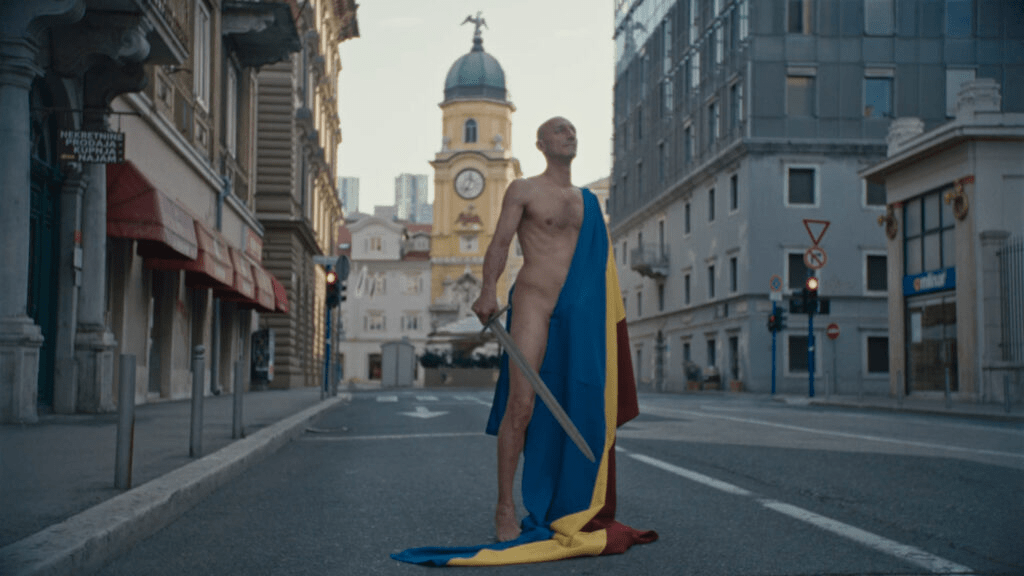
Still from Fiume o morte!, Igor Bezinović (2025).
Fiume o morte! ends with scenes from Rijeka’s traditional carnival, a celebration of local identities and of their changing and subversive nature. Bezinović contrasts localism to nationalism, advocating for smaller scales as the places where complex identities exist. Trieste celebrates the carnival too, but it has two of them: an Italian and a Slovenian one. Local memories are too divided in Trieste where the Italian myth clashes with the complexities of history. Trieste stands as the last bit of Italy where the boundaries between nation and empire blur and do not allow for simplistic storytelling.
Ludovic Brunot is a SGSAH-AHRC funded PhD researcher based at the University of St Andrews where he is affiliated to the Institute for Transnational & Spatial History. His PhD project focuses on Italian nationalism after 1945 and the usage of memory by the far-right in the country. His research engages with the notions of imperialism, borderlands, identity and migration studies on the Italian border with the Balkans. You can find out more about Ludovic’s research here.
 SGSAH Blog