
Guest bloggers Cicely Farrer and Alison Scott reflect on their event, Creative Citizenship in the Archives, co-organised with the SGSAH KE Hub Citizenship, Culture & Ethics (CCE).
How can we, as PhD researchers and community members, employ creative methods within archives as part of our PhD projects and public engagement?
Gathering in PhD researchers to the archives at the National Library of Scotland (NLS) at Kelvin Hall, this event was borne out of conversations we (Cicely Farrer and Alison Scott) had together, and with artist and Glasgow School of Art lecturer Bex Šik. Activist records we had each been researching spurred our will to create space for discussions on the ethics, frictions and excitement in devising creative methods to approach archives. Šik’s ongoing projects with the Women in Communism Oral History Archives recorded by Neil Rafeek in the National Library of Scotland Sound Archives had sparked our curiosity to learn more about Šik’s ways of working, and living with, the interviews of these politically active Scottish women. From this, we developed and offered the day as a forum for learning together. Panelists Charlie McCann from NLS and Caroline Gausden from Glasgow Women’s Library were invited in to offer insights on the archives they care for, and what they felt the opportunities and frictions might be for working creatively with activist archives.
To begin, we asked everyone to contribute some of their archive knowledge. Together we amassed an index of activist archives that participants engage with, varying in shape, location and order of the archives, from grassroots collections, archived websites, youtube accounts, family collections and materials under the care of larger institutions or dispersed among many places. The word ‘activism’ clearly means many things to many people: we asked those in the room to briefly share what ‘activism’ means for them. From ‘admin’ to ‘direct action’, here are some of their articulations:
Revolt. Dissent. Deviance. Supporting marginalised groups. Advocating for what you believe in. Imaging change. Holding institutions to account. Reimagining. Reinterpreting. Recreating. Resisting oppression through action. Putting solidarity into practice. Looking at how the past impacts now.
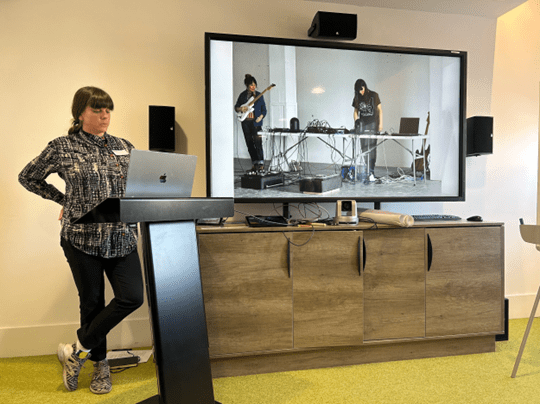
Bex Šik’s presentation.
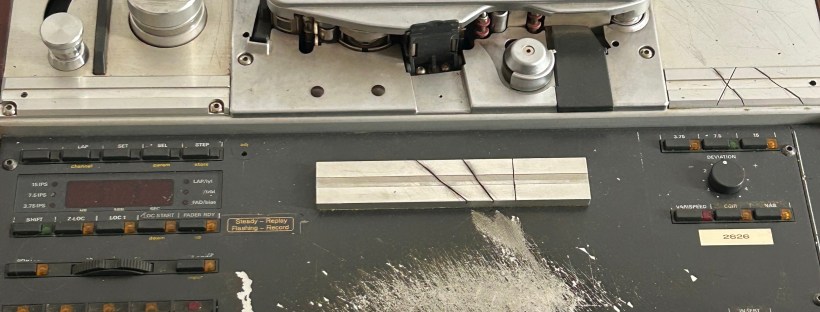
Rooting the day in artistic practice and a specific archive, Bex Šik gave an expanded artist talk drawing on the methods and questions that arose during their residency, animating the talk with sound bites from interviews with women involved in the Communist party in Scotland recorded by Neil Rafeek in the 1990s: Centring alternative approaches to ‘education,’ Šik recounted the workshops they held with young people at Rumpus Room, using these materials directly — listening, writing, and experimenting with reel-to-reel recording. Focussing on the emotional arcs of activism, particularly the idea of hope after defeat (Burnout, Hannah Proctor, 2024), Šik described listening and attending to these archives amid daily life, the role of embodied knowledge, and how their acoustic encounters prompted profound personal change. Šik emphasised the daily reproductive labour of organising and hosting that the recordings evidence: offers of cups of tea, many tones of laughter — helping to consider how oral histories have a specific kind of imagination or life to them.
“Does it change your relationship to the world? Do you care for it and does it care for you?” – Bex Šik
Workshop.
Bex also touched on a feeling of one-sided intimacy with the people whose voices exist in oral history records, a point picked up by contributor Caroline Gausden, empathising with Sik’s description of feeling like they were handling ‘paper soaked with tears.’ Gausden’s contribution drew on her experience of working closely with recordings from the Women’s Audio Archive for her PhD project, looking at how art practices might be framed as feminist manifestos. Later, Guasden introduced the collections and programming approach at GWL, which was founded as an activist archive and library, as their Development Worker for Programming and Curating. She highlighted listening as a curatorial method of support within GWL, whether through commission, encouragement or workshop, to empower participants and artists to work with them creatively. Researchers often enter archives with an idea or a question to guide our search, but frequently an institution invites the encounter first, and so Gausden provoked the question: What if you don’t know what you’re looking for? Highlighting that an open approach is key to creative negotiation.
Holding the workshop at NLS Kelvin Hall gave us insight to their collections from Sound Curator McCann. McCann highlighted some of the practical challenges facing institutional archives of sound and oral history, such as technological, staff capacity and space considerations. He posed questions about access: who has (or had) the equipment for the creation of audio records; the extent of uncatalogued or un-digitised collections; and the lack of ideal, comfortable space to listen to them. He drew attention to projects, like Bex’ residency, and the Modus Arts Tape Letters Scotland project, as examples of a more recent focus on activating NLS’ community collections.
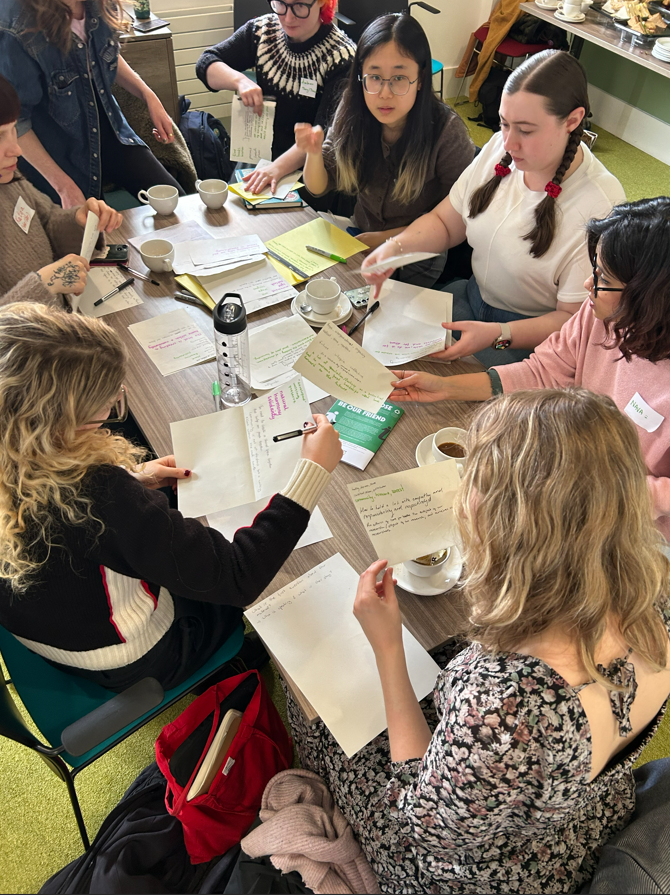
In the afternoon, we led a workshop co-designed with Bex, sharing three archival records for activation, one chosen by each of us. Reacting to materials we were each exploring independently had been generative for us and so it felt generous to offer our creative process to the participants. We chose to present these without context, as though stumbling on the materials incidentally, asking participants to respond intuitively to quick writing prompts, to explore the emotive qualities of activist archives. We anonymously exchanged and remixed words, encouraging the looseness and uncertainty core to creative processes and ideas development. In collating our words, the individual author was decentred and so releasing the vulnerability of naming.
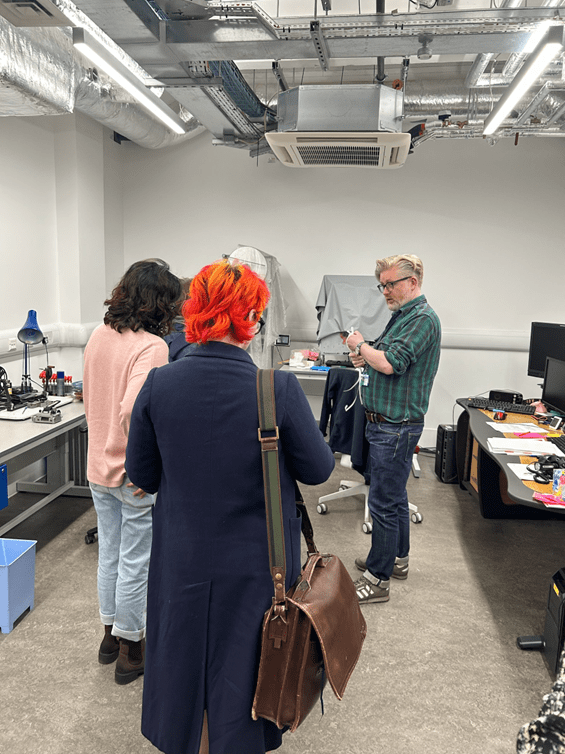
Behind-the-scenes tour of the NLS Sound and Moving Image archive with Sound Curator Charlie McCann.
Limiting access to context brought up debate of the framing of archives and the shared histories they evoke. But of course, we can never fully understand that context and an archive creates a fragmentary experience by nature. We are all under pressure, flicking pages, sifting through for what is relevant to our question or, getting drawn to, what speaks to us. As researchers however, if we don’t interrogate the context, we’ll miss key details, the coded language and symbols. How can intention be read? Discussing activist zines, questions of future planning and ethics arose. What happens if an object or record you made in one context, comes back to you at a different time and place in your life, through an archive? Sometimes consent is withdrawn, intentions and affiliations shift. How is the phrase ‘in perpetuity’ really understood when signing a consent form, and does creative re-use appear in this imagined future? Political affiliation continues to be a protected characteristic in Britain and much activist organising is intentionally obfuscated from view. What is our responsibility as researchers toward the person whose character appears in the archive, and their cause, and how can creative methods support the development of critical perspectives?
Creative Citizenship in the Archives took place at the National Library of Scotland on 2 April 2026.
Alison Scott is an artist and researcher based in Angus, who is currently a practice-based PhD student at Gray’s School of Art, Aberdeen. Her project, which is both informed and supported by the UKRI Treescapes project, focusses on art, forestry and the commons. You can find out more about Alison’s work here.
Cicely Farrer is a curator and researcher based in the north-east of Scotland. She is currently undertaking a SGSAH-AHRC PhD project in History of Art at University of St Andrews and The Glasgow School of Art Archives & Collections. Taking a transtemporal approach, Cicely is researching the history of art, gender and activism at the GSA through the research question How have the women of Glasgow School of Art performed acts of resistance in response to an industrial military complex of the twentieth and twenty first century? You can find out more about Cicely’s work here.

