
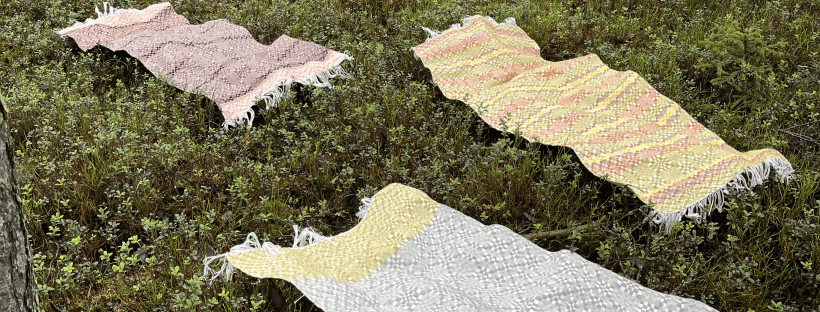
Guest blogger Cecilia Charlton discusses the value of durational ethnographic practices in heritage textile research.
My PhD research, under the current working title ‘Scotland’s Folk Weaving: A Tradition Obscured by Mists and Myth’ focuses on the handmade, regional, pre-industrial textiles of Scotland. This research is part of a broader project to investigate, question and rewrite canonical, colonial, capitalist positions embodied in histories, technologies, and artefacts, and will be carried out in collaboration with National Museum Scotland (NMS). As this research is still very much at the early stages, this article focusses on prior ethnographic textiles research which I undertook in Lithuania prior to embarking on my PhD.
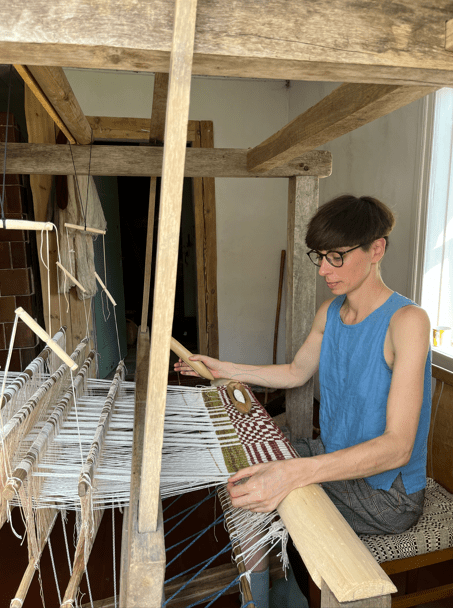
Cecilia at the loom. Credit Johanna Grivel.
In August 2023, I participated in Verpėjos artist residency in rural Lithuania. After working with textiles as the main component of my studio practice for five years, I found myself at a bit of a cross-roads. My work with textiles up to this point had evolved from and therefore adopted the shape of my previous work with abstract painting (my primary medium from 2012-2017), utilising textiles towards concerns around colour, composition and geometric pattern. While I continued to find the aesthetics pleasing and the labourious processes compelling, there was something missing. I found the premise of the Verpėjos residency quite unique: to engage with the practice of traditional sheepherding in rural Lithuania, looking after a flock of 60 primitive Skudde sheep.
Entering this space after spending the last ten years almost exclusively in an urban environment (New York, and then London) was quite a shock. Working with the sheep forced me to re-examine ideas around control, states of being, agency and action. While sheep have a reputation for being passive, malleable creatures I found I was very much at their mercy. They revealed to me the power of moving through the world with grace, of favouring fallibility over force. These wool-producing entities were my guides through this phase of studio development and led to many new avenues of questioning within myself and my practice.
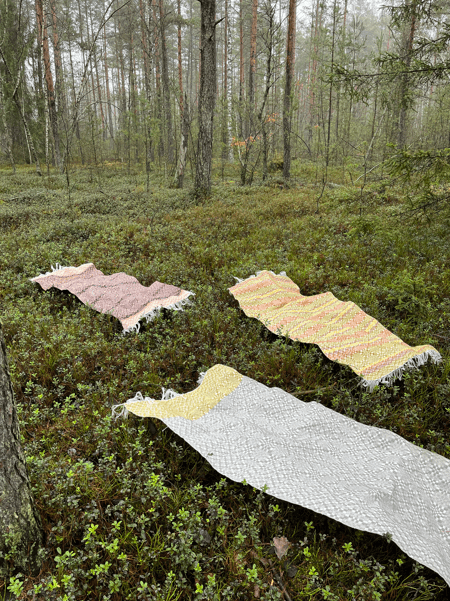
Textiles on the forest floor. Credit Bryan Reedy.
Returning to Verpėjos in December 2024, I focused fully on the traditional weaving practices of the region. With sandy soil due to the most recent glacial recession, the southern part of Lithuania had been mostly overlooked during eras of industrialization and large-scale agriculture – enabling continuity of village life, including practices of handweaving. This has resulted in enduring traditional architecture as well as the availability of historic weaving equipment such as looms. Through the research of a local group called Parėdzymai, I was able to follow local, vernacular methods to prepare a warp, dress the loom, and weave – revealing the relationship between local culture, human needs, and the natural world. Textile practices evolve from these factors, rather than being created in a vacuum (or art studio). This intersectionality brought textiles to life in a way that no composition, colour, or pattern could on its own.
The forest is where I sourced materials for dyeing, as well as renewed mental and physical energy after hours at the loom. Rather than being a neutral space where one can experience ‘nature’, it became a place of exchange – through investigations into natural dyeing I came to know some of the characters in the forest and recognise some previously unfamiliar faces. Other features of traditional village life played a role too; pieces of firewood could be chopped down and whittled to create necessary tools, and their ashes after burning were used to modify colours in the natural dyeing process. Again, I was struck by the interrelatedness of a traditional textiles practice and a traditional way of life. It became quite evident that it is challenging to envision one without the other.
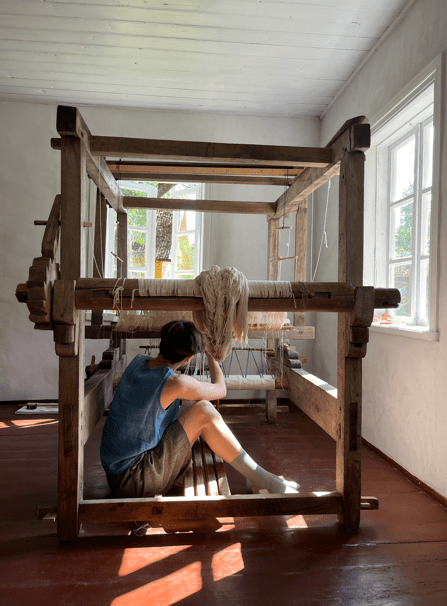
Cecilia in and under the loom. Credit Johanna Grivel.
The final component of this project was people. Engaging with traditional textiles will inherently involve people. Many parts of the process benefit from collaborative work, from caring for the sheep to dressing the loom. Additionally, the learning process is one that develops from the creation of community. In learning about Lithuanian textiles, I have had the pleasure to meet many experts who have astounded me not only with their skills and knowledge but also with their generosity. Heritage craft practices create lineages not dependent on DNA or even nationality but instead through materials, processes and shared passion. I look forward to the unfolding of these themes through heritage textiles research in Scotland.
Cecilia Charlton is a Glasgow-based American artist and researcher working primarily with the processes of weaving, embroidery, spinning, and natural dyeing. She is a SGSAH-AHRC funded PhD researcher at the Glasgow School of Art (GSA). She has exhibited in the UK and internationally. You can find out more about Cecilia’s work here.

