
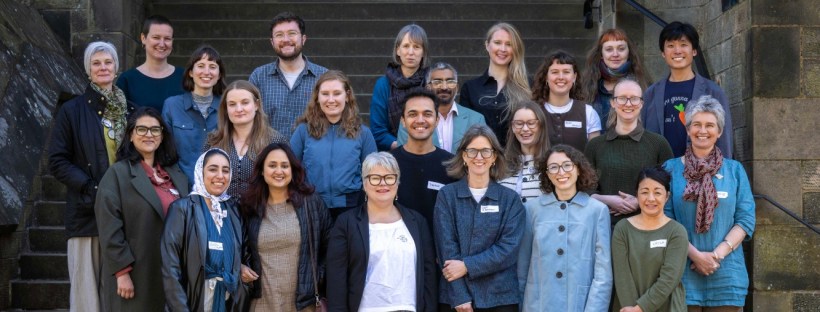
As EARTH Scholars reconvened in Glasgow during Earth Day 2026, Harriet Crisp reflects on the impact of a unique international programme at the intersection of environmental arts and humanities. All photographs courtesy of SGSAH and British Council Scotland.
The EARTH Scholarships (2023-2025) was a unique international research mobility programme delivered by the Scottish Graduate School for Arts and Humanities (SGSAH) in collaboration with British Council Scotland. The programme was thematically focused on the environmental arts and humanities and grounded in a belief in the vital role that arts, culture, and interdisciplinary research play in responding to the climate emergency.
During the week of Earth Day 2026, EARTH Scholars travelled from near and far to Glasgow, to reconnect, reflect, and continue dialogue sparked by the programme. This convivial gathering was part of the EARTH Scholarships programme of impact activity, which I supported in my role as EARTH Scholarships Impact Coordinator.
In this position, I contributed to the production of Creative and Sustainable Futures: EARTH Scholarships Programme Impact Portfolio, a digital publication that brought together reflections, quantitative data, and case studies. Concurrently, I assisted the coordination of a Scholars’ reunion event and the public-facing EARTH Scholarships Impact Symposium.
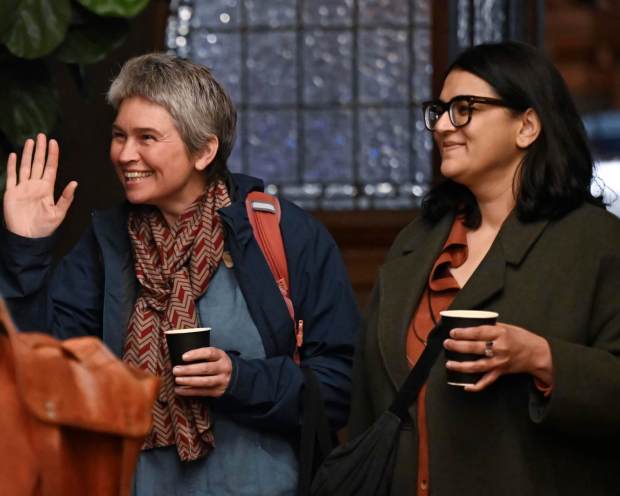
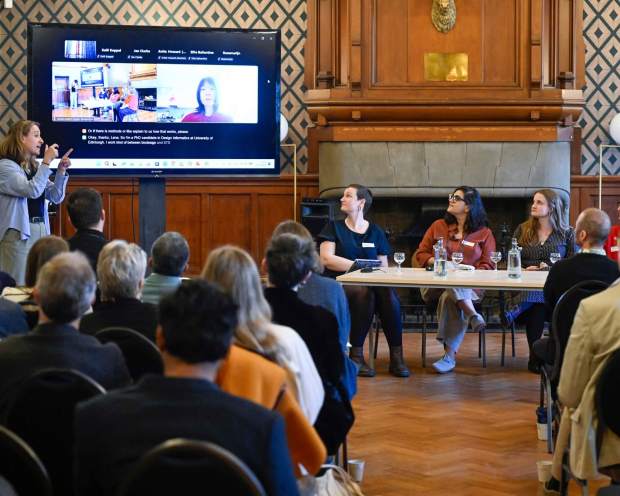
The reunion event brought Scholars together to share their research through 3-minute presentations, followed by a discussion facilitated by SGSAH Director Professor Maria Fusco. Together we reflected on the material impacts of interdisciplinary arts and humanities research in responding to the climate emergency. The Symposium convened Scholars, academics, funders, and cultural professionals for a series of panel discussions organised around the programme’s three research clusters: Place, Time and Action; Making, Method and Multispecies; and Economy, Ethics and Environment. Across both days, Digital displays mapped how specific aspects of the programme – methods, ideas, approaches, or collaborations – had directly impacted Scholars’ research.
My doctoral research investigates imaginaries of water in audiovisual media and is connected to an impact-driven partnership project entitled FORTH2O. The role of EARTH Scholarship Impact Coordinator neatly dovetailed my interests in environmental arts and humanities and impact activity, providing a space beyond my doctoral research to think more deeply about their intersection. Additionally, on a personal level, it was fulfilling to champion and evidence the value of early-career arts and humanities research in an increasingly threatening climate.
Since starting my PhD, I have picked up a new lexicon of terms – ‘REFable’, ‘civic engagement’, ‘grimpact’, ‘pathways to impact’, ‘policy engagement’, ‘knowledge exchange’ – that now pepper pub chats with fellow PhD students and conversations with academic colleagues. This is reflective of the impact framing of the project to which my PhD is attached, but also of the impact agenda within the UK higher education sector more broadly.
Since the mid-2000s there has been an increasing drive to ensure that academic research achieves impact, defined by UKRI’s Research Excellence Framework (REF) as ‘an effect on, change or benefit to the economy, society, culture, public policy or services, health, the environment or quality of life, beyond academia’. Impact is now required by the UK research councils as a criterion for winning research funding and is retrospectively assessed via the REF, the mechanism by which UKRI assesses the quality of academic research and subsequently allocates funding. The impact agenda is something of a hot topic in the higher education sector, regarded by some as a dimension of the neoliberal marketisation of academia and by others as a move to recognising the role universities can and should play in progressive social change.
The impact programme of the EARTH Scholarships engaged, somewhat unwittingly, in this wider discourse. This was particularly evident in the lively discussion facilitated by Maria at the Scholars’ reunion event. In groups formed according to the topic or approach of our research, we reflected on how our research inflected with one another’s and considered speculative and practical impact pathways that arts and humanities research might take in responding to the climate emergency. My group discussed the affective, more-than-representational nature of artistic forms, their subsequent potential for engaging audiences in environmental issues, and the need for place-specific approaches.
Reforming as a larger group, Scholars noted the distinct capacity for imagination, relatability, speculation, and questioning offered by the arts and humanities, an alternative to the drive towards resolution in the sciences and necessary in a world of contradiction. Conversation then turned to the notion of impact and the impact agenda and various perspectives were shared: that an impact framing of arts and humanities research was an over-extension of science-based models of knowledge production; that impact might be best conceived of as ‘traces and tracks’, not always linear, pre-determinable, or instant; and that the impact agenda should be approached as a generative challenge to explain what arts and humanities researchers do.
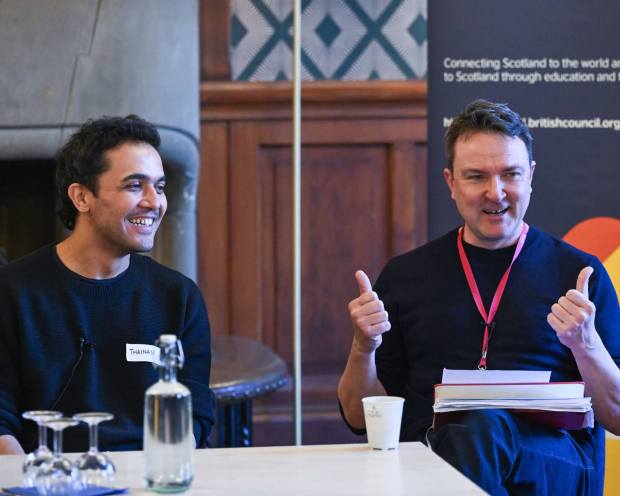
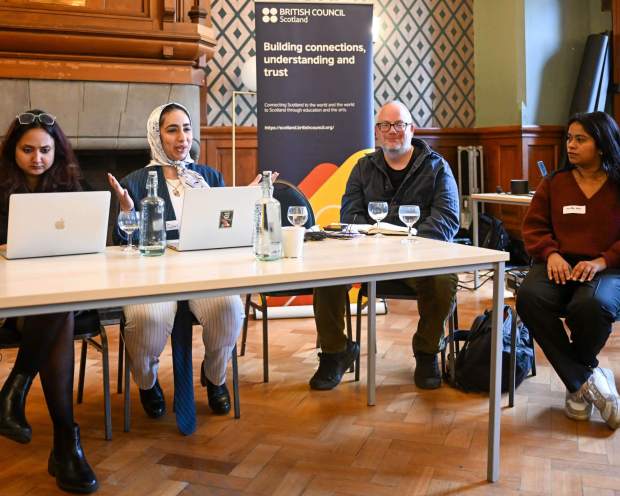
The discussion provided a helpful framing for the next day of panels at the EARTH Scholarships Impact Symposium. Eight Scholars from across the world reflected on the impact of the research they had undertaken through their EARTH Scholarships. Paro Tomar, Zahra Tootonsab, and Miriam Sentler illustrated how archival material and collections might be reactivated to address current environmental and political issues. Ajmal Rasaq emphasised the importance of ethical relationships between researchers and participants in his notion of ‘friendship as a method’. Leyla Craig highlighted the potential of academic inquiry as a pathway to accessibility and empowerment, while Salomé Ambert and Miriam explored artistic forms as prompts for reflection on environmental futures. These are just some of the ideas I took from the day, traces and tracks that might seed further inquiry, collaboration, and action.
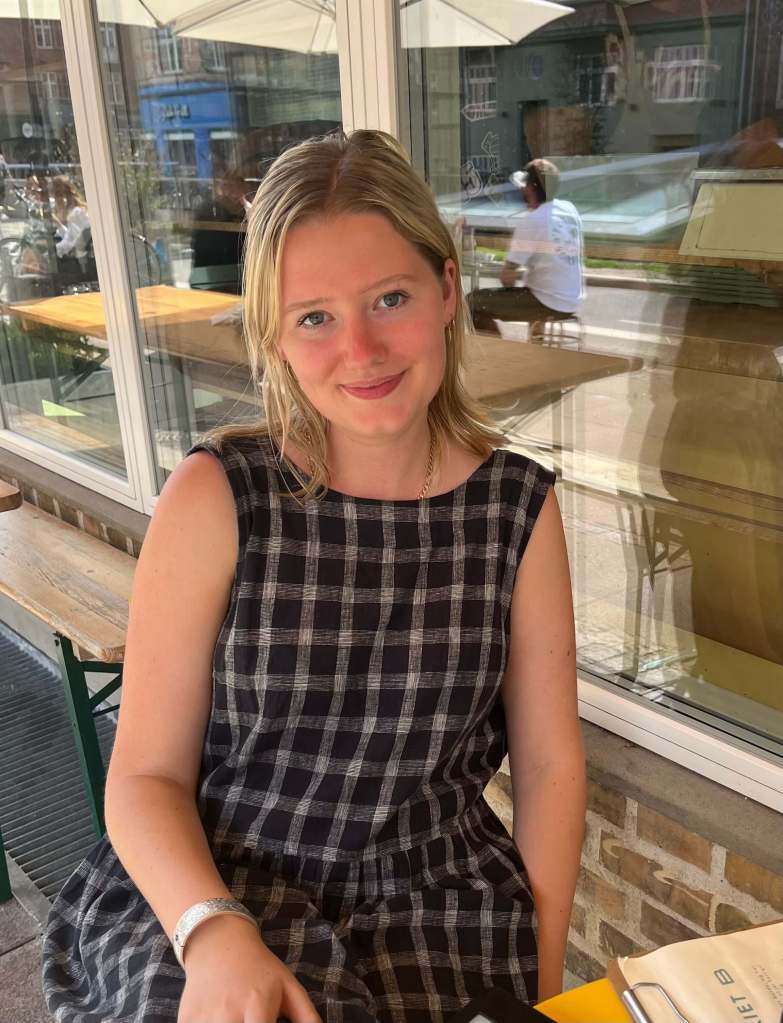
Harriet Crisp is an interdisciplinary PhD researcher and Research Assistant at the University of Stirling. Her research explores how people experience places through sound and moving image, with particular interests in place-based and participatory arts and heritage practices, the environmental humanities, archival reactivation, and phenomenological and ecocritical approaches to film studies. Harriet’s doctoral project investigates past, present, and future imaginaries of water in the Forth Water Basin, Scotland and is linked with FORTH2O, a UKRI-funded Local Policy Innovation Partnership. She holds an MA in Contemporary Art and Archaeology from the University of the Highlands and Islands and a BA in Film and Television from the University of Bristol.

