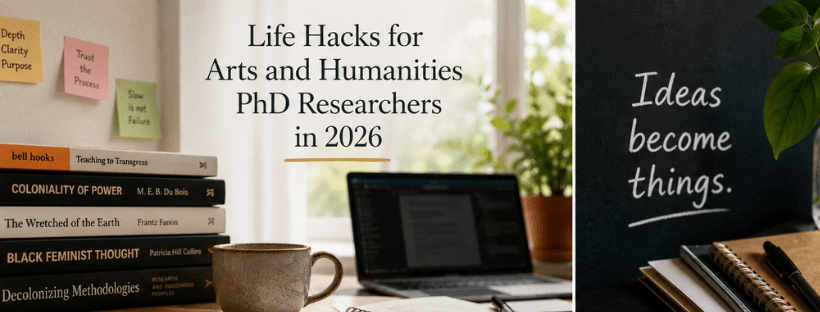
What I Wish Someone Had Told Me About Doing a Humanities PhD in 2026
Let’s start with honesty: doing a PhD in the Arts and Humanities in 2026 is not just an intellectual exercise. It is an emotional, spiritual and structural negotiation. You are being trained to produce knowledge inside institutions that often reward speed, performance and conformity, while your actual work requires slowness, depth and critical thought. If you do not learn how to navigate that tension early, the PhD will start to shape you in ways you did not consent to.
So these “life hacks” are not about shallow productivity. They are about staying grounded, thinking clearly and protecting your capacity to do meaningful work.
First, separate your identity from your research output. Academia quietly encourages you to collapse the two, so that a difficult writing week feels like a personal failure. It is not. Writing is a process of working through ideas, not a performance of intelligence. If you attach your self worth to your drafts, you will either burn out or avoid the work altogether.
Second, stop trying to read everything. That approach will overwhelm you. Read with intention. Every text should answer a question: what is this author doing, and how does it help me clarify my own position? You are not collecting information, you are entering a conversation. That requires discernment, not volume.
Third, write before you feel ready. In humanities research, clarity does not come before writing; it emerges through it. Waiting until your ideas feel fully formed is often just a way of delaying the discomfort of thinking on the page. Start where you are, even if it is messy.
Build a workflow that reflects your real energy, not your ideal self. Some days will allow for deep writing, others will not. Have lower intensity tasks ready, editing, formatting, note organisation or light reading. This is how you stay consistent without burning out.
Be conscious of the intellectual frameworks shaping your work. If you are researching culture, identity or lived experience, especially from a Caribbean or diasporic perspective, be aware of how dominant academic voices can narrow your thinking. Expanding your references and questioning default theories is part of doing rigorous and honest scholarship.
Do not isolate yourself. Some of your best thinking will happen in conversation. Talk through your ideas, explain your work out loud, and pay attention to where it does not yet make sense. That is where the work is.
Use AI as a support, not a substitute. It can help structure ideas or refine language, but it cannot replace your thinking. Your perspective is the value. The value of your scholarship lies not in how quickly words appear on a page, but in the perspective, experience, and critical engagement that only you can bring to the work.
Finally, rest is part of the method.
The kind of thinking this work requires depends on your ability to make connections, and that does not happen when you are constantly depleted.
Some of your most important insights will arrive when you step away from your desk, not when you force yourself to stay there longer.
A PhD will stretch you, but it should not erase you. If you stay clear on that, you will not just complete the process, you will come out of it with a stronger sense of your voice and what you are here to contribute.