
From Advocacy to Mobilisation to Organising
What mechanisms are there for doctoral students to advocate, challenge, collectivise, and take agency both within and beyond the structures of higher education? How might we better take agency, use our advocacy, and form networks of solidarity and support?
On 12 May 2026, we gathered at the University of Glasgow, and online, to explore these questions with doctoral researchers from across Scotland. The event emerged from shared conversations as members of SGSAH’s Doctoral Researcher Committee (DRC) on the role and potential of doctoral student representation and action in a climate of increasing precarity, cuts, and corporatisation within the university sector.
Keynote Reflections: Universities, Power, and Resistance
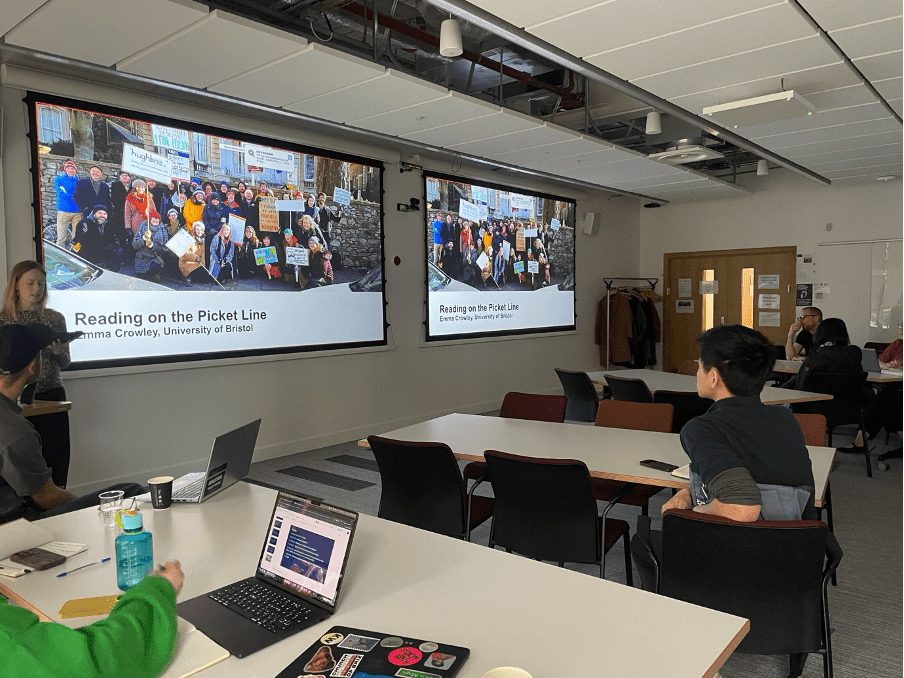
The event kicked off with two keynote talks from Dr Fred Carter and Dr Emma Crowley.
Centring on the concept of dual use, Fred discussed his work critically mapping research partnerships between arms organisations and the University of Glasgow, as well as explorations of how the material conditions of infrastructure might shape artistic and academic methods.
Equally harrowing and inspiring, Fred’s talk spotlighted the challenges of disentangling universities from the military-industrial complex, the importance of solidarity with non-academic staff in higher education, and the potential of student activism, highlighting the recent strike of Harvard’s graduate students as a powerful example.
Emma drew from her experience as a precariously employed academic at the University of Bristol and University College Union (UCU) member to outline the oppressive conditions of universities and the associated culture of compliance, financial insecurity, and social fragility. Located within the department for English, Emma described how radical reading practices move into and out of the university, where staff learn from students within the backdrop of a city whose image is shaped by the toppling of the Edward Colston statue and being branded as the “woke” capital.
Doctoral Researchers, Representation, and the Question of Labour
Turning specifically to doctoral student representation and organising, we then heard from union representatives.
Annie Mason, a Local Coordinator for the Highlands and Islands Students’ Association, emphasised the liminality of the role of doctoral researchers, where they are alternately considered as staff or as students when it is convenient to the institution. She also highlighted the importance of a grassroots dynamic within student representation, calling for organisations to be “student led and staff facilitated”.
Rory Hamilton, a PhD researcher and UCU representative, discussed the challenges of organising as PhD researchers: the disruption that fieldwork poses, the constant turnover, the spatial fragmentation posed by hot-desking, and the liminality and precarity of this form of labour, where there are often no contracts or pensions.
Liam McCabe, an Organiser at the Educational Institute of Scotland (EIS), drew on his experience in student and worker empowerment in education to encourage us to move towards organising, as opposed to advocacy, by bringing others along with us. He highlighted that effecting change sometimes means working against, rather than with, management, where there can be conflicting agendas.
Speaking to Power and Imagining New Networks
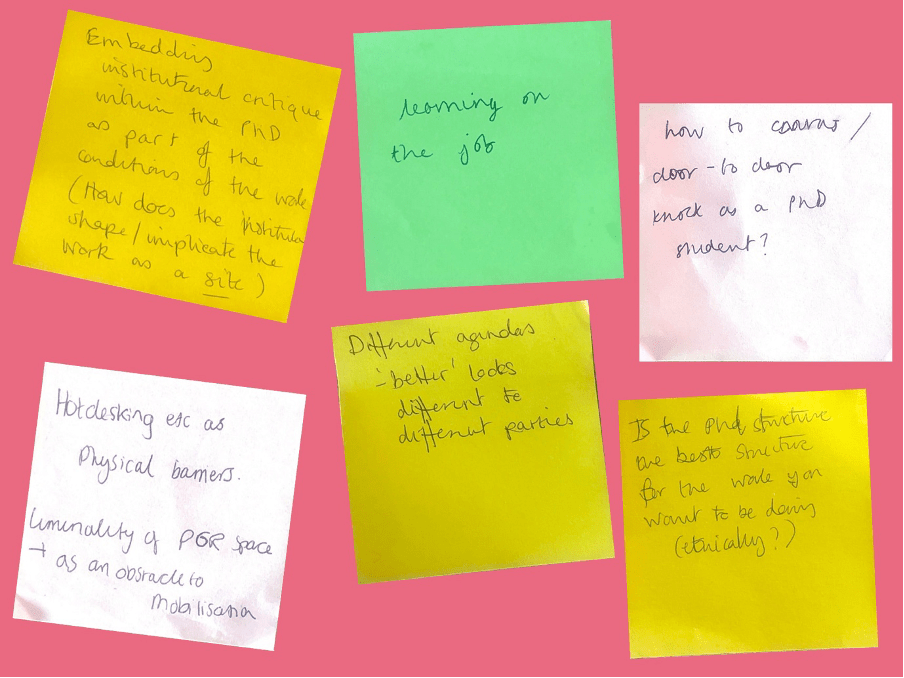
After a short panel discussion, an afternoon in-person workshop followed. This gave space for attendees’ personal reflections on the panel’s provocations and their own experiences of where they had been able or unable to speak to power, the channels available to them, and the possible networks we could imagine.
Time in smaller groups drew out conversations around international student positionality, cultural and class dynamics, the various scales of change we might be able to affect, and the idea of citizenship within and beyond the university.
For many of the attendees, our academic journeys have been, and continue to be, shaped by strikes and industrial action. Indeed, as we write, action unfolds at Edinburgh College of Art during Degree Show with an “alternative degree show”, as students show their solidarity with the Marking and Assessment Boycott.
Discussions of students’ ethical roles within the higher education crisis of precarity, casualisation, and unethical funds spanned how we could address this within our citizenship and solidarity with staff, but also in the way our research unfolds in the “site” of the university.
From Discussion to Resource-Building
Through the workshop and the panel discussion, we gathered resources, networks, and advice in order to shape the beginnings of a directory for further learning and for supporting PhD students to engage in advocacy and unions. This can be found at the foot of this blog post.
The event showcased an appetite for more critical discussion and action within a doctoral student body shaped by the higher education crisis, and a need to further demystify our place within university infrastructures.
As organisers of the event and members of the DRC, how can we embed this learning within the structures of the DRC and SGSAH? We also reflected on what the DRC’s role could be within the wider landscape of student advocacy and activism: how can we more fully embody a “student led” approach, and how can we link better to other networks, unions, and forums to contribute to wider change affecting not only ourselves but our supervisors, colleagues, and those whose work enables our own?
Directory
Networks, Unions, and Representative Systems
SGSAH Doctoral Research Committee
SGSAH/SGSSS PGR Networks
Sparqs
UCU
EIS
Texts and Resources
Raising Expectations and Raising Hell by Jane McAlevey
No Shortcuts: Organising for Power in the New Gilded Age by Jane McAlevey
Arise: Power, Strategy and Union Resurgence by Jane Holgate
“The compliant environment: Conformity, data processing and increasing inequality in UK higher education” by Penny Andrews
The Politics of Feeling: Populism, Progressivism, Liberalism by Ben Anderson and Anna J. Secor
Toward a Woman-Centered University (1973–74) by Adrienne Rich
About the Authors
Harriet Crisp is a PhD researcher in Film and Media Studies at the University of Stirling. Her research interests include archival reactivation, the environmental humanities, artists’ moving image, and ecocritical and phenomenological approaches to film studies. Harriet’s doctoral project investigates past, present, and future imaginaries of water in the Forth Water Basin through film analysis and creative audiovisual practice. Her PhD is funded by the University of Stirling and is linked to FORTH2O, a UKRI-funded Local Policy Innovation Partnership, where she also works as a Research Assistant.
Alison Scott is an artist and researcher based in Angus, who is currently a practice-based PhD student at Gray’s School of Art, Aberdeen. Her project, which is both informed and supported by the UKRI Treescapes project, focuses on art, forestry and the commons. Her research learns from the environmental humanities and particular interests include eco-criticism, art-writing, artists’ moving image, and activism.
Mhairi Ferrier is an SGSAH-funded PhD researcher at the University of the Highlands and Islands, based in South Uist. Her project is a Collaborative Doctoral Award between UHI and Gaelic cultural organisation Ceòlas Uibhist. This project is focused on understanding the heritage of taighean-tughaidh — thatched houses — in Uist, utilising oral histories, archaeological recording, and digital heritage. Outwith this project, wider research interests are focused on Scotland’s cultural and social history, in particular the topics of protest, documentary film, and infrastructure.
We are always seeking new guest bloggers! If you have an idea for a blog post or would like to informally discuss writing for the SGSAH blog please get in touch with Olivia via email at olivia.shaw-lovell@glasgow.ac.uk or connect with the blog on social media.

