
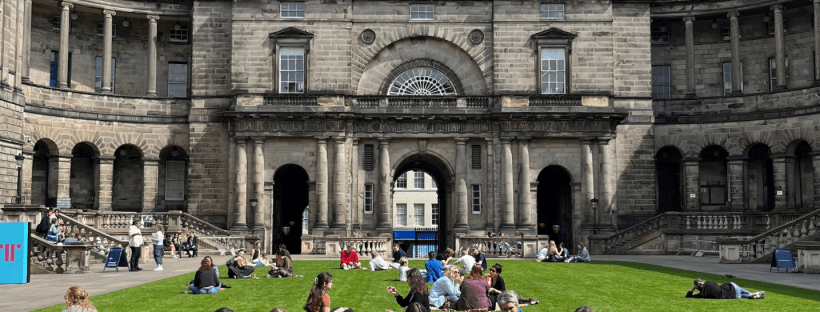
A few weeks ago, I shared about the importance of attending events as a PhD student and researcher, not only for networking, but as a real means of development. If you missed that post, you can read it here: Beyond the Desk: Why PhD Students Need to Show Up Where the Conversations Are Happening.
This week’s blog is from an anonymous contributor who attended the University of Edinburgh School of Divinity Postgraduate Summer School, which took place from 25–29 May 2026. The week also included a special SGSAH Day on 28 May, where SGSAH-funded students shared their research.
And what better way to continue the conversation about showing up than through the eyes of someone who did exactly that?
Here are her musings.
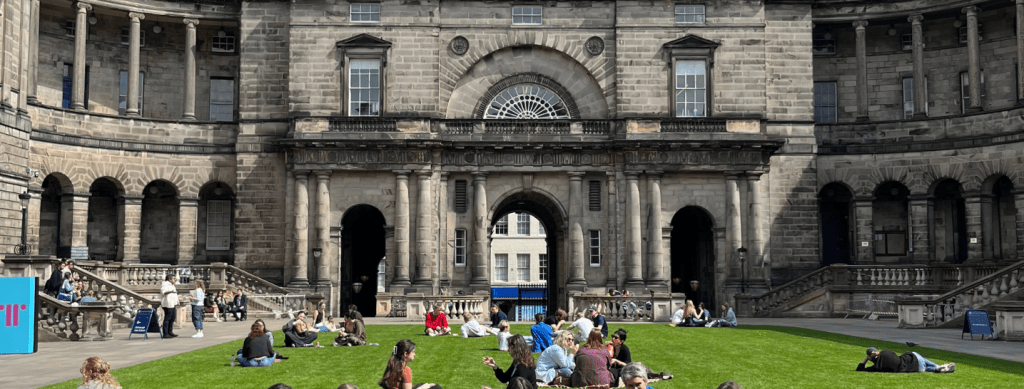
Dear reader, other universities have postgrad students too
Who knew?
There is something oddly comforting about finding yourself in a room full of other postgraduate students and realising that the academic world is much larger than your own desk, your own department, and your own very dramatic reading list.
Rainy Hall had a proper buzz about it. Lots of new faces. Lots of new friends. Lots of conversations happening in corners, over coffee, between papers, and while everyone tried to navigate the lift works with varying levels of grace.
A social experiment? Possibly.
A bonding exercise? Almost certainly.
And then, there was cake

So much cake.
Honestly, an honourable mention must go to the refreshments. Academic events often promise intellectual nourishment, but this one provided actual nourishment too.
And that Black Forest cake?
If anyone has the recipe, the people would like to know. Immediately.
There are many reasons to attend postgraduate events: networking, development, intellectual exchange, confidence building, and discovering new research. But sometimes, there is also cake. And we must not pretend that this is not part of the experience.
A schedule full of difficult choices
There were loads of sessions to choose from, which is both a blessing and a small academic tragedy.
You want to attend everything. You cannot attend everything. You choose one session and spend the next hour wondering what brilliance is happening in the room next door.
I was genuinely sorry to miss some papers.
But the ones I did attend gave me plenty to think about. One paper was on the same passage I was preaching on the following Sunday, which surely counts as divine intervention. Or, at the very least, very efficient preparation.
There was a feast of Gospel explorations in the morning. Jared Hay took us to the park with Jesus. Chelsey Harmon made me want to read Thomas Goodwin, which I was not expecting to add to my list that day. Chris West was outstanding on “divine and serpentine speech”, and I need that paper already.
My reading list has doubled in length.
I am pretending to be calm about this.
Respect to those who stood up and shared
Extra kudos must go to the speakers for whom English is not their first language.
Presenting academic work is already a brave thing to do. You stand in front of people with your argument, your sources, your carefully chosen words, and your hope that no one asks the one question you secretly fear.
To do that in another language deserves deep respect.
These events remind us that research is not only about polished final products. It is also about people finding the courage to share work in progress, to think aloud, to receive questions, and to let others into the development of their ideas.
That is no small thing.
The panel and the search for academic balance
The plenary panel had promise. I was hoping for tips and encouragement on balancing commitments.
You know the dream.
Someone would surely reveal the secret formula for managing research, teaching, emails, life, deadlines, reading, writing, sleep, and the vague pressure to be a fully functioning human being.
There were a few tumbleweed moments.
In fairness, I think we were all tired by that point.
I enjoyed the over-sharing, though. There is something reassuring about academics admitting that they, too, do not have magic bullets. No one handed us a perfect system. No one solved the problem of balance in one panel. No one revealed the sacred calendar method that would rescue us all.
But maybe that was useful in itself.
Sometimes encouragement is not a perfect answer. Sometimes it is simply discovering that everyone else is also figuring it out as they go.
Why showing up still matters
All in all, it was a stimulating and enjoyable day.
It was full of papers, conversations, cake, questions, new connections, tired laughter, unexpected reading recommendations, and the kind of moments that remind you why it matters to show up.
As postgraduate researchers, it can be easy to stay tucked away with our work. There is always another chapter to read, another paragraph to fix, another deadline approaching with suspicious speed.
But events like the School of Divinity Postgraduate Summer School remind us that research does not only grow in isolation. It grows when we listen to each other. It grows when we hear papers outside our immediate area. It grows when we ask questions, meet people, and realise that our work belongs to a wider conversation.
So, if you attended, what did you think?
Which paper stayed with you? Which conversation made you think differently? Did your reading list also grow dangerously long? And most importantly, does anyone have the Black Forest cake recipe?
We are always seeking new guest bloggers! If you have an idea for a blog post or would like to informally discuss writing for the SGSAH blog please get in touch with Olivia via email at olivia.shaw-lovell@glasgow.ac.uk or connect with the blog on social media.

