

At a time when higher education budgets are tightening and funding opportunities can feel increasingly uncertain, many people are questioning whether pursuing a PhD is still financially possible. For international students especially, the cost of tuition, visas, relocation and everyday living can make doctoral study feel like something reserved for people who already have access to money. I am sharing my journey because I know how overwhelming that uncertainty can feel, but I also know that funding exists and that finding it often requires time, strategy, community and a willingness to keep going even when the outcome is not guaranteed.
My PhD journey did not begin when I entered the University of Edinburgh. It began in 2024, when I made the decision in my mind that doctoral study was where I wanted to go.
I was completing my master’s degree at the time, and although I had written in my scholarship application that I hoped to pursue a PhD, it was not yet something that felt set in stone. Then I attended a particular class, and my engagement with the lecturer pushed me to think beyond the master’s dissertation I was preparing. I began to recognise that the questions I was asking and the work I wanted to do could not be contained within one research paper. I kept asking myself, “What comes next?” Eventually, the PhD became my answer.
I remained focused on completing my master’s well, but I also started having conversations with people who were pursuing PhDs, preparing applications or had already completed the journey. As someone coming from another country and trying to understand the academic landscape in the United Kingdom, I knew I could not afford to recreate the entire map by myself. I needed to learn from people who had already travelled the road.
Those conversations taught me that the first step was not simply finding a university. I needed to have a clear idea of what I wanted to research and, more importantly, why I wanted to research it. Your topic may develop over time, and it almost certainly will, but you still need to understand what is driving the work. Funding panels and universities are not only interested in what you plan to study; they also want to understand why the research matters, why you are the person to undertake it and what difference the work could make.
Finding the Right Supervisor

The next step was identifying institutions and potential supervisors whose expertise aligned with my research interests. This alignment is essential. Being admitted to a respected university means very little if there is no one there who understands the work you want to do or can support you in developing it.
I researched academics whose interests connected with mine and contacted the person who would eventually become my supervisor. My introductory email was short and clear, but it explained who I was, what I hoped to research, why I believed her expertise aligned with the project and why I wanted an opportunity to speak with her. I received a response within a few days, and we arranged an initial conversation. I was in the middle of completing an assignment and had been working in the library for hours, but when the meeting time became available, I stopped what I was doing and made myself available. Opportunities do not always arrive when your schedule is clear.
That first conversation was not only about convincing a potential supervisor to work with me. I was also paying attention to whether this was someone I believed I could work with. A prospective supervisor is assessing your ideas, readiness and potential, but you should also be assessing the relationship. Are they genuinely interested in your research? Do they communicate clearly? Do they respect your ideas? Can you imagine receiving constructive feedback from them over several years?
I asked about the programme requirements, the grades I would need, how admissions decisions were made, what the school expected from applicants and what she expected from the students she supervised. I also asked about funding. There was no promise that funding would appear, but a few months later, she sent me information about an opportunity and an upcoming information session. I researched it, registered and travelled from London to Scotland to attend. The funder covered the cost of attending the session, which made it possible for me as a student to be in that room.
I listened carefully as they explained the application process, the expectations and the experiences of previous applicants. I was not only trying to decide whether I wanted the funding; I was also asking myself whether I could prepare a competitive application within the available time. The following day, I met with my prospective supervisor to discuss my developing PhD proposal. We spoke about what was working, what needed greater clarity and what an admissions or funding panel might be looking for. I then returned to London, completed my master’s degree and worked to achieve the grade required for entry into the doctoral programme.
Learning How to Write for Funding

Once my academic results were confirmed, I began preparing both my university application and the proposal that would support my funding application. During that period, I also found workshops designed to help prospective PhD students strengthen their proposals.
This is one of the most important lessons I can share: do not assume that because you have written successful applications before, you automatically know how to write a PhD proposal or funding application. Different universities and funders are looking for particular forms of clarity. They want to see the research problem, your methodology, the feasibility of the project, its originality, your preparedness and the potential impact of the work.
Between approximately August and October, I revised my proposal repeatedly. I shared it with my prospective supervisor and with other people who could offer useful feedback. I participated in proposal-writing spaces where we read one another’s work, asked questions and identified areas that were not yet clear.
There were moments when I became tired of the process. I had just completed an intense master’s programme and left the country, and part of me wondered whether I should delay the PhD application for another year. Then my prospective supervisor contacted me with an update about the application process. That message encouraged me to continue because it reminded me that she was not only responding to my emails; she was genuinely interested in the research I was trying to develop.
That level of engagement mattered. Your supervisor does not hold all the power, and you are not simply waiting to be chosen. You are also deciding whether this is a professional relationship in which your work can grow. A supervisor cannot conduct the PhD for you, but the quality of your supervisory relationship can deeply affect whether the journey becomes a healthy environment for development or an unnecessarily difficult one.
The Application Was a Process, Not a Moment
I eventually applied to the university and was admitted. I then continued working on the external funding application through SGSAH. At the time, the process required institutional endorsement, which meant the university and my prospective supervisor also had responsibilities within the application.
The funding process has since changed, and every applicant should consult the most current guidance rather than relying entirely on someone else’s experience. However, the broader lesson remains: many doctoral funding applications involve several connected stages. You may need admission to the university, internal school approval, references, institutional endorsement and supporting documents from your proposed supervisor before your application reaches the final funder.
Our funding deadline fell on Valentine’s Day- February 14, so we jokingly called it our “Valentine’s Day special”. After months of researching, writing, revising, submitting and waiting, the outcome arrived in the spring.
I was successful in both the school funding process and the SGSAH funding competition. Praise God!
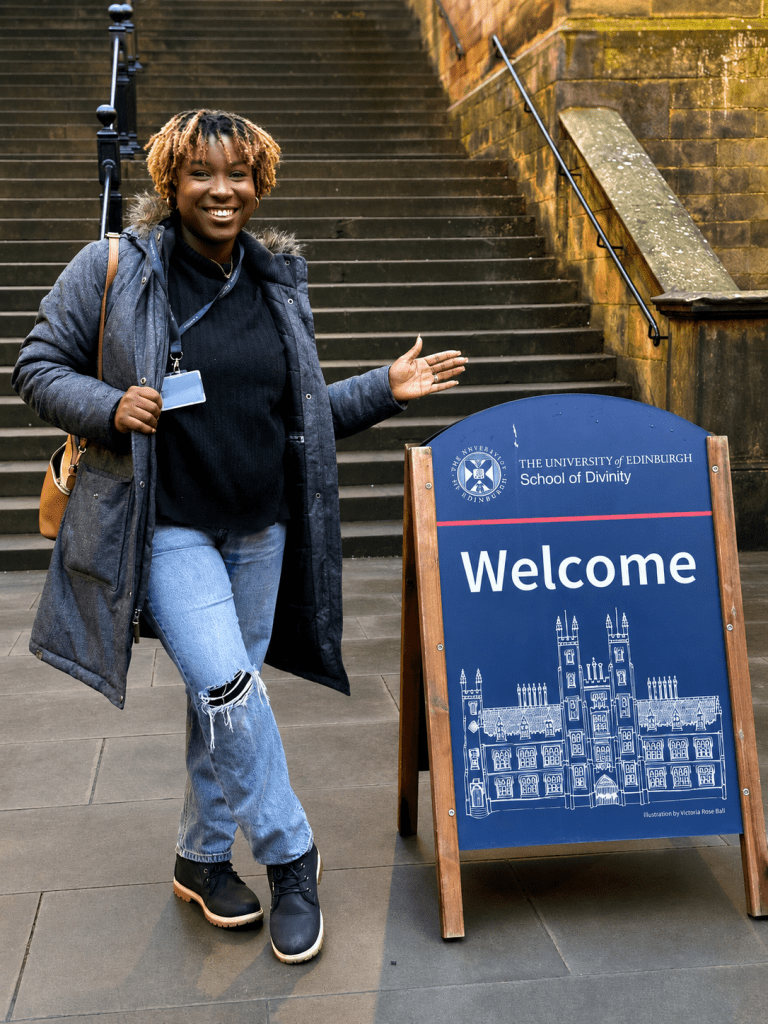
That funding made it possible for me to say yes to pursuing my PhD at the University of Edinburgh’s School of Divinity, where my research is situated within World Christianity and an interdisciplinary conversation involving theology, public health, gender and mental health.
The offer may have arrived in 2025, but the journey towards it had begun in 2024. That is why I always tell prospective students to start early. Funding a PhD is rarely about finding one application and filling it out quickly. It involves developing the research idea, understanding the academic landscape, building relationships, learning how funding systems operate, strengthening your writing and leaving enough time for other people to contribute what the application requires.
What I Would Tell Someone Starting Now
- Give yourself time and give yourself grace, but also be intentional
- Speak to people who have completed the process
- Attend information sessions
- Ask prospective supervisors direct questions
- Search for proposal-writing workshops, webinars, and academic development spaces
- Use LinkedIn, university websites, research networks, and conversations with other doctoral researchers to uncover opportunities you might not otherwise find
- Do not feel that you must keep the entire journey secret and emerge only when everything has been completed. I understand the desire to protect your plans, but there is value in allowing trusted people to support you. Someone may hear about an opportunity that fits your research, introduce you to a useful contact, read your proposal or help you understand a process that initially feels unfamiliar.
- Keep people updated as well. When someone gives you advice or connects you with an opportunity, let them know what happened. Tell them which steps you followed and what the outcome was. Relationships are not only useful for accessing information; they are part of the community that carries us through work that can be emotionally demanding and uncertain.
- Funding is important because doctoral research is already intellectually and emotionally demanding. Wherever possible, you do not want the constant anxiety of tuition and living expenses to overshadow the work you are trying to produce. Seek funding that covers both fees and living costs, understand what the award includes and consider whether the available support is realistic for your circumstances.
- You should also pay attention to alignment. Your project must connect with the priorities of the funder, but that does not mean changing your entire research identity to chase money. It means identifying the organisations that already recognise the value of the work you want to do and clearly demonstrating that connection.
Finally, consider how your research will move beyond the university. What is the real-world significance of the project? Who could benefit from the knowledge you produce? Could it inform policy, professional practice, community programmes, education, public debate or the work of organisations outside academia? Knowledge exchange and impact should not be ideas added at the end of an application. They should emerge from a clear understanding of why the research matters in the first place.
My journey is only one journey, and your process may look very different. However, I hope my experience reminds you that the absence of personal wealth does not automatically mean the end of your PhD dream. Start early, ask questions, seek alignment, allow others to support you and continue refining the work.
Most importantly, do not give up before you have given yourself the opportunity to find what may already be available.
If you would like to share your own PhD funding journey or contribute to the SGSAH blog, please contact me at olivia.shaw-lovell@glasgow.ac.uk. We are always seeking new guest bloggers, and I would love to hear how others have navigated this process.

