
What if completing a PhD meant more than producing a polished thesis? In this guest contribution, Wilson Chak, a doctoral researcher in Systematic Theology at the University of Edinburgh, reflects on academic writing, the pursuit of knowledge and what it might mean to rethink the very idea of completion.
A couple of weeks ago, whilst catching up with a friend who asked about my PhD, I smiled shyly, cocked my head to the left and said thoughtfully, “I’m going to tear it up!” What I said sounded terribly discordant, a wrong note against the jazzy background music and the optimistic start to our conversation. “What the heck? You’re giving up?” he blurted out.
Well, not quite. I’m giving up a way of thinking about my PhD and adopting another paradigm: one in which “tearing” the thesis is the goal.
The familiar storyline of what a successful doctoral dissertation looks like often takes for granted that a “complete” piece of work should be the end product. One’s career seems set out once one hops on the PhD bandwagon: read, write, present, defend, revise and publish. Whilst the journey towards the end can look messy and bumpy, the final product should look polished and tame.
But what if this whole narrative of bringing the thesis to its “completion” is misguided in the first place by the assumption that anything worthwhile must end up somewhere up “there”, whether on a bookshelf, a CV, in a scholarly journal, etc.? What if the finish line has nothing to do with neatly packaged paragraphs on paper?
Don’t get me wrong. I am not anti-intellectual, nor am I arguing that we should produce sloppy work. I am all for writing well and publishing! But what I am questioning is whether, somewhere in the PhD narrative, we have got something askew, making us think that the telos of our work lies in something intellectually grand but rather depersonalised.
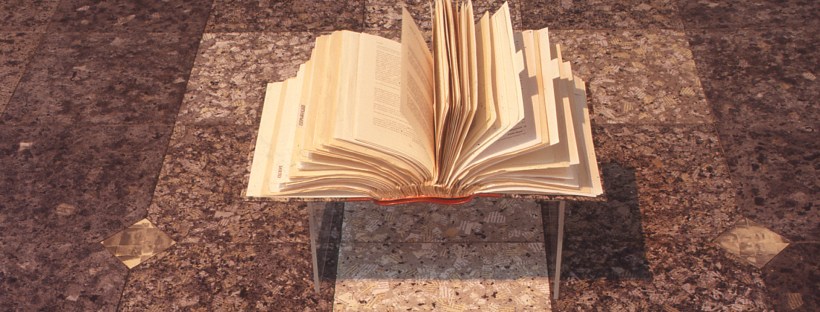
The image I have recently been ruminating on in relation to the process and shape of my PhD comes from Malaysian artist Wong Hoy Cheong’s work, Text Tiles. At first glance, it looks like a floor full of litter. But upon closer inspection, one finds texts shredded from books, burnt and made into tiles. The work invites viewers, or indeed readers, to tread upon these texts in order to truly read them.

The texts made into tiles are taken from various historical narratives that have been manipulated to support authoritarian governments, colonisers and their violence; texts that effectively polish and sanitise their wrongdoing. In remaking these texts, Wong not only suggests that accounts supporting falsehood should be challenged and those in power questioned; he also suggests how they might be challenged.
In other words, Text Tiles teaches us a craft of fragmentation that probes and pokes holes in “completed” texts. Indeed, it teaches us to “shred and tread” on them in order to read them properly.
This is not a fault-finding craft, nor one that seeks merely to disintegrate a particular reading of history and life. It is, instead, a craft that questions the power and privilege that come from texts completed in the upper echelons of the academic world.
Crucially, it is a craft that remakes texts and questions what really makes a text complete. In a sense, Wong’s fragmentation of texts into tiles aims to rewrite them and introduce readers to a fresh way of reading his account. Wong produces a completed piece of work, but one that is paradoxically fragmented into tiles. Tiles: perhaps that’s where texts become complete.
As I work towards the “completion” of my PhD, I return quite frequently to Wong’s artwork, for it seems to call into question my work, my expectations and, above all, my craft. Whenever I feel that my work is “original” and contributing to my scholarly circle, I might just be caught up in the illusion that my writing should find its way into positions of power and perhaps become authoritative.
But that’s where the problem lies. My text is only complete when it’s on tiles.
So, feeling like tearing your PhD? That might actually be a good place to start.
About the Author
Wilson Chak is a third-year PhD student in Systematic Theology at the University of Edinburgh. His research focuses on the notion of kenosis in the works of Rowan Williams and Sarah Coakley.
We are always seeking new guest bloggers! If you have an idea for a blog post or would like to informally discuss writing for the SGSAH blog please get in touch with Olivia via email at olivia.shaw-lovell@glasgow.ac.uk or connect with the blog on social media.

