

Guest Blogger Feature: In this special guest contribution to the SGSAH Blog, EK McAlpine explores how Taylor Swift fandom can offer an unexpected lens through which to understand medieval saintly cults and how popular culture can help researchers translate complex academic ideas for wider audiences.
In September 2025, I began my PhD at the University of Edinburgh with a project exploring the role of gender in venerating Scotland’s medieval saints. While most people today have some awareness of (or opinion about) gender history, the phenomenon of medieval saintly cults is less familiar. But saints were ubiquitous in pre-Reformation Christendom and their stories – melodramatic narratives where good crushes evil, the wicked are punished and the devout are gloriously carried to heaven – were popular culture for medieval audiences. They would have heard these stories in church (or, if they were wealthy enough, read them in manuscripts) and observed feast days assigned to various saints. They would have seen these saints depicted in art, like church wall paintings, carvings, or stained glass, donating money or bequeathing items to saintly altars in churches and cathedrals. Much of this was stamped out with the 16th-century Reformations, and have fallen by the wayside in Protestant countries.
How, then, to explain the quotidian popularity of these saints, and the meaning they had for their devotees? By comparing these saints to the pop culture icons of today. This works particularly well with the female virgin martyrs, who (as Katherine J. Lewis has discussed in ‘Model Girls? Virgin Martyrs and the Training of Young Women in Late Medieval England’) had a particularly exemplary appeal to teenage girls.
St Margaret of Antioch, the fourth-century virgin-martyr saint who is always depicted with the dragon she slayed? Okay Daenerys Targaryen. St Ursula, who normally holds an arrow in her portraits? It’s giving Katniss Everdeen. And the most popular saint of this genre was Katherine of Alexandria. Like most virgin-martyrs, Katherine was a beautiful young Christian woman martyred for refusing to worship pagan deities. Katherine’s persecutor, the emperor Maxentius, assembled fifty scholars to convince Katherine to abandon her faith – not only did the scholars fail, but some converted to Christianity themselves, including Maxentius’ wife. It’s a boilerplate virginmartyr story, complete with threats, bribery, torture, and the saint’s dazzling escort to heaven after her execution, but Katherine held immense popularity with young women. The most relevant modern figure sharing Katherine’s cultural dominance? Taylor Swift. Particularly during her 2023/2024 ‘Eras Tour’, a record breaking phenomenon revisiting almost two decades of Taylor’s musical career across multiple albums, or ‘eras’, with each having its own, self-contained set.

The veneration of saints is called a ‘cult’, and as I experimented with ways to incorporate celebrities into public history, I realised that medieval saintly cults and the Eras Tour go together like Taylor Swift and rhyming ‘car’ with ‘bar’. Let me explain.
A single reference to friendship bracelets in You’re On Your Own Kid had Swifties making bracelets with song titles or lyrics, bringing them to the Eras Tour to exchange. These resemble medieval pilgrimage badges – souvenirs available at shrine destinations, a marker of having been somewhere. Fans decorated shadow boxes to store and display these bracelets, as well as concert wrist-bands, and even scraps of confetti from the show’s closing number: like a reliquary holding items considered sacred. During the Eras Tour, dedicated TikTok accounts would summarise the night before; costume variation, what surprise acoustic songs were played each night, even if Taylor had sung one note slightly differently than usual – just like the custodians of saintly shrines would document the miracles that took place there in texts known as ‘hagiography’. And ‘Swiftipedia’, the Taylor Swift fandom wikipedia makes the Golden Legend look like an amateur pamphlet The point is, 21st-century audiences know how modern fandom-cults work, and I can exploit that to demystify medieval religion and encourage historical interest in its saints.
I kicked off this strategy with some BuzzFeed quizzes. “Choose Taylor Swift Songs and Discover Your Patron Saint!” I took Taylor’s 12 albums, assigned each a patron saint based on their theme, and depending on which album you favour in your answers, you’re assigned one of those saints. This introduces audiences to how saints are identified – St Joseph of Cupertino’s reported levitation makes him the patron saint of pilots, and so I assigned him the album 1989, which has a paper plane motif; Reputation’s snake imagery was paired with St Patrick, while the story-heavy folklore album was matched with writer and polymath Hildegard of Bingen. This quiz was based on preferences, but my next one, “Match These Saints To Their Taylor Swift Soundtrack!” used knowledge of Taylor’s lyrical canon to teach details about individual saints’ lives. It’s a translation exercise.
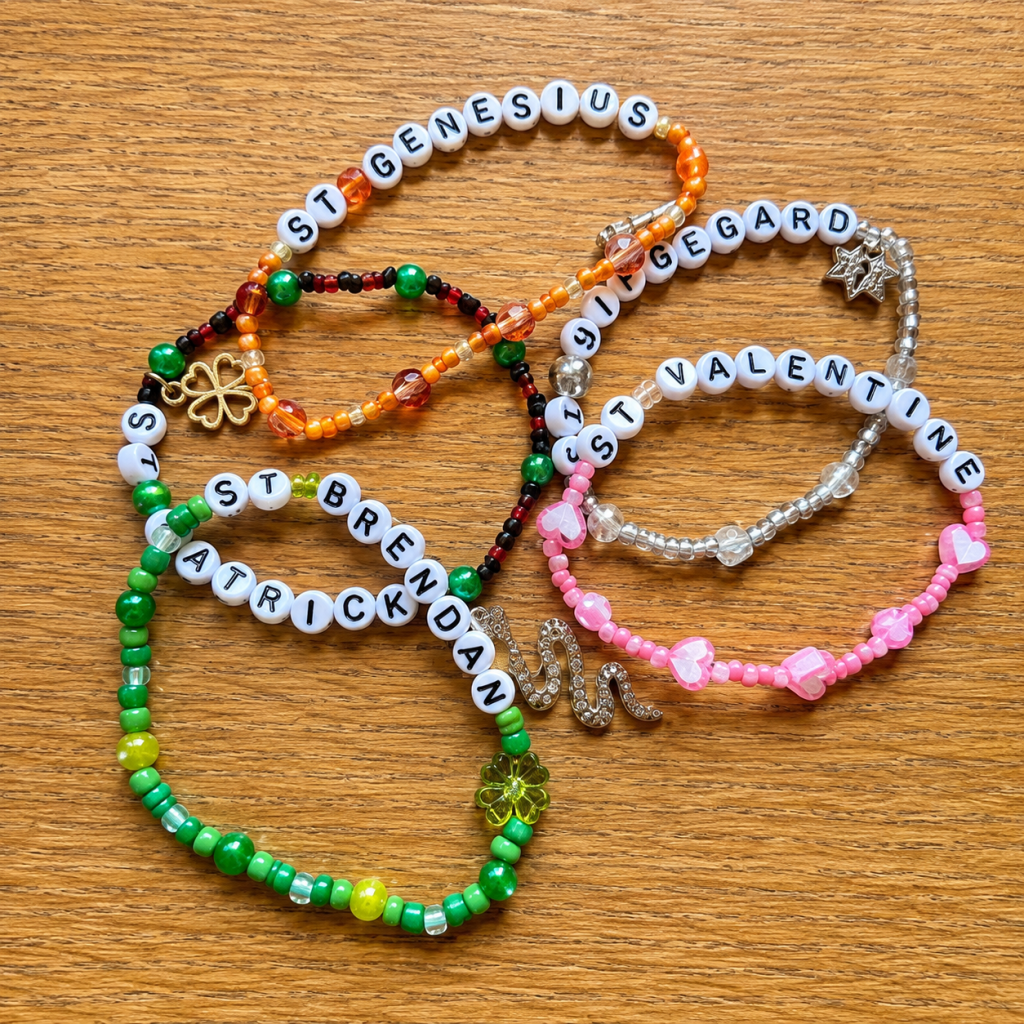
My favourite tactic involves the aforementioned friendship bracelets. Thanks to the Eras Tour’s neat delineation between eras, each had its own aesthetic – a colour scheme usually based on the album cover, and a motif or emblem representing the album’s themes or specific lyrics. This is comparable to the ‘attributes’ of saints, icons depicted in images of the saint, identifying them to a non-literate audience, usually derived from the saint’s life or martyrdom. St Sebastian is always depicted shot by arrows, St Apollonia wields a set of tongs holding her teeth, St Agatha carries her disembodied breasts around on a plate, while St Lucy’s plate has her eyeballs. Medieval saints are surprisingly (and triumphantly) gnarly. So I merged the concepts, making saintly friendship bracelets inspired by their attributes. St Peter gets two keys, of course, St Brendan the Navigator has a little anchor, and St Agnes has a lamb. I even made album-specific ones; St Valentine is Lover; the patron saint of performers; St Genesius of Rome, gets The Life of a Showgirl; and the mention of a dragon in Speak Now’s fan-favourite Long Live means that album could only ever belong to Margaret of Antioch.
My point, then, is that we can use unusual means to communicate our research, to translate it for public audiences. And if that means involves making friendship bracelets and listening to the same twelve albums for a month? Well, it’s just good pedagogical practice.
About the Author
EK McAlpine is a PhD student at the University of Edinburgh researching gender and the veneration of saints in medieval Scotland. EK’s instagram account ‘@ItsLikeHistory’ posts informal yet informative history content through the lens of popular culture to over 20,000 followers, and she is a co-founder of the Medieval Social Media Society. EK writes a monthly newsletter on Patreon at patreon.com/itslikehistory with historical commentary and reviews of visiting heritage sites as a wheelchair user, and publishes longer form content at itslikehistory.wordpress.com.
We are always seeking new guest bloggers! If you have an idea for a blog post or would like to informally discuss writing for the SGSAH blog please get in touch with Olivia via email at olivia.shaw-lovell@glasgow.ac.uk or connect with the blog on social media.


