

Written by: Tamara A. Rice
Each time I arrived at the Scottish section of my Interior Design History lecture schedule, the material felt thin. I would arrive at class, take the front of the room, and, through a few slides, introduce my class to key Scottish design eras, from the Renaissance and royal courts to Scottish Arts and Crafts and eventually to Glasgow Style (the Mackintosh Era). From earlier research, I knew Black people have existed in Scotland for centuries. However, I questioned whether there were Black Scottish designers or architects I might introduce to my students to expand my lecture material. As a Black Design Educator, I have always felt responsible for teaching beyond the textbook and introducing design stories missing from the traditional canon. Yet when I tried to find even an ounce of Blackness I knew existed, I fell short.
This gap prompted my initial research question: Does Black Scottish design exist?
As Jeanette R. Davidson notes in Black Lives in Scotland: Telling Our Stories,
“Black history in Scotland should not only look beyond solely focusing on slavery and colonial legacies; these histories must also go beyond city peripheries and to different places where Black people have lived and have contributed to the geographies of the area.”
(Davidson, 202, p.64).
Trying to find those lived contributions to Black space within Scottish geographies kept me up at night. I knew the archives would never lead me directly to “Black Scottish Design,” and that my research would need to be creative. I also knew I needed to clarify what I meant by “design” and on whose terms. So, the question became: How do marginalized or displaced Black communities in Scotland carve out agency, sanctuary, and identity within their spaces? Does that practice align with the taxonomy of design given to us? Also, how quickly could I travel to Scotland to address these questions?
I then started to reflect on more vernacular design styles, similar to the Arts and Crafts movement. A design style based entirely on local materiality, tradition, and necessity. Unlike the high style of classical design that we are taught in design school, what is the practice of creating and claiming space in a country that perhaps doesn’t always consider you spatially? Whether those spaces are domestic, public, religious, or cultural – I want to know them.

I landed in Scotland in early September, checked into Edinburgh College of Art’s School of Design, and flew into my research. One thing I was reminded to confront immediately was my own Blackness. I’ve always intended to check my ego at the door and be a guest in these communities, but I had to realize that those before me might have had other intentions. A widely admired community leader, who is actively advancing Black Histories and leading by example, mentioned that Black Americans often come and behave as if they’ve just unearthed Black Scottish History. It stopped me in my tracks for several reasons. I realized that I haven’t yet been accepted into the communities that I am looking to research. I also realized that outsiders often over-research communities, take data for their benefit, and leave nothing behind. Black people are not a monolith; our stories are unique, and regardless of me being a Black woman, I had to realize that I occupy an outsider status here. While my initial attempt to research, share, engage, and connect was innocent, it may have seemed premature. Now, my priority is to navigate my ‘Black, but not Scottish’ status, build trust, and respect the boundaries that safeguard Black spatial sanctuaries in Scotland.
Readers, if you find yourself in a similar position, I invite you to share my approach instead of hiding the friction or feeling discouraged, as I might have.
- Speak with your supervisors about possible seminars or workshops designed to train you to build an “ethic of care” when working with communities that are not your own. (SGSAH and SGSSS may have opportunities that speak to this)
- Spend time within the communities you are researching as a friend and supporter. Attend local cultural events, pop-ups, exhibitions, tours, etc. Let the community see you, get to know you, and observe your genuine investment in their culture first.
- Once you arrive at this stage in your research, you might consider giving the community/participants involved agency in how they are viewed. This removes the feeling of being viewed under a microscope and makes them a co-designer of your research.
As I enter year one of my PhD as a ‘Black, but not Scottish’ researcher still figuring out where the libraries are, navigating the boundaries of this living history has already become a profound lesson in humility. It has reminded me to show up as human before researcher, and to sit and listen with an open heart. To my fellow PGRs doing the work across Scotland, possibly staring at a blank Zotero library while grappling with your big questions, please know we do not need to be experts in everything quite yet.
Design is proof of presence, and I want my work here to show how Black communities in Scotland have used design in spaces that say: we are here, we have been here, and we belong. Here’s to listening, showing up, and figuring it out as we go!
How are you navigating the spaces and histories of your own research journey this term? Let me know in the comments below, or connect with me on socials! Instagram, LinkedIn
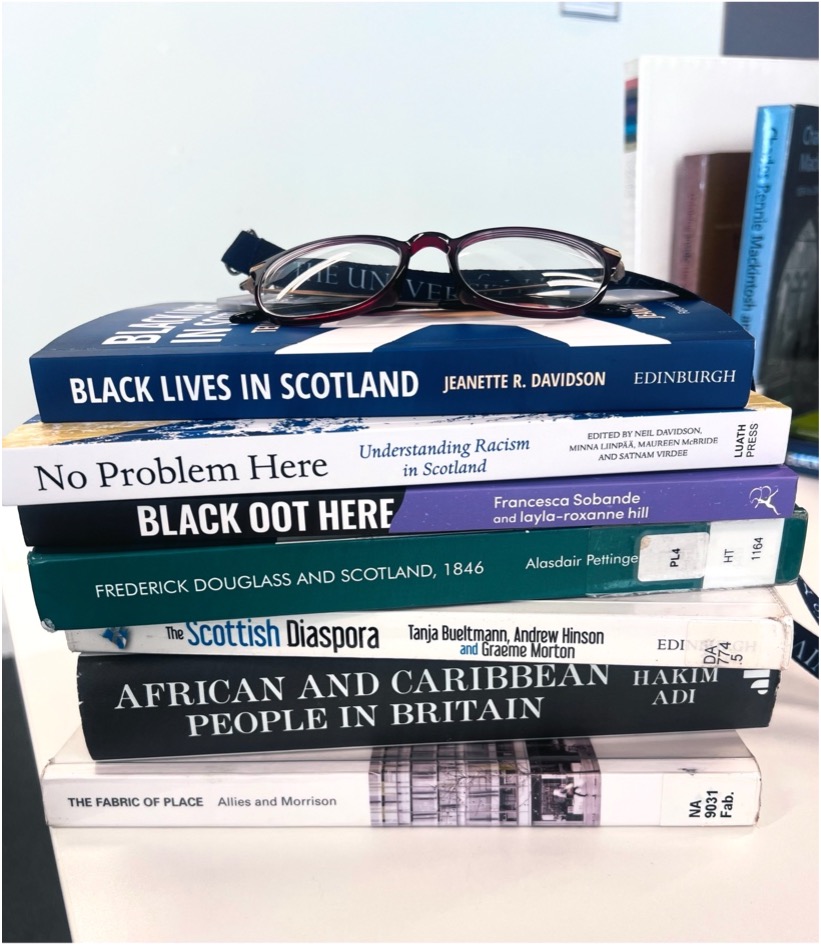
DIRECT QUOTE SOURCED BELOW:
Davidson, Jeanette R. Black Lives in Scotland: Telling Our Stories. Edinburgh University Press, n.d.
AUTHOR’S BIO
Tamara A. Rice is a first-year PhD researcher in the Arts and Humanities at Edinburgh College of Art, School of Design. Her doctoral research examines Black spaces through a design lens, exploring themes of identity, cultural heritage, and diaspora histories within the Scottish context. Navigating Scotland’s physical landscapes and rich archives, her work seeks to bridge gaps between living histories, spatial design, and academic institutions.
SOCIALS
Connect with me!
- Instagram: @PhDbyDesign – https://www.instagram.com/phdbydesign/
- Threads: https://www.threads.com/@phdbydesign
- LinkedIn: https://www.linkedin.com/in/tamaraannrice/
UoE Academic profile is not live yet, sorry!
We are always seeking new guest bloggers! If you have an idea for a blog post or would like to informally discuss writing for the SGSAH blog please get in touch with Olivia via email at olivia.shaw-lovell@glasgow.ac.uk or connect with the blog on social media.

