

How can you mark the moment of thesis submission? Celebrating with friends and family is the obvious choice, but what if you want to add a little whimsy and show just how nerdy you can get about your research? Dr Maike Dinger, this week’s guest blogger, offers one option: find a date that connects to your research topic.
Finding the right moment to finish a project is not always easy, especially for a project with the scope of a PhD thesis. When it comes to finishing the project and determining the submission date, there isn’t always much choice: the submission deadline may be set by the funding body or the university itself, leaving little wriggle room and options. Of course, there are also other reasons to fix on a submission date – and sticking to it (e.g., finances, jobs, caring responsibilities). Whether you are facing external pressures or not, it can sometimes be difficult to let go and click the button to submit – especially, if you have to overcome some form of academic perfectionism or the dreaded imposter syndrome.
How, then, can you set a submission date and stick to it? And how do you make it the “right” one? You might well want to be strategic about the submission date, considering the availability of the examining committee or a convenient date to enter the job market (if there is such a thing). Some of these considerations are out of our own hands, however, and importantly, they often leave us looking for meaning, particularly in times of digital submission platforms. Bygone are the times when a thesis needed to be printed and the completed work could be admired – or cursed – in its completeness before it was physically handed in for examination. Instead, the Covid-19 pandemic sealed the move to paperless dissertations, including PhD theses. The solitary upload to a university platform or a shared folder online lacks all the emotionality which is often connected to a substantial project such as the PhD (and the years, effort, and sweat it demands). This contradiction might leave us looking for meaning and a sense of closure. This was certainly the case for me.
After years of working on my PhD, the idea of having to register my thesis for submission and setting a date to do so seemed daunting and like an uncomfortably big step. At the same time, I knew I would need to submit prior to my final deadline to accommodate other responsibilities that had been piling up. But how could I decide when the work was done and overcome – if temporarily – my own perfectionism to settle on and stick to a date?
Having researched representations and discourses of popular participation in the 2014 Scottish independence referendum campaign, the possibility of a second referendum on Scottish independence had been looming over most parts – if not the entirety – of my research project. In fact, in 2021 a second referendum was announced for 2023, with the proposed date set for 19 October. Although I knew that my project would focus on the 2014 referendum – independent of subsequent political decisions – the announcement of a second referendum brought on the worry that this would change the memories of the first referendum and would, if nothing else, demand an extensive afterword to my thesis. Little did I know then that the date of the referendum “that never came to be” would be the ideal date for my thesis submission.
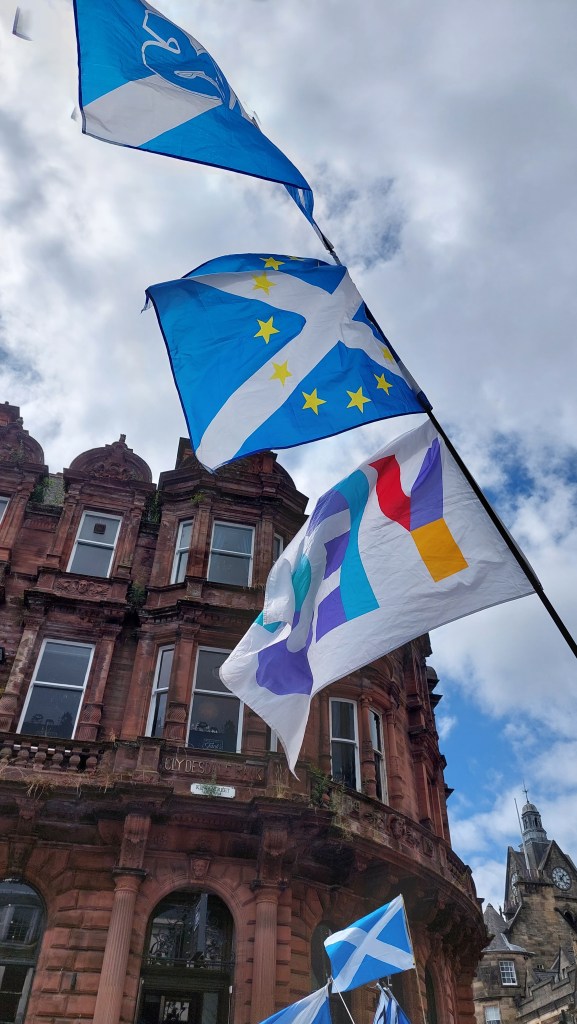
When I found myself looking for a submission date in 2023, I was also looking for a way to mark the occasion. Some of my PhD colleagues had organised parties or booked holidays to stick to a submission date and mark the moment, but neither seemed right to me. Taking into consideration other deadlines, the date earmarked for the second referendum suddenly popped into my head. While it had become clear that a second referendum was not going ahead on 19 October 2023 – after the court ruling in 2022 and the internal tensions that troubled the SNP leadership – it was a realistic submission date for my thesis. And even better: it would let me mark the occasion in a way that suited the topic and focus of the project and what it had come to mean to me. When I told a few friends (and political enthusiasts) at the time, they soon started joking that I would need to do what the SNP had not managed to achieve (that is, stick to a date and deliver on a referendum or related content). The pressure was on now, of course, but I finally felt like I had a specific goal to work towards. And yes, reader, I delivered!

Linking the submission of my thesis to a date that was relevant to my research topic helped me find closure and will remain a fun story to tell myself, if no one else. If you struggle with letting go or are wondering when to submit, why not give it a go and think about which dates would fit with your own thesis topic? It’s by no means the only way to think about the thesis submission, but it sure makes it more fun!
Photos by the author.

Dr Maike Dinger completed a SGSAH-funded PhD on representations and discourses of political participation in the 2014 Scottish independence referendum with the University of Stirling and the University of Strathclyde in early 2024. She is currently a Postdoctoral Research Assistant on the AHRC-/DFG-funded project “Voices from the Periphery: (De-)Constructing and Contesting Public Narratives about Post-Industrial Marginalization” with Bournemouth and Stirling University. Her research focuses on political representations in the media, political activism, national identity and digital democracy.
 SGSAH Blog