
This week, resident blogger Ebba writes about an often hidden struggle: the management of menstruation and PMS during the PhD. The reader is advised that the post deals with depression symptoms, pain, and blood.
When SGSAH hosted Professor Kate Sang for an EDI Lunchtime Lecture titled ‘Blood work: the labour of managing menstruation in academia’ on 29 May 2024, I was glad to see this discussion being had in an academic context. My cycle has a significant impact on my life, and to see this reality reflected in discussions of academic work is meaningful. While I can’t speak to severe issues like heavy periods or Premenstrual Dysphoric Disorder (click the link and scroll down to read about PMDD as a subheading to PMS), I want to share some of the issues that can arise connected to periods and how I perceive of these in connection to doing a PhD.
I associate PMS with excessive anxiety that sometimes makes ‘normal’ albeit challenging aspects of the PhD, like submitting writing, attending meetings, reading feedback, or speaking at conferences, feel impossible. In addition to a temporary weakening of my immune system, depression-like symptoms like self-doubt, sadness, and feelings of meaninglessness often spike during this time (which, for clarity, is likely to be the week before the period, though ovulation can create similar issues). Uncertainty as to how others would react if I were to bring these issues up often prevents me from doing so. Though mood swings, anxiety and menstruation are not the taboo subjects they once were, matters relating to the body can feel at the same time absolutely essential and too personal to address; academia is at once so liberal and so tiresomely traditional, and the fact that being a researcher is not just about the brain but also about the body is often not addressed. It’s frustrating to know exactly why your face is grey and your heart’s racing over minor tasks without letting other people know the reason. If I’d had a twisted ankle or a cold, addressing this would feel more natural than explaining that I’m experiencing PMS symptoms, despite the fact that the former conditions would impact my well-being less.
I’ve thought a great deal about how to frame my experience. Is it one of resilience, soldiering on month after month, finding new ways to care for myself and communicating my needs? Or is it a story of vulnerability that I don’t always know how to situate within my current work environment? I suppose these two options overlap. Most importantly, after years of getting to know my adult self, realising that intense times of self-criticism can be (though isn’t always) connected to my cycle has helped me manage it. While providing advice to others is not the primary purpose of this post, I’ve learnt that unless your symptoms are so impactful that you should speak to your GP, a helpful thing to do is keep a close eye on your cycle. If you know roughly around what time your period will arrive, you can anticipate mood swings and plan for self care. I try to remember that I’ve had this experience before and no matter how down I feel, it always passes. Rather than writing notes to myself with reminders of this, I keep a small pearl in front of me on my desk which I associate with my own sense of self. When things are rough, I look at the pearl and think about all the parts of me that I don’t connect with depression, anxiety, and self-doubt. I remind myself that the story about me is larger than the feelings I have on a daily basis, and tying specific memories to concrete and permanent objects has been a way for me to challenge impermanent and self-sabotaging ideas and emotions.
This is far from the only story to tell about menstruation, PMS, and reproductive health. Pain management associated with menstrual cramps, heavy periods, PMDD, as well as issues relating to pregnancy, post-natal depression, and menopause, are examples of other experiences that can impact the PhD experience. If you have a story to share, whether it’s one rooted in utter frustration or one centred around practical advice, this blog is a great space to write it for.
I’ll finish on a somewhat different note. In Egalia’s Daughters: A Satire of the Sexes (1977), Gerd Brantenberg subverts depictions of moods during menstruation and describes menstruating characters’ actions as fuelled by a powerful sense of purpose and assertiveness. This is part of a somewhat outdated experiment of seeing what would happen if ‘women were treated as men and men treated as women’, an experiment that didn’t challenge binary gender-thinking but highlighted how ‘biological’ discourses around gender could easily be swapped to portray men as biologically weak and women as strong. Still, ever since I read the book aged 16, I’ve wondered what the potential is of this optimistic 1970s view on menstruation. Is there a way to view the frustration that can accompany PMS as a force with the potential to bring about change and political initiative? Most things felt during PMS are heightened versions of valid emotions, and perhaps this is the right time to forcefully challenge issues around us. Or does Brantenberg’s writing belong to an altogether different political and cultural moment that failed, among other things, to distinguish between weakness and vulnerability and thus believed that the only way for marginalised groups to become visible in political life was to adhere to ideals of strength, assertiveness, and dominance?
These are genuine questions. I hope that future writers on this blog will carry on the discussion of menstruation in academia, in response to or independently of my thoughts and questions. I will be a keen reader for sure.
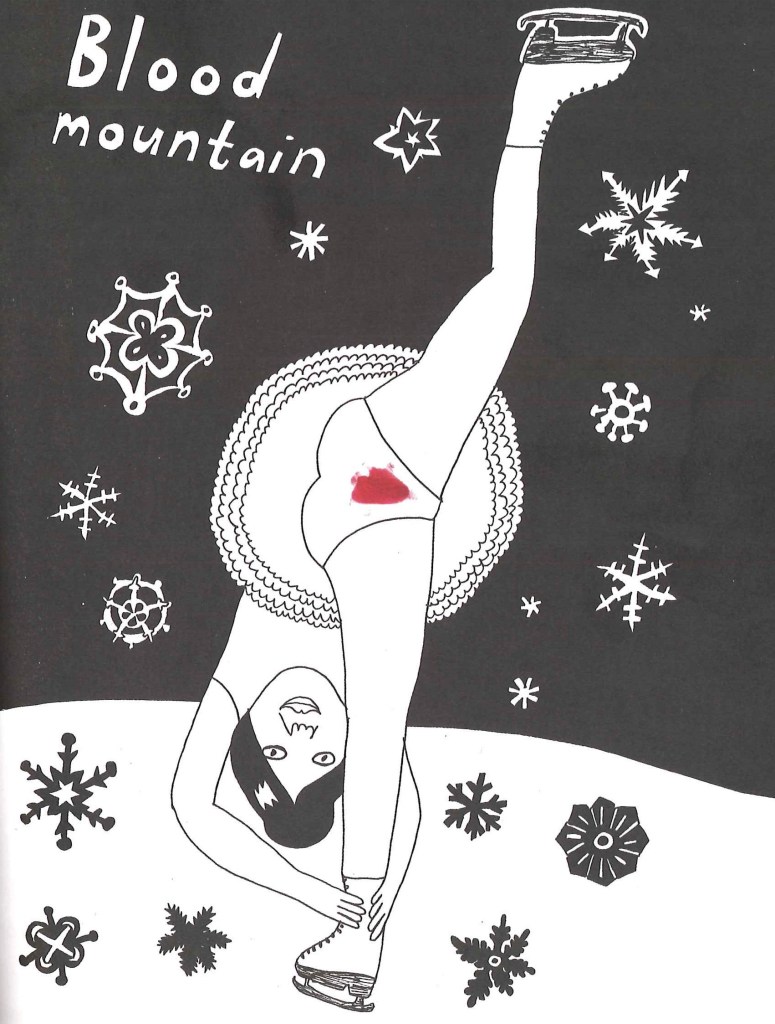
- Liv Strömquist’s Kunskapens Frukt (Stockholm: Ordfront Förlag, 2014) was published in English as Fruit of Knowledge: The Vulva vs. The Patriarchy trans. Melissa Bowers (London: Virago, 2018). ↩︎

