

Resident blogger Ebba Strutzenbladh reflects on two sides of the same coin: teaching and being taught. She writes about the authority and meaning of the teaching figure in the classroom, the educator’s perceived power to exercise control over students’ written and spoken voice, and of the potential in developments surrounding AI engines to transform the role of education.
I’ve always loved teachers, and throughout my years at school, many of my teachers liked me too. What I often forget, however, is that I also used to be terrified of them.
In hindsight, what scared me was probably my teachers’ ability to demand changes to my personality in exchange for high marks. Along with other girls at my middle school, I was told that I should not let the boys ‘take up all the space’ in the classroom, that I needed to assert myself and demonstrate ‘leadership skills’. There was a sentiment, in those days, that young girls wouldn’t be able to occupy positions of power in the workplace when they grew up, and the only way our teachers could think to change the future was to ask shy girls to change their personalities. Without being more vocal, I was told, I wouldn’t achieve the highest mark, and so I did my best to become the kind of student that evaded such criticism.
Throughout my years at school, because I was smart and liked to learn, teachers often took my written and oral performance very seriously. If I didn’t speak with authority in the classroom, wrote paragraphs with neat topic sentences and connecting words like ‘however’, and ‘nevertheless’, and kept within the set word count, the word disappointing appeared on my evaluation forms. I was constantly nervous, always striving for perfection to avoid my teachers’ disappointment, though I was never quite sure what perfection would look like and what it was good for. It’s taken me many years to recognise that there was nothing wrong with the person I was as a child: someone who loved to learn but preferred a little extra time to process new ideas; someone who was naturally shy; someone who asked questions more often than she made assertive claims. I’ve learnt to distinguish the emotions of those who teach me from my own intellectual performance. My learning process belongs only to me.
I was taught in school that there’s no room for shyness, silence, or inconsistency of performance in the classroom. Texts must be neat, coherent, and immediately legible. In a way, I was taught to write and speak the way that AI engines, when used ‘successfully’, communicate: with unmistakable clarity of expression and self-confidence, each argument put forward logically and systematically. I wonder what the place will be of human writers now that AI has laid claim to the seemingly perfect and necessarily non-subversive layers of language and communication that I spent twelve years of my life honing.
‘Let’s imagine a shy poet – after all, this is not altogether unusual. Should the poet aim to shed his shyness? Or can it be useful? Perhaps an ostensibly bad card, like Two of Spades, can turn out to be good. The game we’re playing might be Lowball Poker.’1
I wonder about the current undergraduates too. Do they, like I did, come into their degree with a preconceived notion of what kind of jurisdiction belongs to educators? I remember from my first degree that even HEIs, while not taking on the same level of responsibility as schools, are not above trying to coax specific behaviours out of students. When I was an undergraduate, some courses required you to speak at least once every seminar in order to get a passing grade. While university is a great space to find your own voice, meet friends, and gain an understanding of what healthy debate and discussion look like – something that certain students perhaps need a push to discover for themselves – I wonder about this method. If students must be forced to speak, what are they being taught other than that the classroom demands complete conformity? That producing speech for the sake of saying something is desirable? And does some students’ reluctance to speak have to do with the perceived authority of the teaching figure to assess and grade their speech, their personal voice, and ultimately parts of their personality?
If so, there’s no wonder students would want to use AI to write essays. On the surface, AI engines have perfected the type of language that many believe constitute the ‘authoritative academic voice’. New academic writers, like undergraduate students, are unlikely to feel that they can compete with ChatGTP in terms of surface-level perfection.

Can we, as humans, compete with AI in terms of producing text? Perhaps in our complexity. A human being has the capacity to express a unique form of ambiguity. In fact, human writers are interesting because of the gaps in meaning, the misunderstandings, and the ambiguities that we produce. We’re naturally flawed, complete with subconscious inner worlds that cause us to make errors we don’t fully understand. We produce sentences in which we ramble on mindlessly without getting to the point, if there even is a point, and perhaps there’s joy in that. There’s certainly personality in it. Perhaps flawed communication, even speling mistakes, can find a new place in the world, an interesting and unpredictable subgenre of writing once AI software is co-writing and proofreading our mainstream texts.

Thinking back on that intense fear of teachers I had as a young person, and having myself taught (and delighted in) undergraduate students, I’m interested in ways to prevent teaching figures from being associated with the harsh form of discipline that has students crying in the library the night before an essay is due. If computers are to be in charge of the disciplined whipping-to-perfection of communication, surely we can be in charge of something else?
gaga di bling blong2
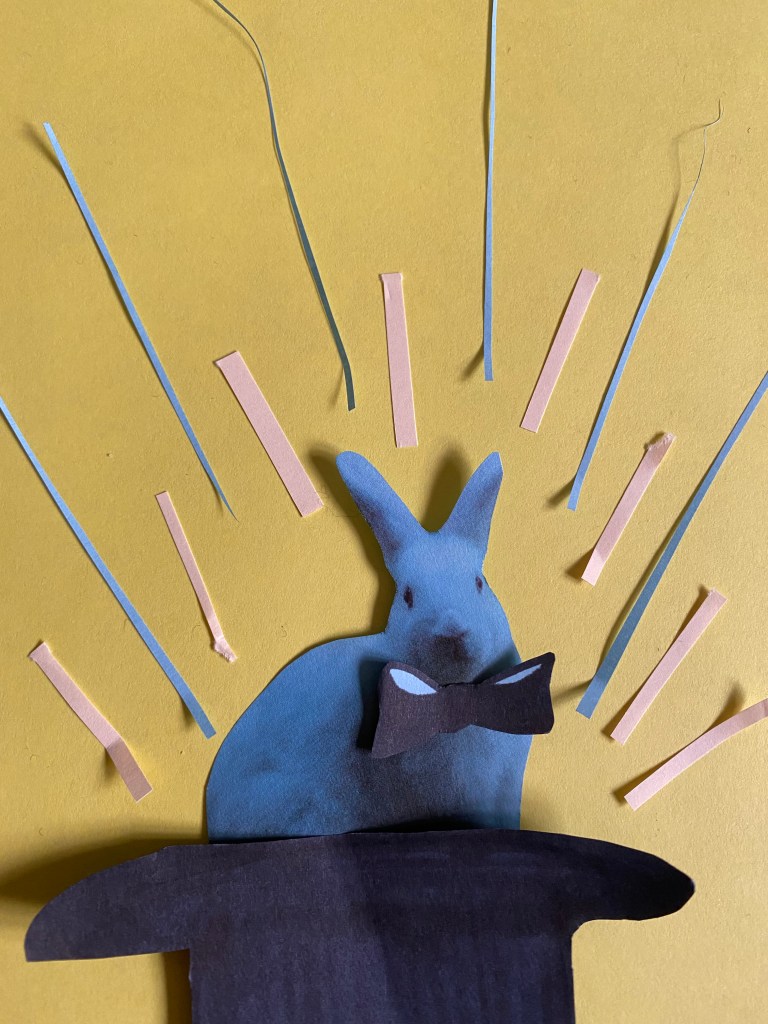
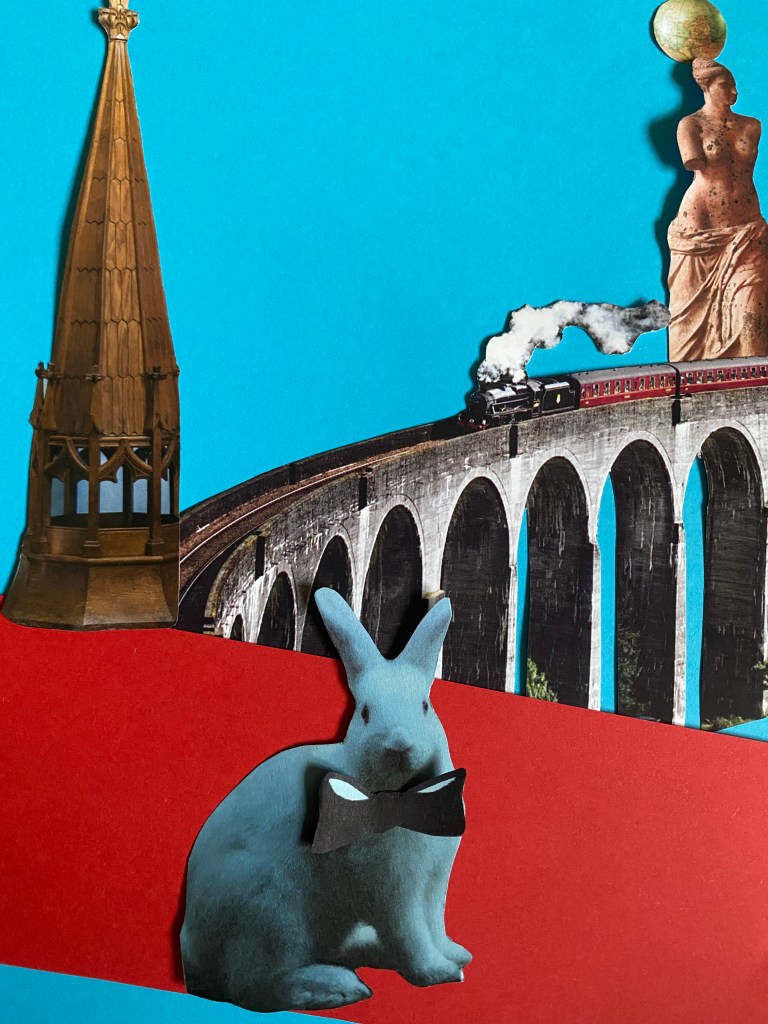
Images from The Celebrity Bunny, a book I made for my niece about a rabbit who dutifully works for a magician until one day she’s so tired of being pulled out of the hat, she escapes and finally gets a good nights’ sleep.
- Ulf Karl Olov Nilsson, Röstautograferna [The Voice Autographs, trans. my own] (Stockholm: Norstedts, 2019), 22. ↩︎
- Hugo Ball, ‘Gadji beri bimba’, allpoetry.com [accessed 30 September 2024]. ↩︎
 SGSAH Blog