
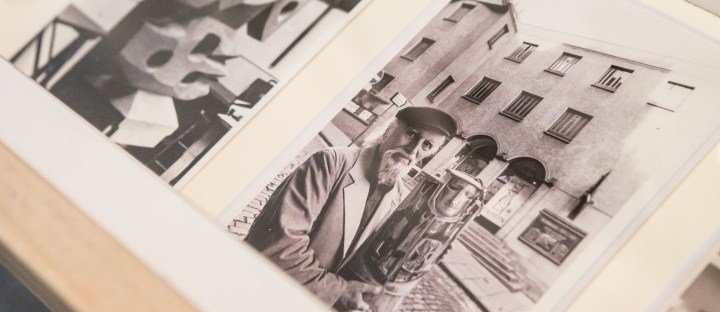
Resident blogger Jelena Sofronijevic shares a second extract from their research article about the artist Zeljko Kujundzic (1920-2003), ahead of their presentation at Unbordering Futures: Migration Studies in Urgent Times, a PhD conference at the University of Edinburgh, in March 2026.
…During this time in British Columbia Kujundzic developed complex public sculpture, often featuring the thunderbird; a mythological bird-like spirit widespread in indigenous and First Nation cultures, which is deeply rooted in his own migrations and movements across borders and seas.
But despite moving away from Scotland, Kujundzic maintained his connection with the country from afar, and its influence endured in his practice. Letters to the Kujundzic family in British Columbia in the 1970s, were recently displayed in the exhibition SEEDLINGS: Diasporic Imaginaries with Travelling Gallery (2025). They illustrate how the artist remained active and engaged with Scotland’s cultural communities. From the scrawl, we can explicate the outcomes of unrealised projects, if not assume conversations about seafaring, classical mythology, and contemporary practices.
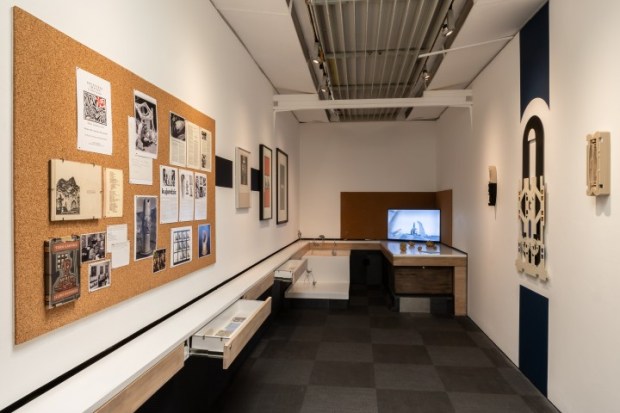
Kujundzic’s time on the western isles of Scotland reveals itself particularly important. He is widely considered to have developed one of the world’s first experimental solar kilns, experimenting with solar heat following close study of sun-baked bricks produced by Anasazi Indians near Montezuma’s Castle in Arizona between the 7th and 13th centuries. This interest in ceramics as a medium can certainly be traced in Edinburgh and his relation to artists including Bernard Leach and Joan Faithfull, who established a pottery on the Isle of Mull.
The shores of Mull appear again in an experimental film recently salvaged from the depths of the family archives, ‘Quest under Sea’ (c1950s). This eight-minute film follows the artist and his family across land, along beaches, and into the waters of the western coast. There is no clear narrative, blurring the boundaries between experimental film, documentary, and holiday footage – as well as concrete poetry, with the artist’s hand-drawn intertitles or interventions. It reveals Kujundzic’s deep relation to water and natural environments, as prominent in the passages of Torn Canvas recounting his natural ability for swimming and fishing, and wonder and affinity for the Dalmatian coast. Likewise, archive editions of The Scotsman – to which Kujundzic was a regular contributor – provide further details about the artist’s wider ecologically and environmentally-engaged practice, such as his efforts to cultivate seaweed.
Kujundzic’s paintings currently held in private collections and family homes across the UK reinforce an apparent interest in geology, evident in the scenes of showing the extraction of granite from Tormore and stone quarrying depicted at the opening of the film. Negated by the black-and-white footage of ‘Quest Under the Sea’ are the deep red colours of the rocks, present in Faithfull’s pots comprised of local clay, and her comprehensive text, The Ross of Mull Granite Quarries (1995), which relates the ecological and economic decline of the island.
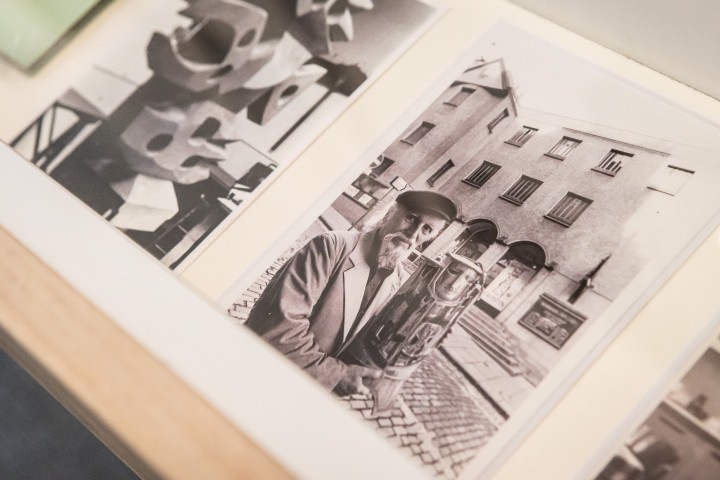
‘Quest Under the Sea’ also prompts consideration of what more conventional verbal and written histories miss from an individual’s lived experience. Can we ever enter Kujundzic’s currents and circles, by remaining firmly on land? Was there something of the western shores of Scotland and Canada – and their relative safety – that enabled his warm recollections of the western shores of Yugoslavia, if not the dirtied, industrial rivers of the Danube and the Tisa?
Kujundzic need not be ‘excavated’ as such; in Canada he is well-known, exhibited and remembered. Yet his foundational role in Edinburgh’s growing artistic community on the precipice of the Festivals, and formative early work with artists and writers, has been overlooked in more conventional histories of Scottish art. His contributions remain hidden in plain sight, publicly visible only to the faithful of St Mahew’s in Cardross and Edinburgh Jesuit Church, and in libraries, to those who read beneath the by-lines of the poets Hugh MacDiarmid and Joseph Chiari, as with Hamilton Finlay and Wells.
Beneath the Salisbury Crags, John Knox House, the oldest original medieval building surviving on the Royal Mile, carries one reminder of the artist’s many identities. Six medals of Scottish kings and queens, commissioned and cast in metal in the 1990s, speak not only of the artist’s many heritages – Scottish history crafted from metalwork of his family trade – but also Kujundzic’s early exhibitions in the adjoining building, once known as the Netherbow Arts Centre, and at present, the Scottish Storytelling Centre. Photographs from these early exhibitions – and reproduced posters, of later exhibitions including Ancestral Images: Batiks, Ceramics, Prints (c.1998-2000) – are also rare documents of the exhibition space in the basement, which otherwise has not been preserved. Deeper knowledge and understanding of individuals can often reveal more about the cultural ecologies and infrastructures within which they worked; vice versa, acquiescing the fall of one artist into posthumous obscurity risks the loss of cultural histories more widely.
The palimpsestic nature of this single building on the Mile – much like the many institutions, and nation-states, of Kujundzic’s life – is a poetic reminder of the artist’s complex practice. His patriotic public commission is a prompt to reconsider his own works in print, which deserve to be removed from the shelves.
Read the first extract on the SGSAH Blog, and the full article in Scottish Art News, published by the Fleming Collection.
Hear more at Unbordering Futures: Migration Studies in Urgent Times, a PhD conference hosted by Glasgow Refugee, Asylum and Migration Network (GRAMNet, University of Glasgow) and Citizenship and Migration Research Network (CMRN, University of Edinburgh), at the University of Edinburgh on 4-5 March 2026. The programme is led by Dr Katherine Keenan, St Andrews University and Mr Dean Smith, PhD student, from SGSAH’s sibling organisation, the Scottish Graduate School of Social Science (SGSSS).
This research article was written during an Interdisciplinary Residency at Hospitalfield in Arbroath in November 2025. Visit the website to learn more about other opportunities, including the Graduate Residency, and SGSAH Researcher-in-Residence programmes, and read from previous SGSAH-organised writing retreats.
Jelena Sofronijevic (@empirelinespodcast) is a producer, curator, writer, and researcher, working at the intersections of cultural history, politics, and the arts. Their independent curatorial projects include exhibitions like Invasion Ecology (2024), SEEDLINGS: Diasporic Imaginaries (2025), and Can We Stop Killing Each Other? at the Sainsbury Centre (2025), and they produce EMPIRE LINES, a podcast which uncovers the unexpected flows of empires through art. Jelena is pursuing a practice-based PhD with Gray’s School of Art, curating exhibitions of Balkan and Yugoslavian/diasporic artists in British art collections.
 SGSAH Blog