

This week, guest blogger Lucy Jackson shares her PhD story, delving into her research on accents and media bias. Lucy’s research examines how the Glaswegian accent and the people who speak with one are represented in the media. She looks at stereotypes, how the media influences our biases, and how eye-tracking techniques can reveal what we really think.
What’s in an Accent?
From fashion choices to hairstyles, we constantly project our identity to the world. Even our coffee orders and music tastes serve as signals that help others form judgments about us. Another critical marker of our social identity is our accent. The way someone speaks can reveal their origins, whether their speech is in their first language, and even suggest aspects of their social class, education, and personality.
These perceptions can lead to discriminatory judgments known as accent bias. While the UK protects characteristics like age, gender, and ethnicity from discrimination, accents are not covered. Accent bias isn’t as visible as other forms of discrimination, but that doesn’t mean that it poses no real-life issues. Research has found in the UK that working-class speakers of urban accents are more likely to be judged as less intelligent and competent, which could harm their job prospects. These judgements have been found to influence criminal convictions, where non-standard accent speakers have a greater likelihood of being accused of crimes and receiving harsher punishments.
Language attitudes and speaker evaluations develop in many ways. How do these attitudes and stereotypes form, and where do they originate? This is a lively topic in linguistics. One significant yet underexplored influence is the media.

A Spoonful of Media Helps the Bias Go Down
In our digitised world, media is all around us. From endless phone scrolling to the TV shows we watch, the music we blast in our ears and even what we read on a page. Studies have shown media to shape our social perception and influence attitudes towards race, body image, and sexual aggression. Linguists have found media to impact language production, like when you adopt your favourite phrases from “Love Island”, or when Glaswegians start to produce speech traits we find in London because of their consumption of “Eastenders”.
However, the effect of media on language attitudes and how we judge speakers remains underexplored. Previous research has identified accent stereotypes in Disney films, children’s TV, and prime-time shows. But I’m bringing this research area from across the pond and looking at the Glaswegian accent. How is it represented in film compared to other UK accents? What stereotypes does the Glaswegian accent bring?
My research focuses on the heavily stigmatised Glaswegian Vernacular (GV) accent, spoken by Glasgow’s working-class population. Negative stereotypes paint Glaswegians as violent, aggressive, anti-social, and of lower status and intelligence. To see whether the media also circulates these social connotations of Glaswegian, I will be analysing characters across 12 films. In this, the Glaswegian Vernacular (GV) will be compared to 8 other accents that vary across region and class.
The Meaty Data Stuff
Time to crunch some numbers. Together with a coding team, I conducted a content analysis of 233 characters from 12 films, looking at 25 attributes. Attributes included things like age and gender, as well as traits such as aggression and intelligence which we ranked with Likert scales, where 1 is the least and 5 is the most. This generated ordered data (or ordinal data), which is a great way to look at representations and portrayals.
To make sure that the results were as robust as possible, multiple raters coded the data, aiming for high intercoder reliability. Our study hit an intercoder reliability of 86.7%, well above the 80% benchmark which indicates a reliable coding framework!
To analyse any patterns between character portrayals (attribute ratings) across accent groups, I conducted Kruskal-Wallis tests, Post-Hoc Dunn tests (with Bonferroni adjustments) and probabilistic ordinal logistic regression. This table shows the results of the post-hoc Dunn tests:
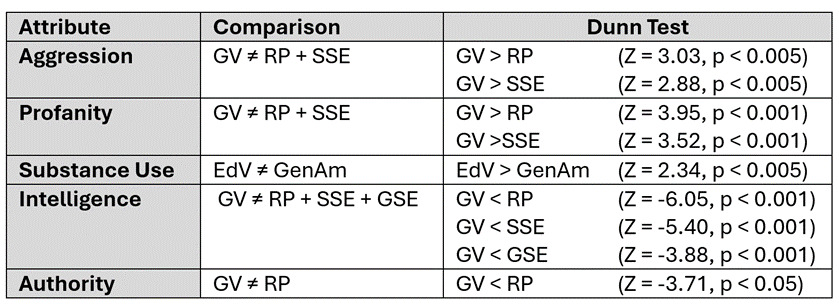
For those of you who want to interpret the table yourself, the ≠ shows when GV is significantly different to any accents in the data for that given attribute. The positive z-score and greater than (>) symbol demonstrates when GV has higher ratings of that attribute. For example, GV shows higher levels of aggression than RP, with a positive z-score (3.03, p<-.005).
And for anyone who doesn’t enjoy crunching some meaty data, it shows that there are significant differences in how characters are portrayed based on their accent, particularly in aggression, profanity use, substance use, intelligence, and authority.
Glaswegian Vernacular (GV) characters were portrayed with higher levels of aggression and profanity compared to Received Pronunciation (RP) and Standard Scottish English (SSE). GV characters also showed significantly lower intelligence and authority levels compared to the standard accents, including the middle-class variety spoken in Glasgow (GSE). Edinburgh Vernacular (EdV) characters had high levels of substance use, influenced by the film “Trainspotting” and its plot surrounding a group of friends engaged in heavy drug use.
With all this data, I was able to predict the probability of a character’s particular attribute based on their accent. Not only is this a useful tool for designing my eye-tracking experiment, it’s a great excuse to go all-in with the pretty colours. Take a look at the predictions on profanity use for an imaginary male adult character, where 5 (in red) indicates an extremely high level of profanity use and 1 (in purple) indicates a low level:
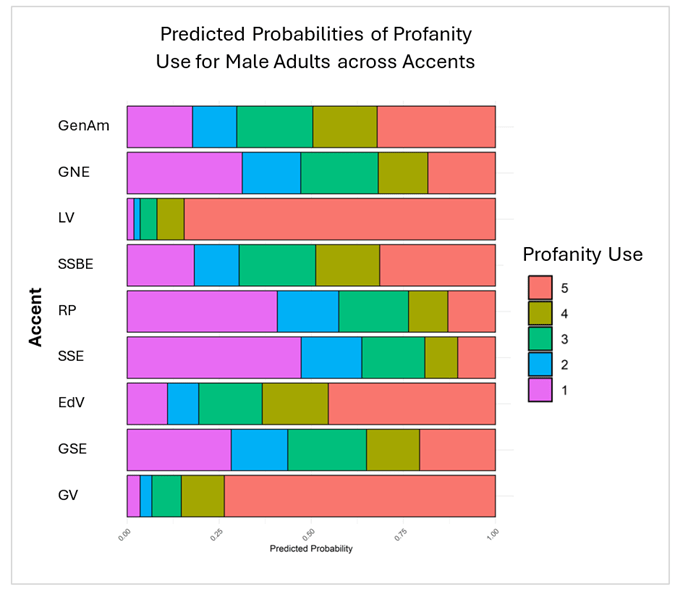
The GV accent on the bottom of the graph is very red, indicating that, based on the data, adult male characters with a GV accent are much more likely to show extreme profanity use. In comparison, if this imaginary character was rocking an RP or SSE accent, they would be much less likely to be effing and jeffing.
Summin’ Up the Stats
My research, which happens to be the first empirical investigation into GV accent portrayal, aims to uncover patterns in character portrayal. From my data, Glaswegian Vernacular characters were found to be stereotypically portrayed as having higher levels of aggression and profanity use, and lower levels of intelligence and authority.
The patterns in these portrayals support existing research on the downgrading of working-class, vernacular speakers in terms of status and competence. And it provides empirical data that accounts for the negative stereotypes assumed about Glaswegians as being extremely violent and anti-social.
Burn Your Televisions
We can see from the findings that accent-based stereotypes are floating around in the media, but what does this mean? Should we set our televisions on fire?
(As a pioneer in media studies once said… rough day at the office).
Accents are a salient tool in creating fictional worlds, and we might even argue that accent-based stereotypes are part in parcel of the nature of depicting society. Because there is so much social meaning in language, we can quickly develop a character with rich layers just based on their accent and speech, and all the social associations that come with that (I talk about this more my previous research on Yorkshire accents in Game of Thrones, read that here).
Regardless of where we stand on accents, the media relies on the social information imbued in accents as a creative tool. But does this reliance further reinforce societal biases? That’s what I will be looking at next in my PhD, by using eye-tracking techniques to investigate the influence of media exposure on our unconscious and conscious biases. Stay tuned!

Lucy Jackson is a 2nd year PhD researcher in Sociolinguistics at the University of Glasgow. Her research explores phonetics, accent bias, media influence and eye-tracking techniques as a measure of implicit cognition and biases. Find more about her research on her website (https://lucy-jackson.github.io/).
 SGSAH Blog