
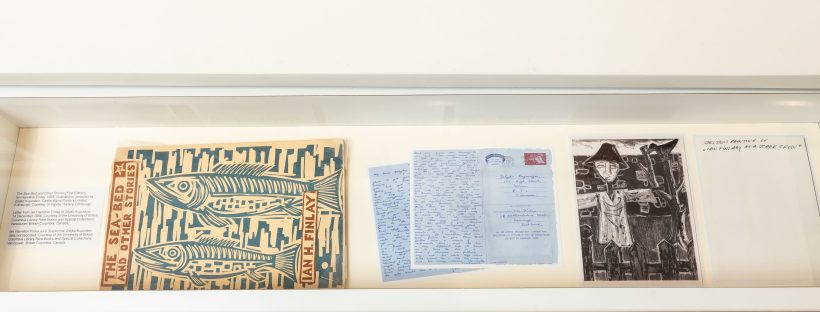
Resident blogger Jelena Sofronijevic shares an extract from their research article about the artist Zeljko Kujundzic (1920-2003), written during an Interdisciplinary Residency at Hospitalfield in Arbroath, and published in Scottish Art News.
The Golden Eagle, Nannie Katharin Wells’ 1960 anthology of poetry to Scottish nationalism, is more closely associated with the colour red than gold. Not in its socialist persuasion, but because of the distinctive woodcut print of Arthur’s Seat and Salisbury Crags on its cover, designed by the artist Zeljko Kujundzic (1920-2003). Its colour palette of orange-red, cut with electric blue, was typical of Kujundzic who, between 1948 and 1958, found place and community in the city of Edinburgh below.
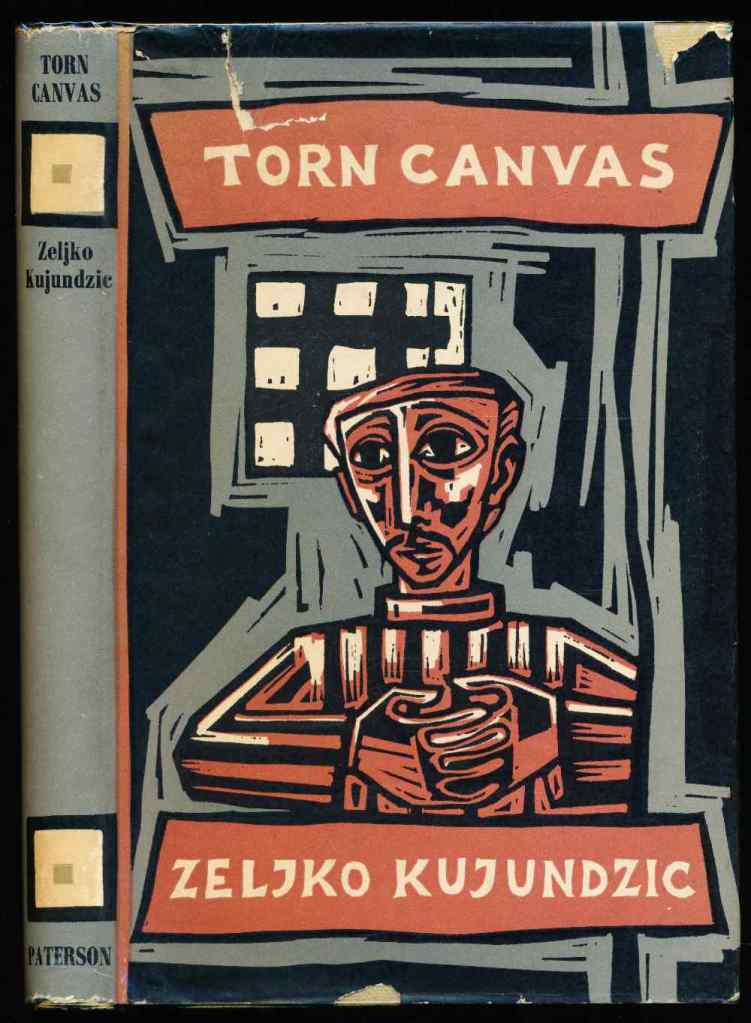
Kujundzic was a multidisciplinary artist and fifth-generation craftsman of Turkish descent. He was born in Subotica, then part of the Kingdom of Serbs, Croats and Slovenes, soon-to-be-renamed Yugoslavia and now present-day Serbia. The artist’s autobiography Torn Canvas published by Richard Paterson Ltd in 1957, traces his many migrations in pursuit of education in Dalmatia (now Croatia), then Venice between 1939-40 and onto the Royal College of Art in Budapest between 1941-44.
Kujundzic’s proclaimed Yugoslav identity and language persisted throughout his life, along with his Turkish family name and cultural heritage. A man referred to in his autobiography as ‘Uncle Jeno’, a goldsmith or kujundžija, practiced the family trade which first began ‘in the service of the Sultans’. This legacy endures through generations: Kujundzic’s eldest child, Kate Enewold (Kathleen Kujundzic), continues to work in metal, particularly silver, today.
The distinctive, orange-red shade of Kujundzic’s woodcut on Well’s anthology can be traced throughout the artist’s prints and works on paper. Paprika was particularly popular in the Ottoman Empire which, for much of the 16th and 17th centuries, spanned the countries of Central Europe. The red peppers from which it is made were first referenced in print in Hungary in 1604 by the name Török-bors (Turkish pepper), and were quickly cultivated in the Balkans, and South West Asia and North Africa (SWANA), once transported to Europe from South America by Spanish and Portuguese colonialists.
We also see this distinctive ‘paprika’ shade in the textiles of Senta-born Bernat Klein (1922-2014). However, despite the connections between the artists – both were born in the region of Vojvodina, where both Serbian and Hungarian remain official languages, and were active in Edinburgh after the Second World War – there is nothing to suggest they ever crossed paths in Scotland.
Klein, in pursuit of assimilation, distanced himself from the region and its diasporas, whereas Kujundzic actively supported displaced artists from Yugoslavia and Hungary through exhibitions, commissions, and cultural connections from Glasgow to London. Food, however, often arises in the memories and memorials of both artists. In Shelley Klein’s The See-Through House: My Father in Full Colour (2020), a biographical account of Klein’s life, the author emphasises Klein’s relationship with food. Paprikás – a potent dish enjoyed across Central Europe – is still prepared today by members of the Lorimer family, who lived with the Kujundzics in Edinburgh in the early 1950s. Robert (R. L. C.) Lorimer (1918-1996), a distinguished publisher, shared a passion for literature not only with Kujundzic, but with a successive lodger of the family, Ian Hamilton Finlay – whose first texts were exclusively illustrated by Kujundzic. The same ‘intense’ blues and reds, and ‘clean’ dove greys, as described by the artist in Torn Canvas about his first toy boat, recur in these works on paper, such as The Sea Bed and Other Stories (1958).
Before establishing more permanent lodgings in Sciennes Gardens, the Kujundzic family had lived on a sailboat in the harbour at Musselburgh. Kujundzic’s partner and frequent collaborator Ann Kujundzic sewed their eldest child a colourful sleeping bag, and she nestled in a cubby hole under the bow.
The friendship between Robert Lorimer and Hamilton Finlay later broke down, and Kujundzic left Scotland for British Columbia. Here, Kujundzic and Ann helped establish the Nelson School of Fine Arts, now known as the Kootenay School of Art. This radical education programme was a departure from his previous pedagogical experience as a Visiting Lecturer for the Arts Council of Great Britain at the Edinburgh College of Art…
Read the full article in Scottish Art News, published by the Fleming Collection.
This research article was written during an Interdisciplinary Residency at Hospitalfield in Arbroath in November 2025. Visit the website to learn more about other opportunities, including the Graduate Residency, and SGSAH Researcher-in-Residence programmes, and read from previous SGSAH-organised writing retreats.
Jelena Sofronijevic (@empirelinespodcast) is a producer, curator, writer, and researcher, working at the intersections of cultural history, politics, and the arts. Their independent curatorial projects include exhibitions like Invasion Ecology (2024), SEEDLINGS: Diasporic Imaginaries (2025), and Can We Stop Killing Each Other? at the Sainsbury Centre (2025), and they produce EMPIRE LINES, a podcast which uncovers the unexpected flows of empires through art. Jelena is pursuing a practice-based PhD with Gray’s School of Art, curating exhibitions of Balkan and Yugoslavian/diasporic artists in British art collections.
 SGSAH Blog