
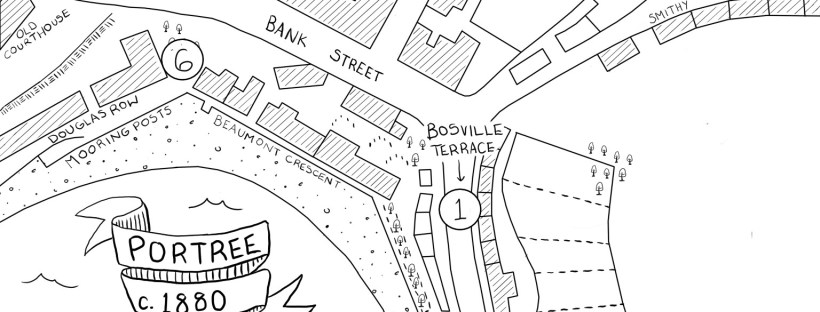
In the next post of the ecologies strand, guest blogger Grace Wright reflects on their SGSAH-supported residency at Cove Park in Scotland, and the place of zines in archives, academic research, and active resistance.
In June 2025, I spent a week at Cove Park on residency, developing and writing my plans to make a SGSAH-funded zine based on a corner of my PhD research. This was a very welcome moment to breathe and reflect on my progress so far and how I share it. My thesis – which I am rapidly approaching the due date of – looks at women’s participation in land agitation in the 1880s Highlands and Islands of Scotland. The zine emerged from my interest in how local resistance and the social networks that sustain it are recorded, remembered, and understood, and how places are charged with meaning through their history. I wanted to experiment with how to share the marginalised histories I was working on with my home community – embedded as they are in the housing and land politics of the Isle of Skye at their current crisis point.
The time I spent at Cove Park also offered me space to reflect on the relationship between my academic research and creative practice. I usually work with textiles; packing constraints on travelling to Cove Park meant I couldn’t bring a sewing machine, perhaps for the better! I already had the beginnings of a zine in mind and funding from SGSAH to print it, I just needed the time to actually write it.
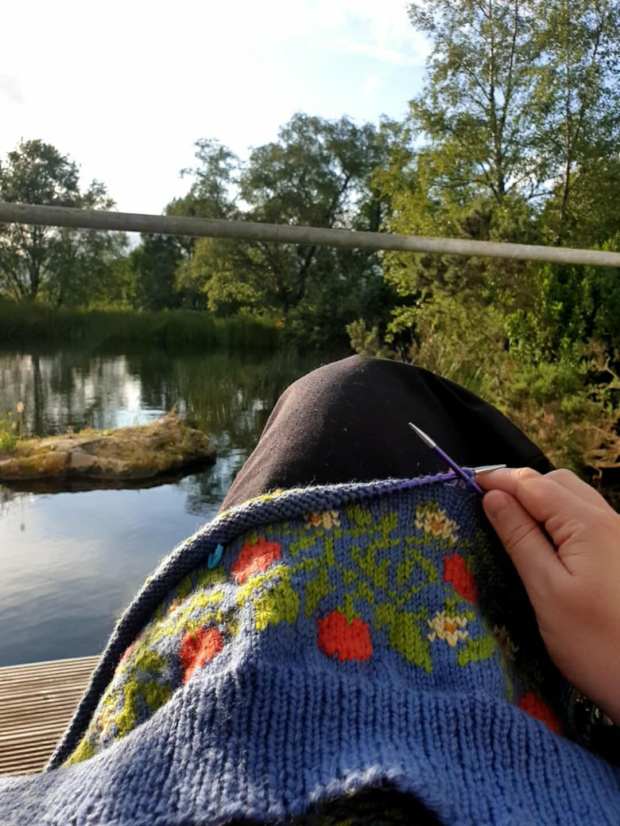
Still managed plenty of knitting though!
The zine, Plotting the Protest: Portree, maps Portree in the Isle of Skye through land agitation networks in the 1880s. This came through a dawning realisation that the town – like any place – exists in layers of historical period and the traces of this remain today, though I had overlooked that in growing up there. Portree was just Portree, but has also been a different Portree to generations before.
My favourite expression of this sense is by Paul Lynch in the introduction to his book Red Sky in the Morning (2013). He wrote, in response to the question of why his historical fiction book was about his own people and place, ‘I can see the whites of their eyes.’ By this, he meant that he knows them through their shared space, culture, and people. He know how they would speak, move, and interact. I have reached a stage where I can see Portree in the 1880s in this way. There are buildings I can’t pass without thinking about the person who lived there, the networks they held, and how that shaped land agitation. It was a sense of this I wanted to capture in the zine.
My main source of information for dynamics explored in the zine was police reports; my maps were based on Ordnance Surveys. These are both official accounts, shaped by institutional perspectives and priorities. They are recording places and people to manage them and their behaviour. The subjects of these forms of recording are largely voiceless: the disobedient ghosts at the feast.
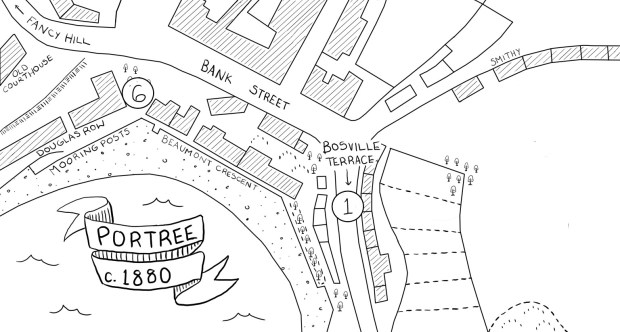
Zine-making has a long history of being used in the construction and circulation of alternative archives. It’s not possible to create a new archive for the land agitators’ of the 1880s – though I hold out hope for future discoveries in attics – but the information now available can be used in new ways, to tell different stories. Working it as a zine also meant that it could remain provisional and open-ended; it is not a fixed or full account, but a statement of how these histories might be encountered, questioned, and shared.
Returning to Portree through this process has changed how I understand both my research and its relationship to my home. The zine sits alongside my thesis, trying to think through historical knowledge in a way that is tactile, local, and shareable. As I approach the end of my PhD, this feels especially important. The project has reaffirmed for me that creative practice can help untangle historical questions, and that small, informal forms — like zines — can hold complex, contested histories. In plotting these protests, I have also been plotting ways forward for how I want to work, write, and share history beyond the thesis.
The zine, Plotting the Protest: Portree (2025), is available to read online at: https://archive.org/details/plotting-the-protest-portree/mode/2up.
Grace Wright is a SGSAH-funded PhD researcher based at the University of Glasgow. Originally from the Isle of Skye, her research focuses on women’s participation in land agitation in the 1880s Highlands and Islands of Scotland, emphasising the voices and actions of those living on the land. You can find out more about Grace’s work here.
 SGSAH Blog
One thought on “Plotting the Protest: Zine-Making as Research and Resistance at Cove Park”