
Concluding the British Council Scotland SGSAH EARTH Scholarship Scheme series, guest blogger Alison Scott reflects on the ongoing impacts of the programme for scholars based in Scotland.
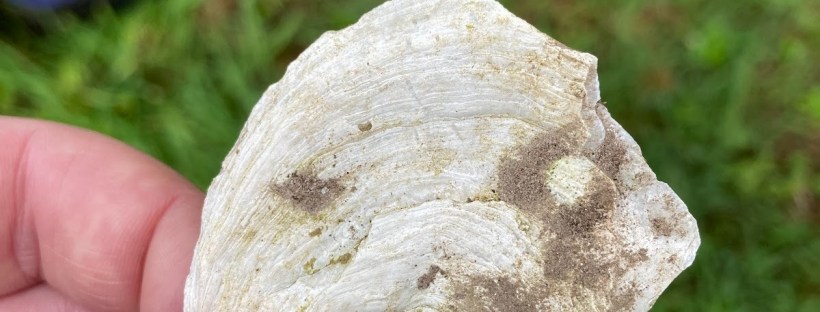
Three shell fragments have sat on my bookshelf for almost a year now. A cockle and a few broken pieces of common oyster. I try to keep them separate from those I find at my local beach. The grooves of these fragments are ingrained not with sand, but remnants of silty mud. They are dated from the Late Mesolithic to Early Neolithic, and were exposed by an archaeological dig from their thousands of years of burial as part of a shell midden. Left on the surface of the tilled earth of an agricultural field at Tarradale (near Muir of Ord), they were handed to me, thick with mud, by community archeologist Eric Grant. I remember toying with them delightedly, boots squelching in the same mud, while our guide Dr Ben Elliott from the University of the Highlands and Islands spoke to the group of the Storegga Slide tsunami’s impact on this area. The shells served as evidence of the people who lived here in the deep past, and their practices, as we reflected on our environment’s current instabilities and our roles as researchers within this moment.
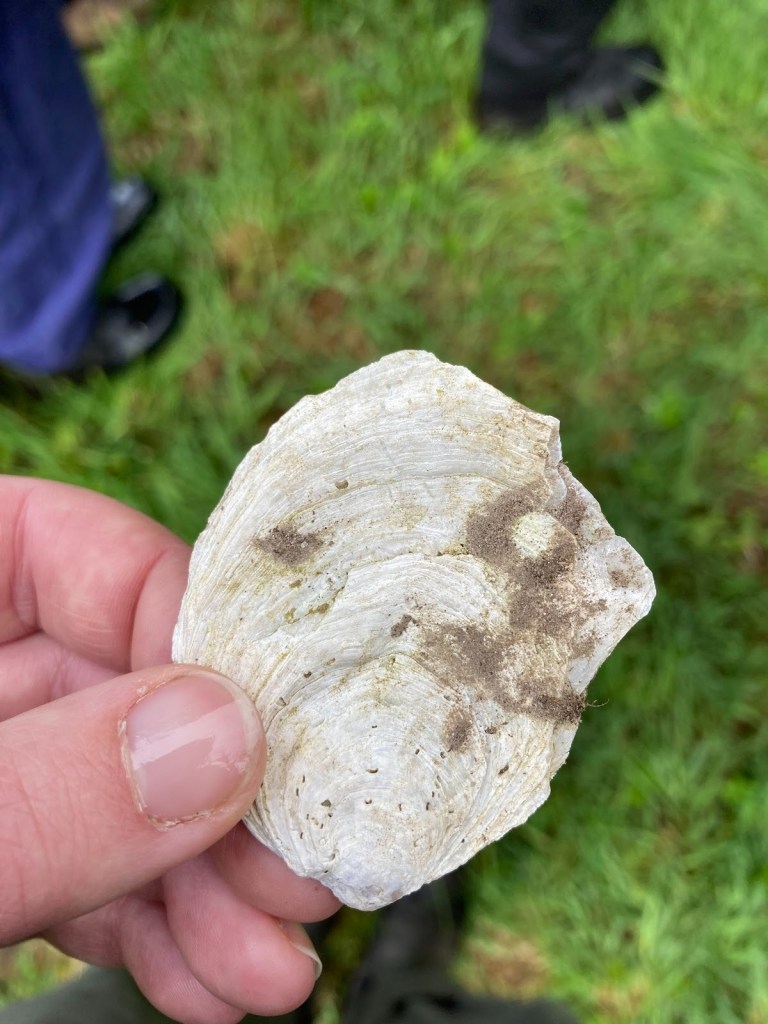
Shell fragments. Credit Alison Scott.
It was around this time last year, Spring 2025, when I took part in SGSAH’s EARTH scholars Cohort Development programme as a Scotland-based PhD researcher. I remember I applied to the opportunity wanting to make stronger connections with other researchers in Scotland and beyond, who were engaged in environmental arts and humanities projects. With a studentship at Gray’s School of Art, Robert Gordon University (RGU), I’m not a SGSAH-funded researcher, and the programme helped me to gain more of sense of orientation within the doctoral landscape and the wider field of environmental humanities: it became a route to engage with other practitioners I’d yet to find at that stage in my studies. A year on, some details of the trip have grown hazy—a buzzy blur of trains and seminar rooms, lively conversations on buses and beaches—while some parts, like the trip to Tarradale, remain for me in sharp focus. The impacts reverberate as the relationships and conceptual threads continue to shape my outlook. The people, places and research we were exposed to helped to sow seeds, fledging connections that could be picked back up, built from the shared experiences of our travels around Scotland, and I feel this was very likely the case for everyone there.
A core aspect of the EARTH programme was of course the visiting international scholars who the Scotland-based researchers joined for the Cohort Development trip as part of their longer stays in Scotland. I was lucky that Marta Kucza, usually based in Estonia, would be spending time at Gray’s School of Art with mentoring from my primary supervisor, Dr Jen Clarke. Marta’s work connected with my own in terms of common interests in moving-image, and sensorial ways of understanding forest environments. It was a privilege to spend time together visiting The Sill in Northumberland with Jen (as part of Jen’s work on Agroforestry Futures) and in Aberdeen as the new Aberdeen Environmental Arts and Humanities Network launched.
Among the other Scotland-based researchers, I recall speaking with Anna Stacey about shared interests in lens based methods and issues around how we understand and conceptualise land ownership visually. Now, along with Harriet Crisp, we are co-organising a reading group called Imaging Environments through the Edinburgh Environmental Humanities PhD LAB, the second of which will take place on 31 March 2026, and which all are welcome to join. The reading group explores how differing visualisations—from remote sensing to activist cinema and archival footage— interact and trouble each other. It asks, what possibilities might speaking across these diverse forms, modes, and technologies raise for our academic and artistic inquiries? How can we equip ourselves towards ethical and critical modes of witnessing, watching, and receiving visual media by reading, watching, and discussing together?
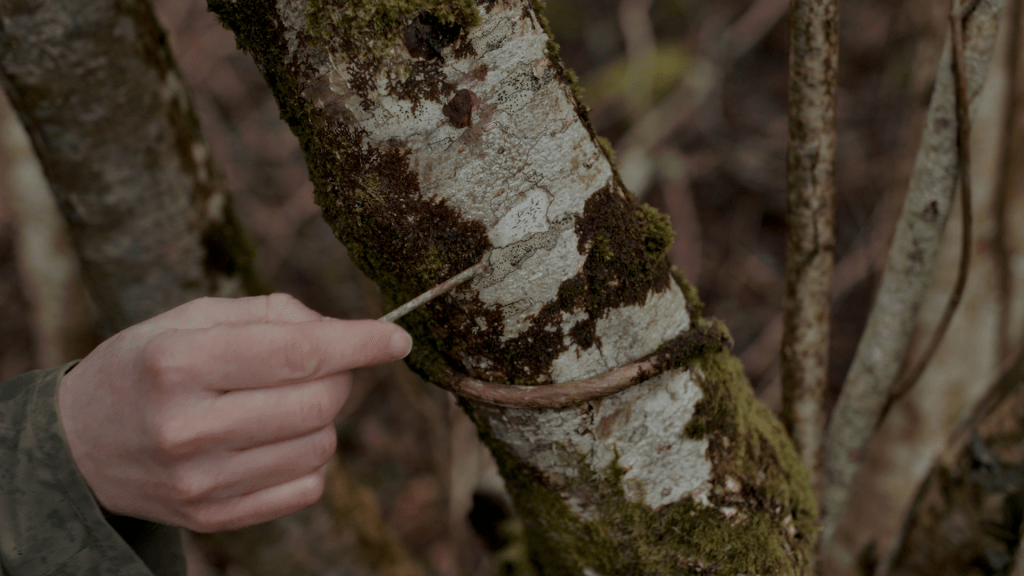
Still from Congenial Soils and Favourable Situations, Rachel McBrinn and Alison Scott (2022).
Shortly after the EARTH trip, members of the cohort Eilidh Guthrie, Janet Sit, and I attended the SGSAH intensive Fieldworking: Interdisciplinary Approaches at Glasgow School of Art’s Forres campus. The focus there on interdisciplinary collaboration, creative methodologies and critical approaches to landscape and the rural felt like a natural continuation of the EARTH programme, and among others we were joined by Ellie Ballantine who took part in the 2024 EARTH cohort. Both Eilidh and Ellie are now valued peers in Scotland, and I continue to learn from as they expand their studies of wetland restoration and forest temporalities respectively. This is all to say that part of the EARTH programme’s impact for me has been an expanding sense of connection, and a feeling of a shared conversation among emerging researchers in the environmental arts and humanities that extends beyond those who were part of the cohort.
And so the shells from Tarradale function for me as material evidence of a deep time I can barely conceive of, and our inherent environmental instability, but also as a highly sensorial reminder of a much more recent time that I think of fondly, where objects and ideas were shared generously. They remind me to continue that approach. Perhaps it’s time I write the shells a label, but I’ll leave them muddy.
The EARTH Scholarships Impact Symposium is at the University of Glasgow on 22 April 2026.
To participate in Imaging Environments, contact astacey@ed.ac.uk.
Congenial Soils and Favourable Situations (2022), a film made collaboratively by Alison Scott and Rachel McBrinn, is currently on view in Where we meet land: environment and ecology in artists’ moving image at Fruitmarket in Edinburgh, which concludes with an artist’s round table discussion on 22 March 2026. The film was commissioned by Cove Park and ACT, who together form the Argyll Climate Beacon.
Alison Scott is an artist and researcher based in Angus, who is currently a practice-based PhD student at Gray’s School of Art, Aberdeen. Her project, which is both informed and supported by the UKRI Treescapes project, focusses on art, forestry and the commons. You can find out more about Alison’s work here.
 SGSAH Blog