

Reflecting on her current SGSAH-internship with the Aberdeen City and Aberdeenshire Archives, resident blogger Ebba Strutzenbladh shares her process of brainstorming public outreach ideas that highlight the existing strengths of a place or region rather than competing for space with established enterprises and creative practitioners. This exploratory post about roaming the streets of Aberdeen and Nairn aims to inspire the reader to let others into their own creative process sooner rather than later.
As I mentioned in my introductory post, I’m currently interning with the AC&AA, where I’m exploring ways of responding to the archive’s holdings through creative writing and immersive storytelling. The question that frames my project is what the best way is to draw audiences to the archive’s collections, and particularly to the unusually well-documented distant past of the city of Aberdeen. This is a selfish question in the best way, meaning that I myself really want an answer. For a long time, I’ve dreamt of transforming my research on the women of late medieval North-East Scotland into stories that resonate not only with historians, but with anyone who wants to engage with the past in a way that feels meaningful to them.
One aspect of the project involves bringing the stories from the archives into the streets of Aberdeen in a poetry format; this an experimental element of the internship, as I kept it open on my proposal form exactly how this street art initiative was to be carried out. I’ve been exploring ideas of decorating the streets of Aberdeen with rain-activated paint, inspired by the ‘Raining Poetry’ concept that I got to experience on a visit to Adelaide last year. I’ve also looked into decorating empty shop windows along Aberdeen’s Union Street with vinyl art as a way of highlighting the potential of the city’s main street and its locales, as businesses there were hit hard by the Covid-19 pandemic.
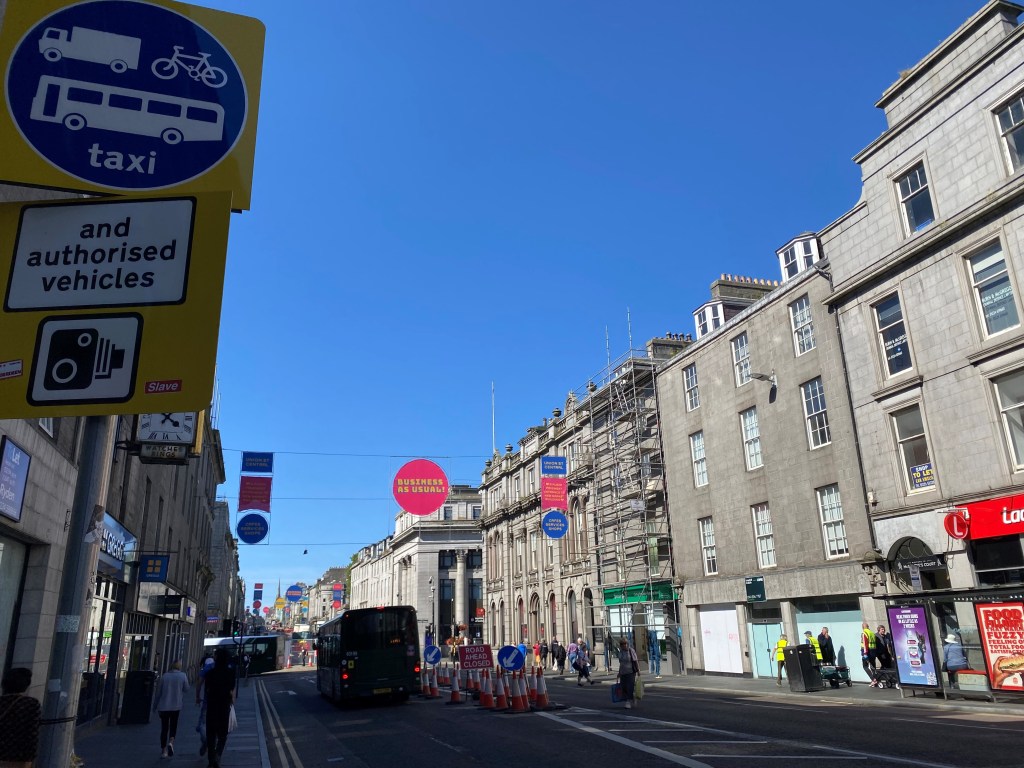
As I had hoped, my internship connected me with some exceptional creative practitioners and public outreach experts in and around Aberdeen. The questions they’ve inspired me to ask about impact, engagement, and the potential for the public to guide the research questions posed by humanities scholars could – and probably will – be the subject of its own post on this blog. At the moment, however, what strikes me most is the question of what relationship people actually have with public spaces today. Walking down Union Street last week, I struggled to process all the posters, commemorative statues, street art, and QR codes on stickers attached to walls and street lights. This is not to mention the traditional features of the street vying for attention: street signs, shop windows, traffic cones, blinking lights. Clearly, I’m not the first person to try to catch people’s attention as they move from A to B.
And what was I doing, surrounded by these messages and signs? Of course, I mostly kept my eyes on my feet, reluctant to engage with the overwhelming amount of content thrown at me. As a friend said over a card game recently:
‘To be honest, I’d never read anything posted on a shop window.’
This is not to mention the fact that city centres no longer attract the kind of crowds they once did. Rather than listing all the reasons for this decline, I’ll just say that this is a shame. Aberdeen has a lot of engaging street art. A colleague recently took me down St Nicholas Lane to show me Carrie Reichardt‘s 2017 contribution to the Nuart street art festival, a mosaic celebrating women from Aberdeen’s history:

Rather than adding more content to the streets, I felt a desire to highlight the striking pieces of art that are already there, which make Aberdeen such a special and diverse place. So many talented practitioners and enthusiastic groups are already shaping the urban landscape of Aberdeen. Is creating ‘visual competition’ really what my project should be aiming to do?
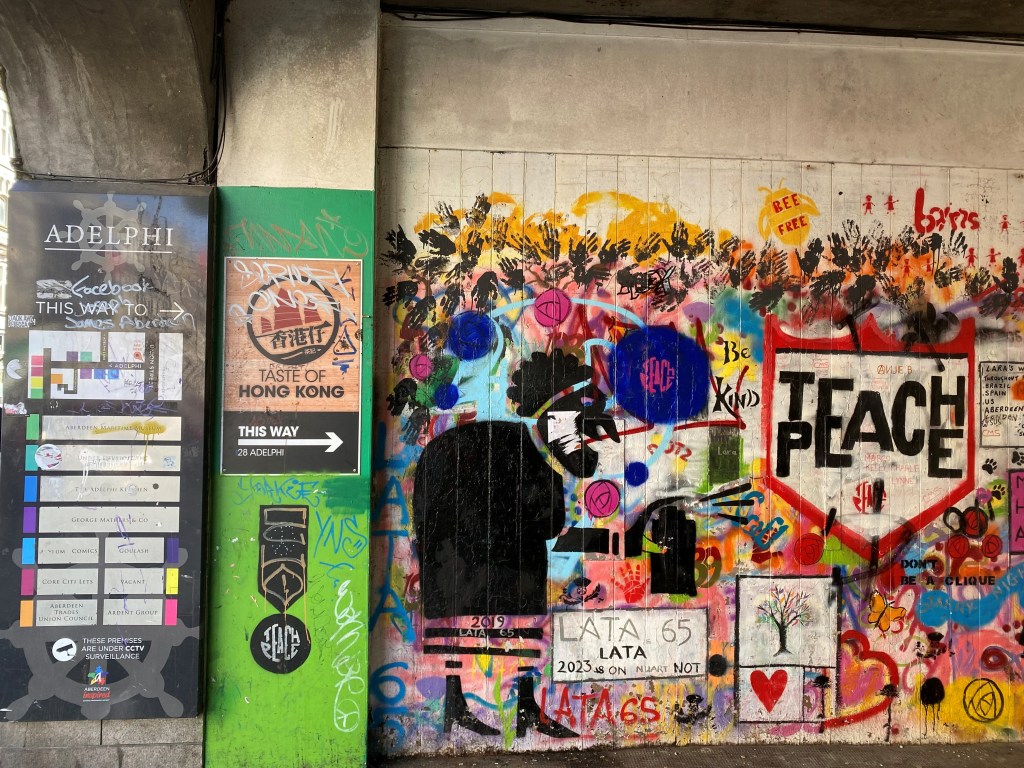

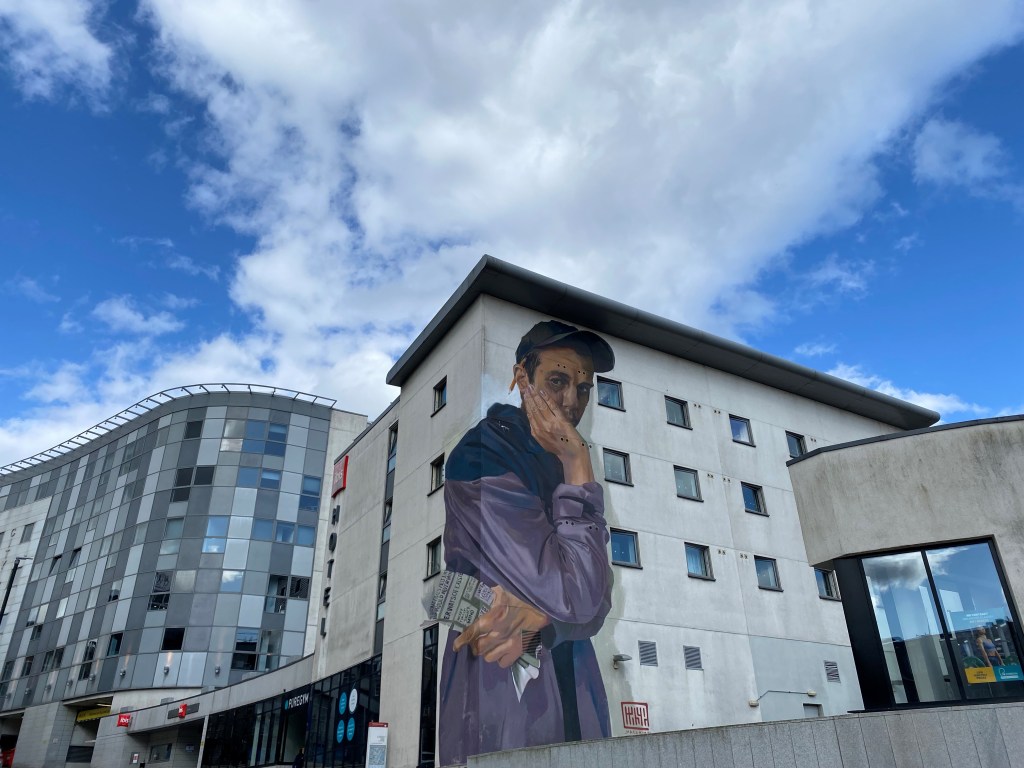
It feels vain to prioritise my voice and my desire to leave a mark on a place that’s already striving to channel so many voices and experiences. In our age, everyone is a creator, a sender of some form of content, but it seems rare to stop and honestly ask, Does the receiver actually want what I’m sending? And perhaps more importantly, If everyone is a sender, will anyone take the time to be a receiver in a meaningful way?

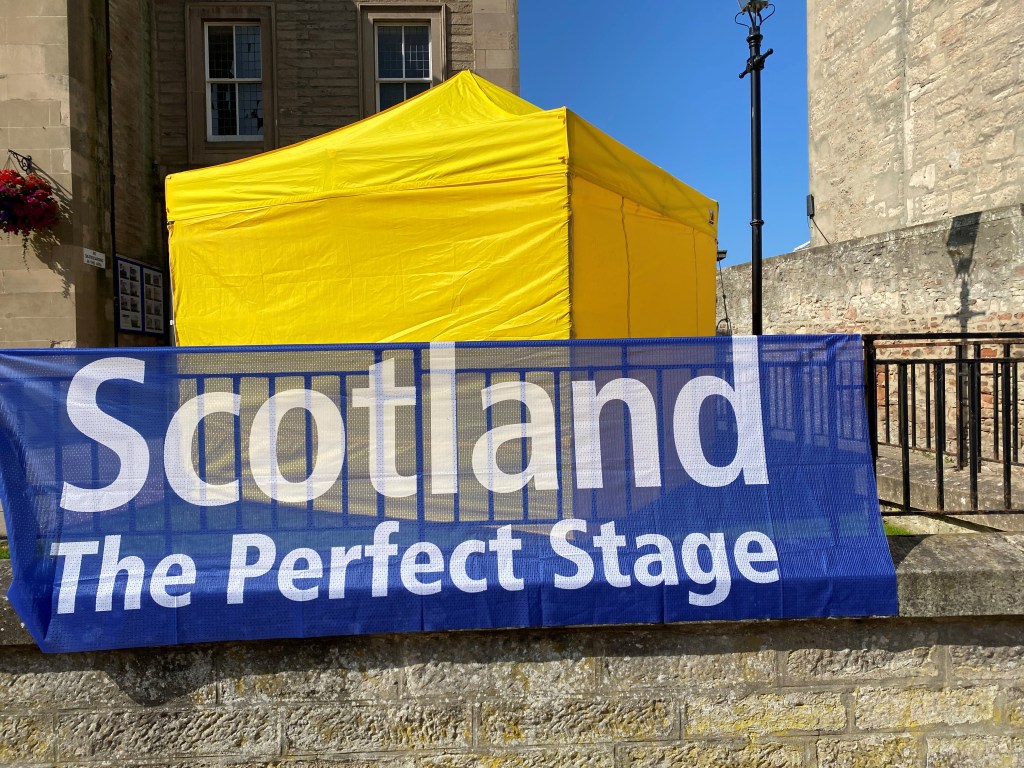
This Saturday, I travelled north to Nairn for their annual Book & Arts Festival, and continued to reflect on ways of bringing culture to the streets. Being a small town, Nairn had a much more consistent expression of its community culture than Aberdeen. It seemed that almost all local businesses had found ways of joining in on the celebration of art and culture, whether it be through decorating the street or providing spaces for cultural events. There was even a ‘walkaboot bard’ roaming the town centre, improvising poetry based on what he saw and heard around him.


The bard’s performance was so responsive to his surroundings that, though the audience was fairly quiet, it felt like a dialogue. The café itself was clearly happy to serve as a temporary venue for the performance, which got me thinking about the potential for collaboration between local businesses and cultural creators. Not everything happens in the streets – many indoor public spaces contribute to a city’s, town’s, or village’s sense of energy and community. This is true in 2024, but was also true in 1424 when the women that I study were discouraged from walking the streets alone and much of their labour occurred in their homes; they were still integral parts of the urban community and economy. In fact, one important lesson from my PhD is that the distinction between public and private spaces is not self-evident, and is certainly not dependent on whether one is indoors or outdoors.
While Union Street and other parts of Aberdeen’s city centre can feel cluttered today, local cafes, restaurants, pubs, community centres – even hospitals, medical centres, libraries and theatres – may well be open to participate in projects that highlight the history of their locality, even if it just means offering a small section of their wall or window. Such collaborations would draw attention to the vibrant life of Aberdeen, rather than trying to ‘fix’ the spaces not currently in use.
To conclude, this has been an attempt to share my thought process with you, rather than come up with specific pieces of advice or guidance. I’ve shifted from viewing my surroundings as a blank canvas to seeing Aberdeen as a space with a distinct character that I want to be in conversation with. However, I’m not done thinking about what I want this project to be in its final shape. Sharing the storm in my brain with transparency will hopefully inspire you to invite others into your thought processes too, rather than trying to achieve perfection before you initiate conversations about the things you’re passionate about.
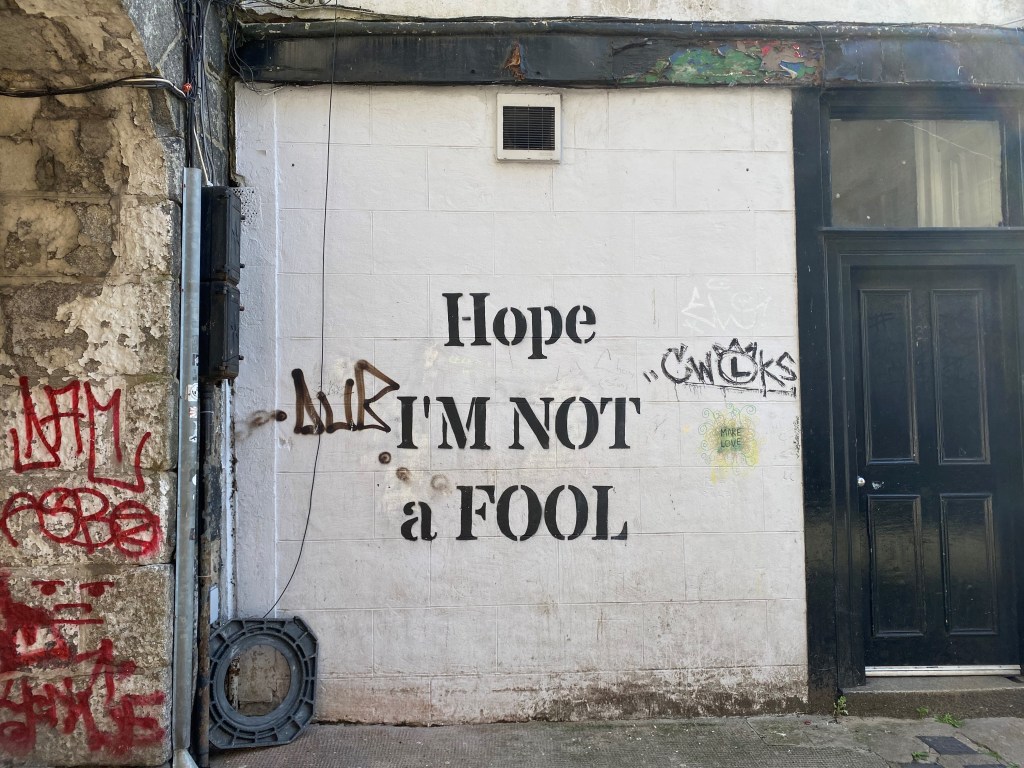
All photos my own. Artwork by the artists as specified in each case, where possible.

Ebba Strutzenbladh is a SGSAH-funded PhD researcher at the University of Aberdeen. She has an undergraduate degree in History from Aberdeen and an MSt in Women’s Studies from the University of Oxford. She can be found on X (formerly Twitter) @strutzenbladh and has published historical fiction in Causeway / Cabhsair Magazine.
 SGSAH Blog
“Thank you for this insightful piece on the importance of public spaces in cultural outreach! The discussion on how these spaces foster community engagement and inclusivity is both timely and thought-provoking. It’s inspiring to see how architecture and public design can play such a pivotal role in bridging cultural gaps. Looking forward to more articles like this!”
LikeLike