

This week, Ceit Langhorne invites you to the world of her PhD thesis: Gaelic-speaking Scotland and its heroic tales. She explains some of the meaning lost in translation between English and Gaelic, the importance of local culture in preserving heroic tales, and how she plans to work with local communities as part of her research. Be sure to read to the end, where Ceit links to her podcast and Gaelic short film.
Haidh! Is mise Ceit/Kate Langhorne! I’m in my second year of my AHRC-funded research at Sabhal Mòr Ostaig, Scotland’s National Gaelic College (Oilthigh na Gàidhealtachd s’ nan Eilean). Tha tiotal a’ phròiseact agam mar a leanas: ‘Rewilding Fionn Mac Cumhaill; the Cultural Ecology of the Gaelic Heroic Tradition in the Landscape of the Gàidhealtachd.’
A’ SGRÌOBHADH AN TRÀCHDAIS ANNS A’ GHÀIDHLIG
I am writing my thesis in Gaelic. I have been speaking Gaelic for around 15 years, and have studied it at Aberdeen University and Sabhal Mòr Ostaig. Up until this point, however, the bulk of my written coursework has been in English. So, the experience of writing academic Gaelic is a new one for me!
In many ways, Gaelic is a very straightforward language. Academic English can be very dense. But in Gaelic, you would be doing detriment to the meaning you’re trying to convey if you over-exert a rather extensive, abstract vocabulary. Many theoretical frameworks and terminology designed first in the English language, are used in Gaelic scholarship, and translated literally into Gaelic, and that can lead to some interesting questions. To what extent can English terminology be used in literal translation? Furthermore, should we be seeking to hold English language concepts first, rather than speaking on our own cultural terms? Dualchas do- làimhsichte and so-làimhsichte for example, is ‘intangible’ and ‘tangible heritage’. I can’t help but question the literal translations of these as ‘unhandle-able’ and ‘handle-able’ heritage. The Gaels have our own concepts of ‘heritage’: dùthchas, (the sense of responsibility to look after your homeland and therefore your right to be there and to belong to it), and dualchas (what you learn about how to live in this place and how to make sense of who you are from those who have come before you- encompassing knowledge of songs, place names, genealogy etc) (Col Gordon; 2023). Dualchas cultarail is sometimes translated literally from the English ‘cultural heritage’, and that confuses me a bit. Heritage is inherently cultural in Gaelic, so how does this literal translation stand?
SGEULACHDAN GHAISGEIL- DÈ TH’ ANNTA?
The Gaelic Heroic tradition is an oral and manuscript narrative tradition, shared by Scotland, Ireland and the Isle of Man: the Gaelic nations, if you will. In brief, there are two strands to this tradition. The first is the Finn Cycle, concerning the exploits of Fionn Mac Cumhaill and his warriors, known as the Fèinn, Fianntaichean, or the Fianna. The second is the Ulster Cycle- tales concerning the exploits of characters in the reign of Ulster king Conchubar Mac Nessa – such as the warrior Cù Chulainn, Deirdre and the sons of Uisneach. The Ulster Tales are much more strongly connected to Ireland in the manuscript tradition and so they are more concretely situated there. They are not as widely told in the Scottish Gaelic tradition as the Finn Cycle tales are, however. Fionn is indeed the more popular figure in Ireland and Scotland. In Scotland more specifically though, he hunted giant quarry with his warriors across our moors and forests, and competed with them over different warrior feats.

CÀIT A BHEIL NA SGEULACHDAN SEO?
I’ve been interested in these stories for a while. I love how surreal they are! The graphic violence that ensues because of the slightest argument between these warriors is exceptionally funny and cartoonish! There is a timeless nature to these stories of human pride, frustration and impulsiveness. I have previously experimented with these notions in a puppet film I made in 2021, called an Duan fo Ghlas- the Fianna in a Time of COVID. Just what did Fionn and his warriors do during lockdown??
I’m also interested in the relationship these stories have to our landscape in Scotland. I have taken a few core narratives to the Scottish Gaelic Heroic Tradition and have begun to trace them within the individual localities in which these have been told, mostly in the place names of mountains, lochs, islands, and prehistoric forts. I consult oral recordings from locals, undertaken in the 1950s-70s, by fieldworkers from the School of Scottish Studies. I also examine statistical accounts and transcribe recitations from the fieldwork of John Francis Campbell’s contemporaries in the nineteenth century, the likes of which you will find in Leabhar na Fèinne, or in the collection Popular Tales of the West Highlands (1860), the Dewar Manuscripts (John Dewar, 1870s) or indeed in John Gregorson Campbell’s the Fians: or Stories, Poems and Traditions of Fionn and his Warrior Band (1891). It is the local cultural engagement with landscape creatively through the Gaelic heroic narrative, and other aspects of tangible and intangible cultural heritage in the land, which we may term ‘cultural ecology’ (Raghnaid Sandilands and Mairi McFadyen; 2021).
The scope of these narratives is immense and diverse in Scotland. The narrative of Diarmad and Grainne (Fionn’s nephew who ran away with Fionn’s betrothed Grainne), has been situated in Glenshee, Kintail, Glenelg, Lismore, Sutherland, Skye, and Knapdale.
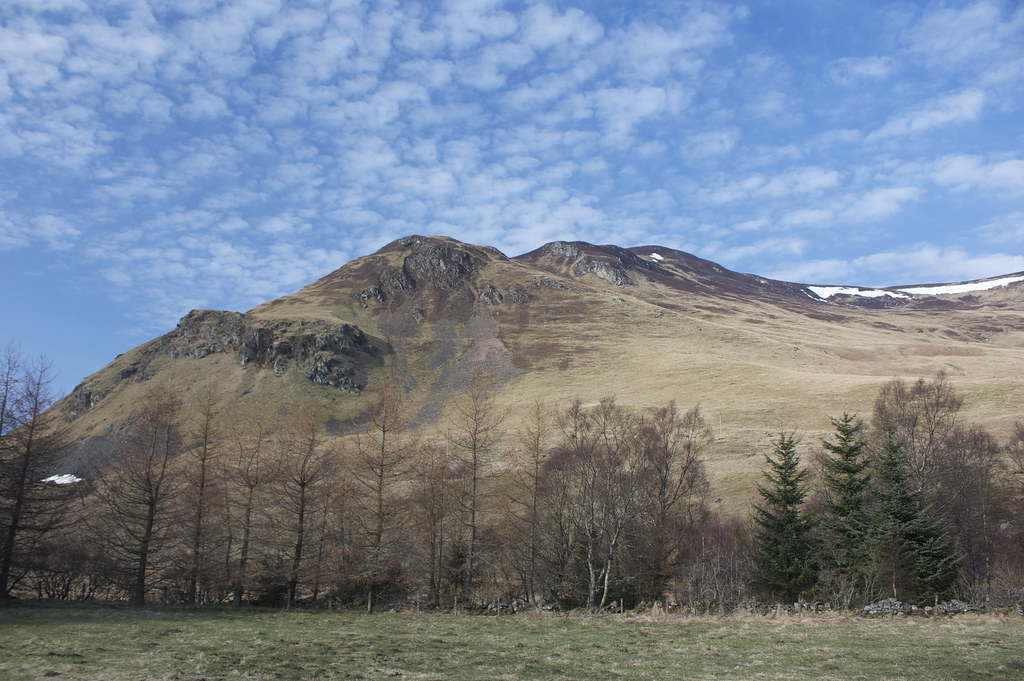
Clusters of toponyms detailing Diarmad’s fateful hunt of the Torc Nèimh (the great poisonous boar) can be found throughout the Scottish Gàidhealtachd. Try this out for an interesting exercise: consult any OS map to find Ben Gulabin, Gullipen, Gulben, or Ghuilbinn (the Snouty Mountain). Look to see if there is a loch, Beinn or Abhainn an Tuirc, close by (denoting the boar). Look out for Ben Gullipen, in Aberfoyle, and Brig o’ Turk, near Callander (Donald Meek; 1998).
There is also a fabulously visual ballad, called Duan na Ceàrdaich, which has been situated in various places across Scotland. As per the story, the warrior Daorghlas, raced with Lòn Mac Lìobhainn (the Fairy Smith of Lochlann) to the door of his forge. This forge is said to have been by Loch Meallt ‘Kilt Rock’, in the north-east of Skye. Find it also on Glaisbheinn, in Kintail, or on ‘Cnoc Angail’ in south-west Islay.
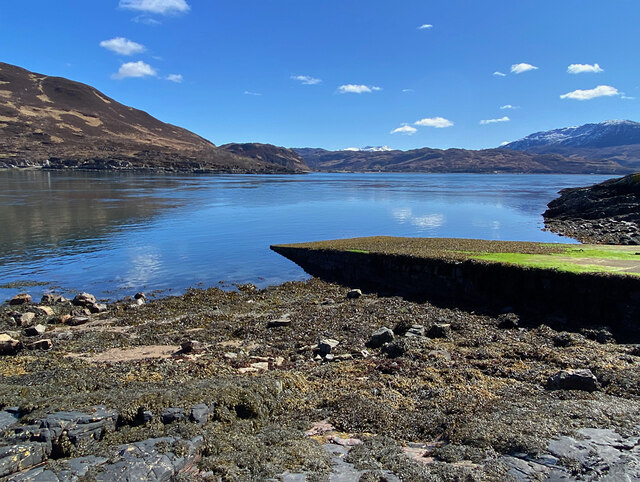
Caol Rèithe, or Kylerhea, the strait between Skye and Glenelg on the mainland is repeatedly asserted in the oral tradition of the area to be named after the warrior Reatha, who fell in and drowned.
SEANFHACLAN, LUCHD-TURAIS AGUS DÙIN.
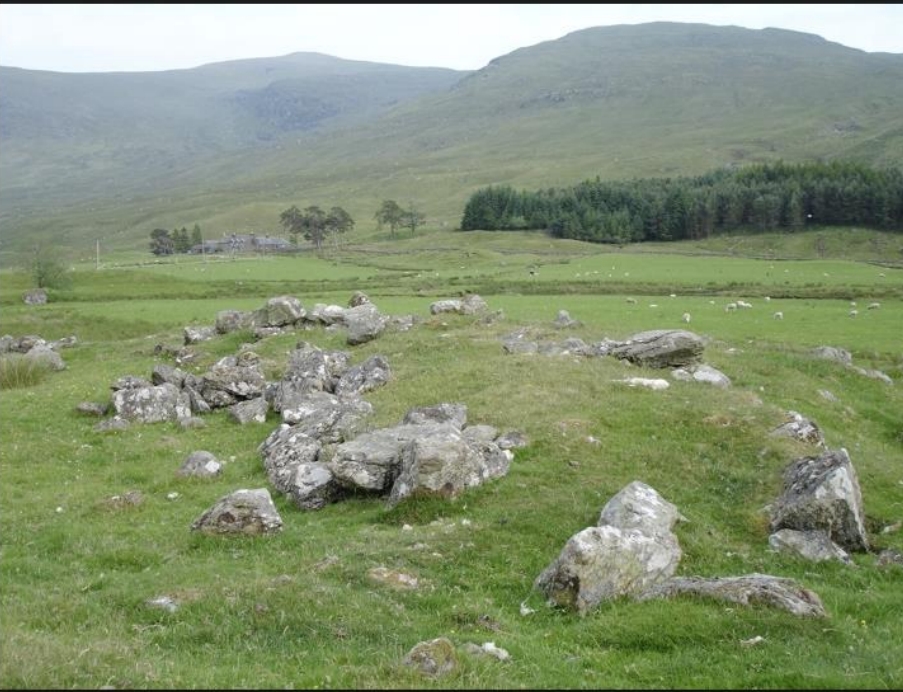
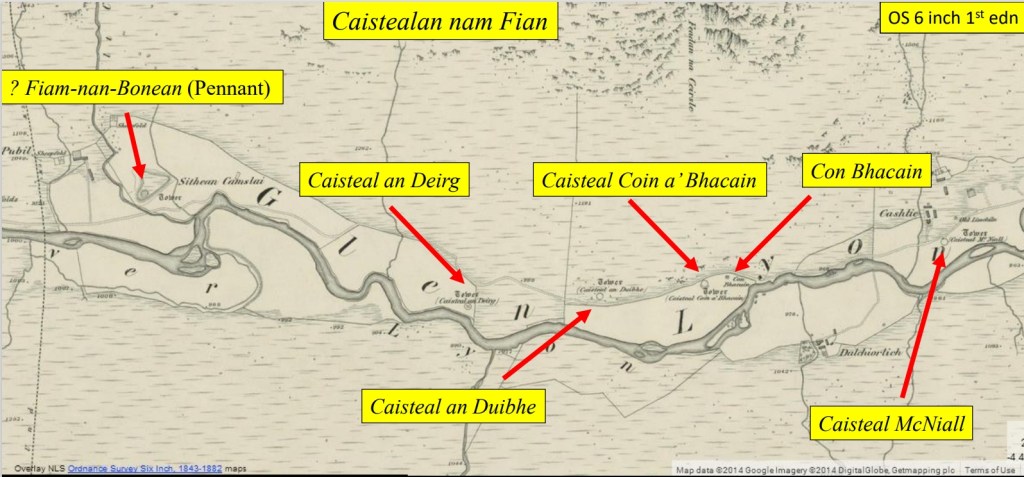
Similar to the numerous mountains and place names, many archaeological structures have been named as the abodes of the Fianna. Glen Lyon is one example, in Highland Perthshire. You find them mentioned in the travel account of Welsh naturalist Thomas Pennant (1772), who took his own highland tour, and attributed it to the forts in Glen Lyon and Killin. He detailed the following proverb:
“Bha da chaisteal-deug aig Feann
Ann an crom-ghleann nar clach.”
[Fionn had twelve forts,
in the winding glen of the stones.]
Duncan Campbell (1888) elaborated on the names of some of these individual structures in Glen Lyon, such as Caisteal an Dearg; and Caisteal a’ Chon-bhacain (where the Fianna tethered their dogs).
The great antiquity of these stories and their associated prehistoric sites was assumed throughout the eighteenth and nineteenth centuries, and asserted by travel writers such as Pennant. Pennant was inspired by James Macpherson’s Ossianic poetry (Nigel Leask: 2016), in which Macpherson claimed to be transcribing straight from Ossian’s original 3rd century manuscript!
It is important in my research to understand how writers like Pennant consumed narratives inspired by Ossian, and how ballads were being circulated and adapted in the eighteenth century. Then you can begin to see how this kind of material, interpreted and repeated by a certain kind of audience in a certain literary culture, contributed to the situating of these characters in their localities. How did these ballads and stories get to be the way they are now, in the places where they are told?
A’ CUMAIL NA SGEULACHDAN LEIS AN SLUAGH, AGUS A’ LORG SGEULAICHEAN ÙRA.
I believe these narratives to be the most rewarding to analyse when approached on the local level, through local voices. From there, you can begin to understand how wider circulations and exchanges within ballad traditions have manifested in that locality. In short, you can appreciate the richness and complexity of this tradition when you unfold the different aspects of a local telling. This tradition is best comprehended when observed through the prism of understanding that one local person has of their area, whether it’s in the eighteenth or nineteenth century, or in the present day.
Thus, one aspect of my research will be to analyse the knowledge that individual communities (as well as archaeologists and local heritage sector professionals) have of these different stories in their areas today, as well as their engagement with this material. Most recently, I’ve interviewed a couple of people whose family connections go back several generations, and the ways in which characters and events in the local story have transformed into different kinds of narratives. Viking graves are abundant, and these participants will also identify the last place the Faeries were seen in the area, or give details about the Gaelic their parents spoke. These conversations have been the highlight of the fieldwork so far.
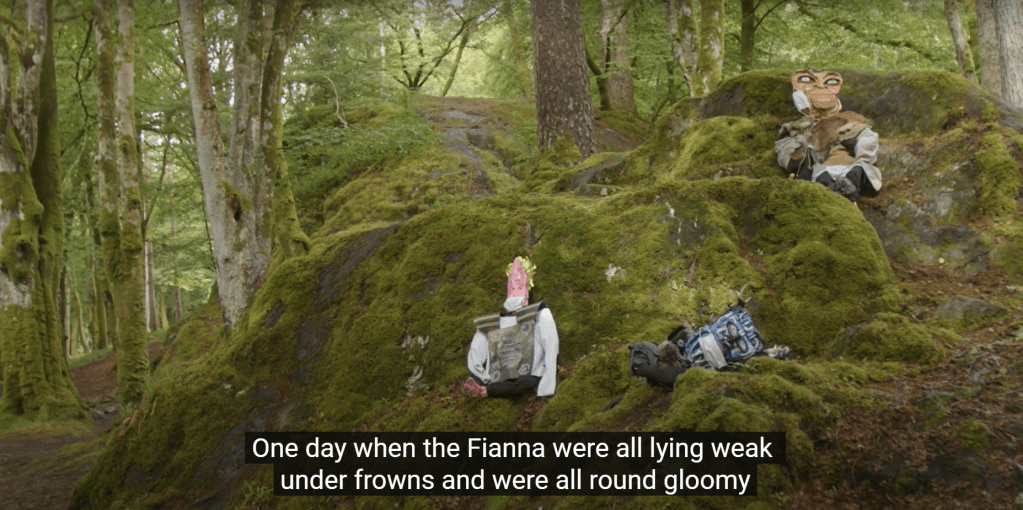
I will hold lectures in cultural centres and local museums with community groups and work with Gaelic medium schools wherever possible to tease out the songs and ballads inherent in these localised stories. My aim with this fieldwork is to engage an audience with the story in question, and to inspire them to investigate the circulation of their own heroic ballads in their area. In Glencoe Primary School, for example, I will use simple masks to tell the story of the battle between the Fianna and the Vikings – on the slopes of Sgòr nam Fiannaidh and down towards Ballachulish – and then encourage them to imagine themselves as otherworldly superhuman warriors in the battle. Hand-outs at the end of the sessions will detail each site along Loch Leven-side where the action takes place, so that the children can continue the discussion with their parents when they visit these sites in the area. I’m thoroughly looking forward to embarking on this aspect of the work, but I am nervous about making a lasting impact with the young people especially (a kind of audience I’m not quite as accustomed to), and inspiring a curiosity in them to learn something about this tradition when I leave them.
This tradition is entirely about dialogue and debate, and the shifting of narratives and attitudes to that tradition through time. Finding the routes and by-roads by which stories have come to us is the way to learn about the production of knowledge and power. Learning the complexity of this is an empowering first step towards engaging with your locality and cultural heritage, and taking your place in a wider dynamic social and cultural sphere. What is the imaginative potential of this material to inspire a re-engagement with place and environment more generally? That’s what I’m off to investigate!
Nach guidh sibh gach soirbheas leam! Wish me luck!
Am bu mhath leibh tuilleadh a chluinntinn mum chuid rannsachaidh? Èistibh ris sa Ghàidhlig anns a’ phòd-chraoladh agam a leanas.
Listen to a summary of my research in Gaelic, as well as a discussion on the legacy of these narratives in the Scottish landscape, on this blogspot/podcast.
Want a laugh?! Have a wee look at my puppet film, an Duan fo Ghlas here!
Leabhar-Liosta
Campbell, Duncan; (1888) The Book of Garth and Fortingall : Historical Sketches Relating to the Districts of Garth, Fortingall, Athole, and Bredalbane / [Duncan Campbell]. Inverness: Northern Counties Newspaper and Printing and Publishing Company.
Campbell, Gregorson, John; (1891); The Fians: or Stories, Poems, & Traditions of Fionn and his Warrior Band; second edition 2005; Elibron Classics.
Campbell, J.F; eds.; (1872); Leabhar na Fèinne: Gaelic texts, Heroic Gaelic Ballads collected in Scotland chiefly from 1512-1871; Spottiswoode, London.
Gordon, Col; Dùthchas – What are we actually talking about? (theshielingproject.org) – blog-spot for Proiseact na h-Airigh/ the Shieling Project (22nd March 2023).
McFadyen, Mairi; Sandilands, Raghnaid; On Cultural Darning and Mending: Creative Responses to Ceist an Fhearainn/ The Land Question in the Gàidhealtachd; Scottish Affairs Vol. 30; Issue 2: Scotland’s Gàidhealtachd Futures(2021).
Meek, Donald; (1998); Place-Names and Literature: Evidence from the Gaelic Ballads in The Uses of Place-Names; ed. Simon Taylor; Scottish Cultural; Edinburgh; pp147-168.
Pennant, Thomas (1772); A Tour in Scotland, and Voyage to the Hebrides; MDCCLXXII. Chester [Eng.] Printed by John Monk.
Ceit Langhorne is originally from Glasgow, and now lives in North Argyll. Ceit has been working in Gaelic cultural heritage for the last few years, in a creative capacity; her work encompasses podcasts, storytelling, public talks, music and creative writing. Her PhD research has been a great opportunity to unpick a particularly interesting, rich and often misunderstood aspect of our folk tradition.

