
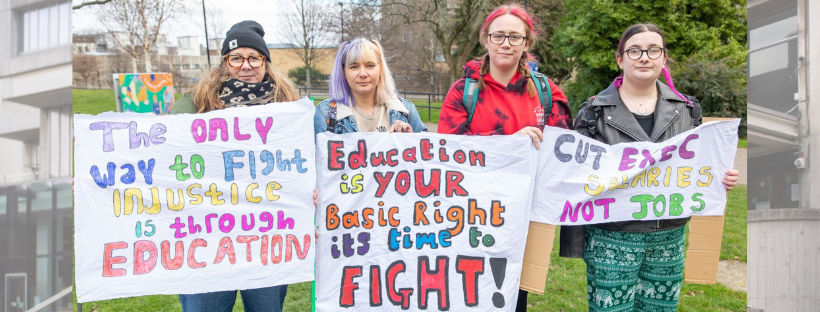
This week, guest blogger Taylor Jeoffroy sheds some light on the current Scottish HEI funding crisis, sharing her personal experience as a PhD student at the University of Dundee and reflecting on the ways in which precarity in the sector affects postgraduate researchers directly…
Will my degree be less valuable? Will the university still be here next year? Will my course be cut? Will my supervisor lose their job? Should I transfer? Will I still be able to teach? Will there still be a place for me in academia?
Students all over the University of Dundee’s campus — just one among several Scottish Universities facing financial hardship — have been asking themselves these questions since the news regarding the University’s £35 million deficit broke last November.1
Timeline of Events
In case you haven’t been following along, here’s a summary of the University of Dundee’s financial crisis over the last few months:
November 13th, 2024: £30 million deficit is revealed, and the Principal, Iain Gillespie, warns that job cuts are inevitable.
December 6th, 2024: Iain Gillespie resigns as Principal and Vice-Chancellor of the University of Dundee. The week prior, reports were made regarding his exorbitant business trips.2
January 30th, 2025: University of Dundee staff voted to strike over the university’s plans to cut jobs. The University, in an email sent by Interim Principal, Shane O’Neill, deemed this premature as the University had not yet presented its recovery plan. The strike ran for 3 weeks from the end of February.
March 11th, 2025: The University announces that the deficit had grown to £35 and puts forth their plan to overcome the financial situation, including: limiting institution-funded research, restructuring of the academic schools into faculties, selling some University property and assets, and cutting 632 FTE jobs, about 20% of the University’s staff of over 3000 employees. This would be made up of 197 academic roles, 119 school-based professional services posts in schools, and 316 directorate roles-based professional services roles.3
March 20th, 2025: The Scottish Funding Council (SFC) gives the University £22 million to support it through the financial crisis.
March 25th, 2025: The SFC launches an investigation into the University’s financial situation, led by Professor Pamela Gillies, former principal at Glasgow Caledonian University.
April 25th, 2025: University staff again vote to strike over proposed job cuts.
April 29th, 2025: The University plans to cut only 300 jobs in its new plan that would heavily rely on public funding.4
June 6th, 2025: The university opens a voluntary redundancy scheme as part of the plan to cut 300 FTE jobs.
June 15th, 2025: AAB Audit & Accountancy Limited’s report on the University’s financial records from 1 August, 2019 to 31 October, 2024, is leaked to The Courier, outlining the University’s ‘inadequate financial reporting.’
June 19th, 2025: The investigation, led by Pamela Gillies, presents their report (referred to as the ‘Gillies Report’), placing Iain Gillespie, Shane O’Neill and former chief operating officer, Jim McGeorge, at the center of the financial crisis.
Following this, interim principal, Shane O’Neil, Tricia Bey (Acting Chair of the University Court) and Carla Rossini (Convenor of the Finance & Policy Committee) resigned.
June 24th, 2025: The Scottish Funding Council (SFC) agrees to £40 million in financial support over two academic years or three financial years.5
How Dundee’s Crisis is Affecting Postgradutes
Since the news broke last November, so much has seemed uncertain for students, but postgraduate students seem most affected. Following the initial announcement, my school of Humanities, Social Sciences, and Law informed us that they would no longer be funding ‘add-ons’ such as attendance at conferences. Within a week, they announced reduced funding available for hourly-paid tutoring.
Personally, not only was I not offered a teaching position in semester 2, but I had to leave a different paid position early. 4 PGRs were hired for a 7-month contract before the University’s hiring freeze. However, our contracts were not issued in time, we were brought on as casual hires and, subsequently, one of the first to be let go in March. Additionally, funding for teaching over the summer term has been cut drastically compared to last year. As a self-funded student, I rely on these opportunities not only for finances, but also, for gaining practical experience in higher education.
Postgraduate students, forever caught between student and staff member, are being hit from both sides. We are not just here to earn our degrees, but to gain experience in teaching, to participate in conferences, and to gain experience within the academy. And yet, some of the first cut-backs targeted us directly.
Personal Reflections
As long as I can remember, I have always wanted to be a teacher. When I entered university, I knew that was where I wanted to end up teaching. When I began my Ph.D. at the University of Dundee, I couldn’t wait to teach. I completed the required module as soon as I could and began teaching in my second year. When I feel stuck with my research, interactions with students, being in the classroom, and preparing lessons keep me going. If you had asked me a year ago what I wanted to do after I finished my Ph.D. I would have confidently told you that I would be a lecturer. But now, I’m not so sure. I feel lost and not just because it is my institution that is experiencing the most significant financial issues, but because of the atmosphere in higher education at the moment.
Now, more than ever, positions in academia feel precarious. There’s the threat of the financial crisis looming over our heads as one by one our ‘add ons’ are cut back, offices dwindle, and our writing up year fee increases from £100 to £500.
I wish I had a hopeful message to end this post on. I don’t know what the future may bring. I don’t know if there’s a place for me in academia or if that’s what I’m even working towards anymore. All I know is that I am not the only Ph.D. student asking themselves these questions right now, and that, at least, is comforting.

Taylor Jeoffroy is an English Ph.D. candidate at the University of Dundee. Her doctoral research examines Aphra Behn’s plays to explore the relationship between sex work and the Restoration stage (1660-1680). Her research interests focus on the intersection of history and literature, 17th-century theatre, and education in the humanities. She has been heavily involved in theatre and performance, both on stage and behind the scenes, for over 10 years. Most recently she was the President of ACT theatre at the University of Dundee. Taylor has presented at the Saint’s Graduate English conference and has written for the Dundee University Review of the Arts (DURA). Find more about Taylor and her research by connecting with her on Instagram.
- http://www.thecourier.co.uk/fp/business-environment/business/5124945/job-losses-inevitable-as-dundee-university-faces-30-million-black-hole/ ↩︎
- https://www.thecourier.co.uk/fp/politics/scottish-politics/5128980/dundee-university-flights-luxury-hotels/ ↩︎
- https://www.bbc.co.uk/news/articles/cp8yzvmjzy6o ↩︎
- https://www.bbc.co.uk/news/articles/c3evyepk2jvo ↩︎
- https://www.gov.scot/news/direct-support-for-dundee-university/#:~:text=This%20is%20in%20addition%20to,Dundee%20received%20%C2%A322%20million ↩︎
 SGSAH Blog