

This week, PhD Researcher Lewis Wood kicks off a three-part series reflecting on the 2025 EARTH Scholarship Programme. In this post, he highlights the importance of critical reflexivity in precarious times and how his fellow EARTH Scholars have supported this ongoing endeavour…
What does it mean to be a doctoral researcher in the arts and humanities at a time of global collapse? As a scholar foregrounding relationality in literature, queer and critical theory, and psychoanalysis in specific relation to the AIDS crisis, my work explores how a pandemic which took hold in the US and the UK over four decades ago generates a recognition of vulnerability – or what Judith Butler calls ‘precariousness’ – from and through which we can begin to conceptualise and generate coalitional alliances which circumnavigate the identities that so often prevent us connecting with people different from ourselves, even when our common interests align. We may not all be the same – we may even dislike each other or believe vastly oppositional things – but we possess equal rights to exist and flourish and our existence is, inevitably, mutually bound; the water, food, shelter, and safe environments which are prerequisites to our being can only be attained through sustained and productive relations – or so the logic goes.
Thinking Through Precarity
I know and can express the value of this work in theoretical terms, but my morning cycle to the National Library of Scotland nevertheless necessitates a sort of leaning into cognitive dissonance which enables me to work on relationality in a world where connection, transmission, and understanding seem everywhere to be forestalled or, at the very least, to come up lacking. My SGSAH-funded PhD commenced in October 2023; my first and second years have, therefore, been coextensive with the rise of AI chatbots (to which many are outsourcing their critical faculties wholesale), the ongoing dismantling of the rights of trans and gender non-conforming people in the UK, and our spectatorship of, and inculcation within, genocide in Palestine. All of this is set against the backdrop of accelerating climate and ecological collapse. Taking these crises – and the enormous challenge each of them should pose to the ideal of ourselves as subjects within a liberal democracy – alongside the atomisation and isolation which frequently accompany the monastic life of a productive researcher, and you have a healthy recipe for psychosis.
The message here is not one of self-pity; on the contrary, thinking through precarity generates an ethical call to direct our efforts and attentions to those whose exposure to violent regimes of power renders them most vulnerable; our eyes must remain trained on the sources from which this violence erupts and the people who are most predisposed to feel its harms. It is, however, to claim that doctoral research can no longer afford to be value neutral. Humanities scholars tend to run in fear from the words ‘research impact’ because they imply a value judgement in accordance with commercial logics, but surely ‘impact’ is a word we must take up and recapitulate because never has a redoubling of the value of critical thought – our premium contribution to the social order – been more necessary or urgent.
The EARTH Scholarship Programme
At no point in my research have I felt more fortunate, revitalised, or cognisant of the value of the humanities than during my participation in the 2025 EARTH Scholarship Programme. Cooperatively organised by the British Council and the Scottish Graduate School for Arts and Humanities, the programme developed out of the United Nations Climate Change Conference hosted in Glasgow in 2021. Now in its third iteration, the Scholarship supports ten international scholars in undertaking research residencies with guest supervisors at Scottish universities, complemented by ten researchers already undertaking doctoral scholarship at Scotland-based institutions, and all of whom were brought together for a two-week intensive programme of theoretical, exploratory, and artistic workshops in late April.
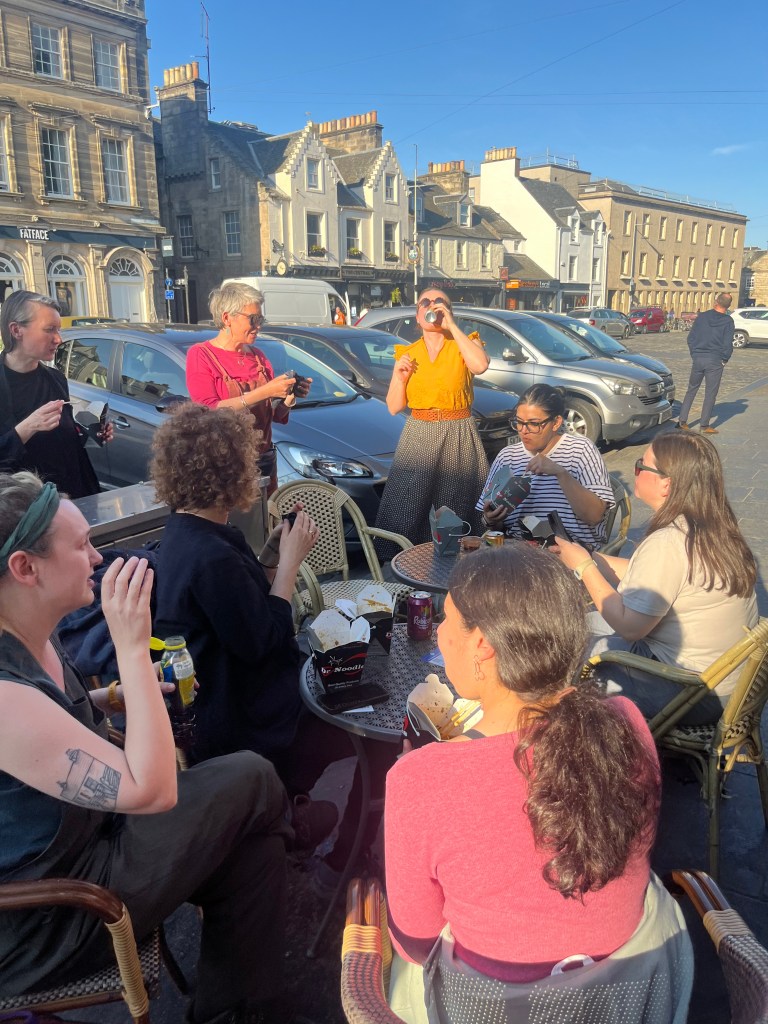
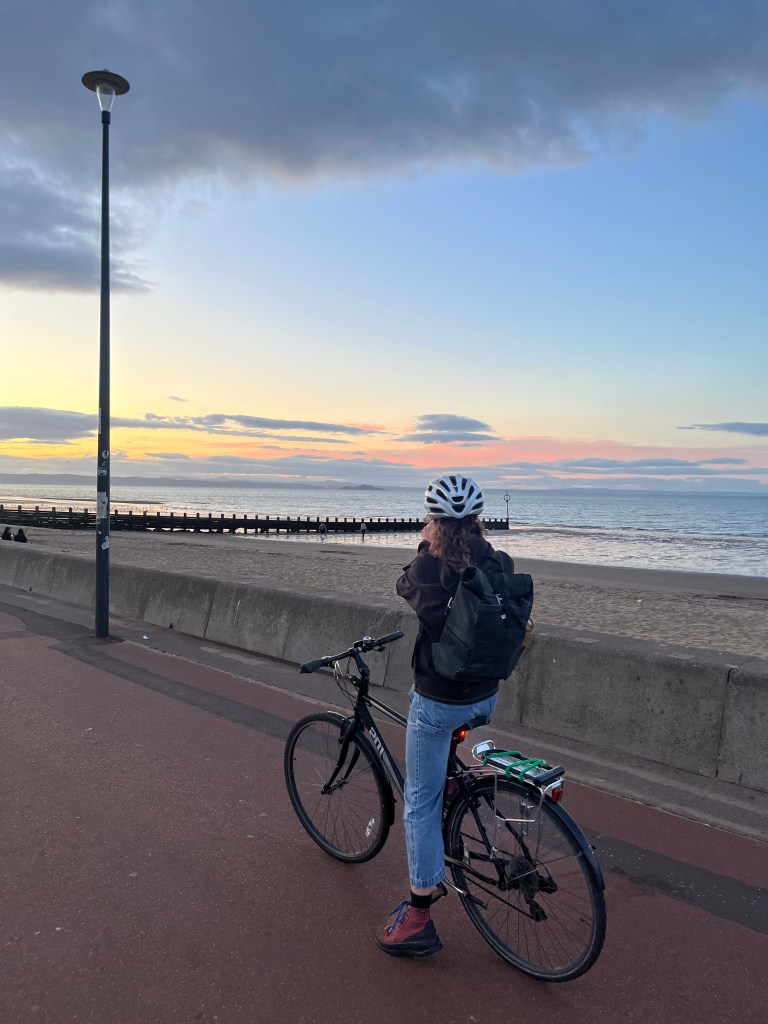
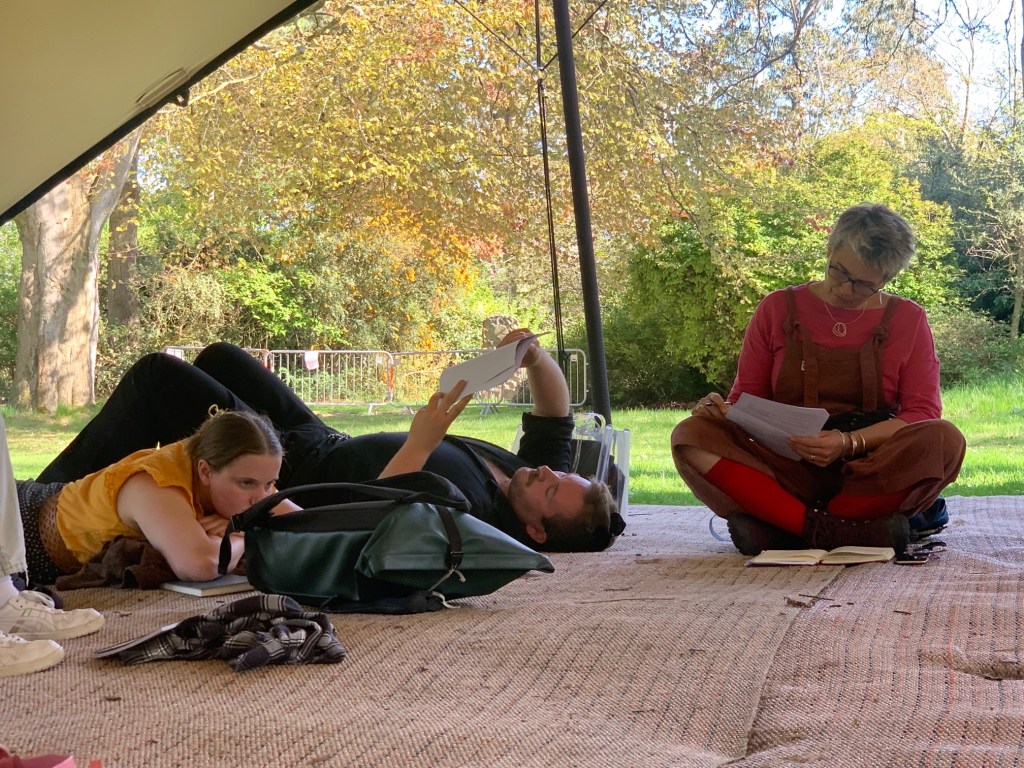
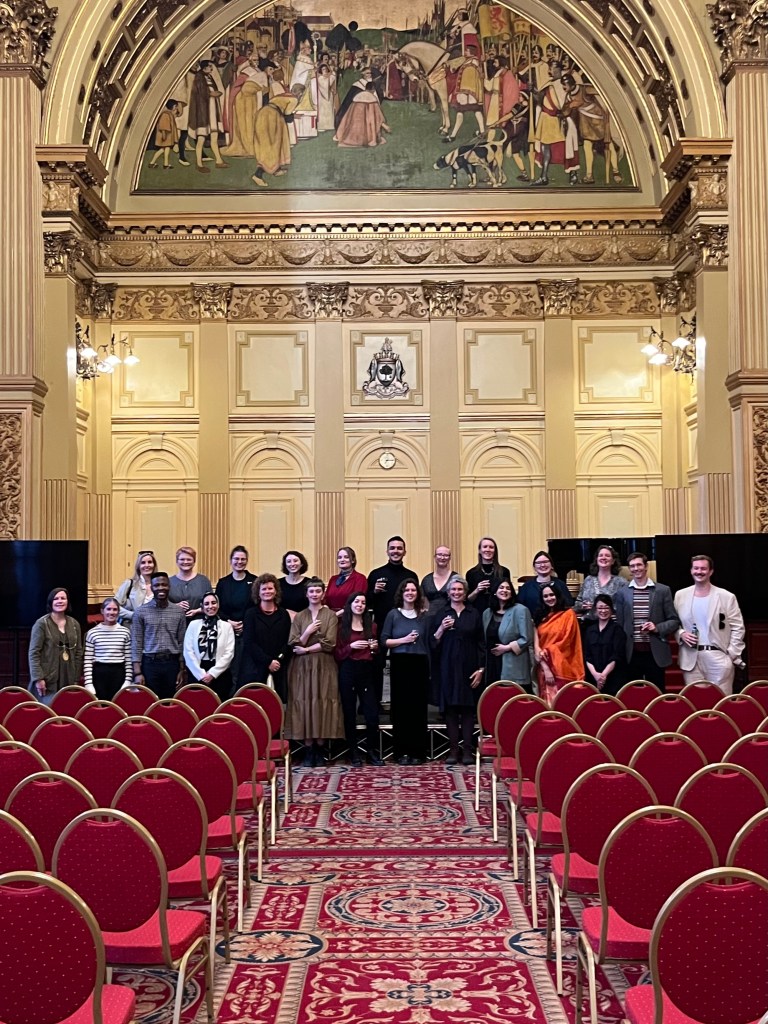
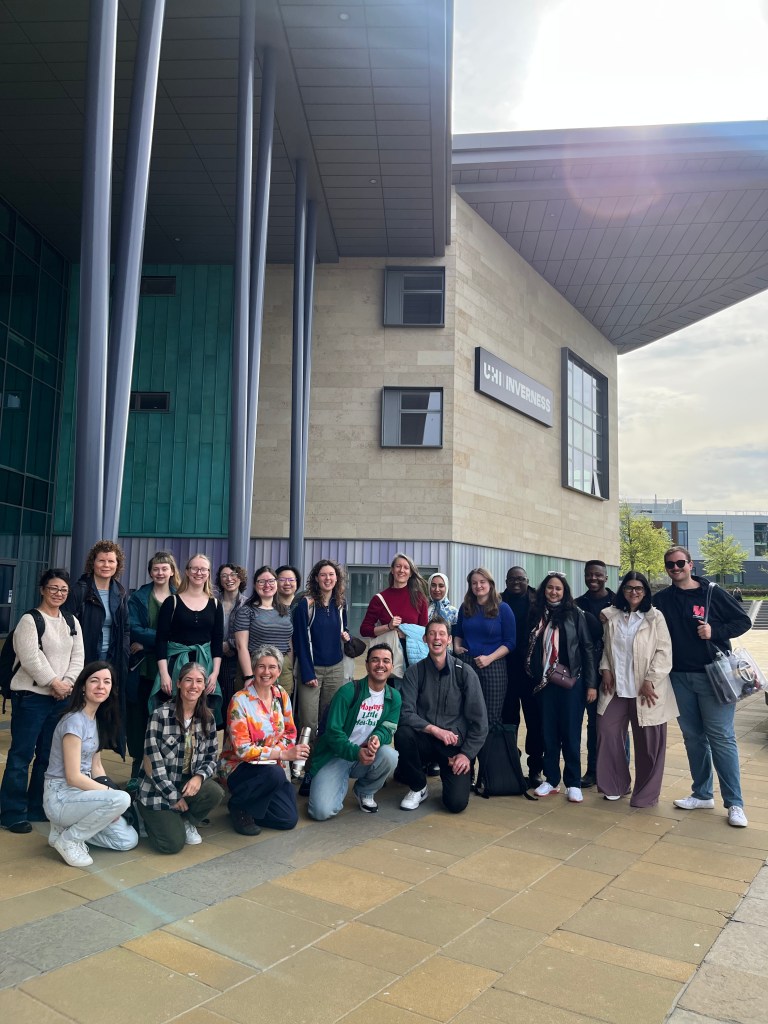
Beset by my own prejudicial suppositions, I packed my bag for the intensive expecting to meet 19 other scholars who shared my passion for animal rights – a subset of my work on relational ethics which informed my selection for the programme. Not only were most of the group enthusiastic carnivores, but they brought with them their own ideological matrices and ethical imperatives; they were, in other words, different to myself – and it is here that the relational imperative arises. Our tour around Scotland started in Glasgow and continued to Edinburgh, Inverness, Dundee, and St Andrews, before returning to Edinburgh for its conclusion, but the most profound moments, for me, arose from within the programme’s gaps – coworking on a train, walking from one building to another, gossiping over emails in a Premier Inn bar at night. In these moments, conversations occurred which further unravelled my presuppositions while replacing them with new modes of understanding – illuminations which came as much from the discovery of new theorists as they did from the stories we shared about ourselves, and through which we came to understand experiences that are radically removed from our own. The novelty and power of the EARTH programme resided in its coalescence of these moments of subjective and intellectual revelation with a programme of scheduled activities with academics, policymakers, and artists, which situated the emerging relations between scholars within broader institutional and social environments in which our learning could immediately be utilised and extended.
Final Thoughts
Perhaps this is an archetypally verbose way of making a banal point: that we met and learnt from each other and that the programme allowed us to apply that learning immediately. But is this – meeting, conversing, discovering – not entirely the point? Butler once said that ‘the first steps toward non-violence, which is surely an absolute obligation we all bear, is to begin to think carefully and to ask others to do the same,’ and it is here that the EARTH programme becomes the academic project par excellence: a temporary coalition of scholars asking each other to listen and be heard in return– aspiring together towards the alleviation of harm to the earth upon which we stand, and the others with whom we share it. I am grateful to the artists and academics who generated the programme throughout and to the British Council and SGSAH for their vision. But my premier gratitude is to my 19 fellow scholars, now returned to their respective homes, for their reminder of the value of the library and the importance of the work that comes from it.
This is the first entry in a series of three pieces provided by participants of the EARTH Scholarship Programme for 2025. Isobel Harvey, a researcher exploring the archaeological and palaeoenvironmental history of Scottish peatlands at the University of Glasgow, will share a subsequent piece on the specific value of cross-disciplinarity in the humanities, followed by a co-authored piece by two of international EARTH Scholars – Zahra Tootonsab, who examines the relationship between sheltering and decolonial flourishing at McMaster University in Canada, and David Ogoru who researches the environmental history of coastal communities in Nigeria and West Africa at Brown in the US – who reflect upon their respective work on the ethics of interdisciplinary research.

Lewis Wood is a second-year AHRC-funded PhD student from Manchester working on AIDS-response Literature and Queer Theory at the Universities of Edinburgh and St Andrews, supervised by Dr Benjamin Bateman and Professor Glyn Davis. He read English at St Andrews with theses focusing on Gertrude Stein (first-class MA) and CAConrad and Anohni (MLitt with distinction). Lewis was awarded Honorary Life Membership of the Students’ Association for his contribution to LGBT+ life in St Andrews and he has worked as Coordinator of the St Andrews Literary Festival, the Executive Officer to the Vice-Chancellor of the University of St Andrews, and he currently teaches literature and judges the James Tait Black Prize at Edinburgh. Lewis relocated to Italy in autumn 2022 to serve as a queer-specialist prize juror at the Milan and Catania International Festivals and, as a recognised public speaker, he has interviewed Ali Smith, Bimini, and Judith Butler.
You can follow Lewis’ research through the following channels:
- Email: lewis.wood@ed.ac.uk
- Instagram: @SusanSonfag
- Research Profile: https://edwebprofiles.ed.ac.uk/profile/lewis-wood
 SGSAH Blog